Facts
Metalite Eco Future Labs Pvt. Ltd. (“Corporate Debtor”) imported goods under the EPCG duty-exemption scheme in 2014–2015 and executed eight EPCG bonds in favour of Customs, supported by bank guarantees issued by Bank of Baroda against fixed deposits/margin money.
Source reference: para. 3The guarantees aggregated to approximately ₹89,16,128 and contained provisions concerning renewal and payment upon non-renewal.
Source reference: paras. 62–65The Corporate Debtor entered CIRP on 14 March 2023 and was ordered to be liquidated on 21 November 2023, with Ms. Shruti Gupta appointed as liquidator.
Source reference: para. 4Customs submitted a claim of ₹1,81,27,632 for non-fulfilment of export obligations, which the liquidator admitted in full.
Source reference: para. 5The liquidator thereafter sought release of the expired guarantees and transfer of the corresponding FDR amounts to the liquidation account.
Source reference: para. 6Customs contended that the guarantees remained operative because of auto-renewal and auto-payment clauses, while the bank maintained that the FDRs could be released only upon expiry or discharge of the guarantees.
Source reference: paras. 10–20, 31–40The NCLT directed Customs to return the original bonds and Bank of Baroda to remit the FDR amounts to the liquidation account.
Source reference: para. 8Customs appealed to the NCLAT.
Source reference: no citationIssues
Whether the Adjudicating Authority could direct Customs to return the original EPCG bonds/bank guarantees and direct Bank of Baroda to transfer the underlying FDR amounts to the liquidation account.
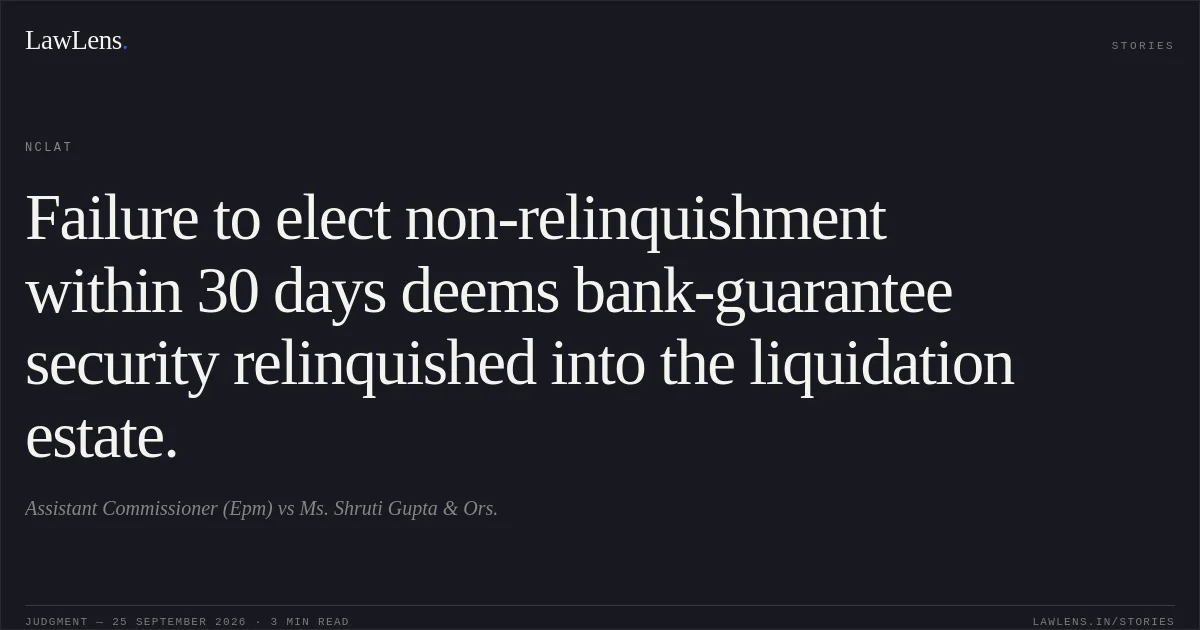
Source reference: para. 58Whether Customs’ failure to communicate an election to realise its security interest within thirty days under Regulation 21A of the IBBI (Liquidation Process) Regulations, 2016 resulted in deemed relinquishment of the security and its inclusion in the liquidation estate.
Source reference: paras. 59–61, 68Whether the bank guarantees and underlying FDRs remained enforceable or had become available for inclusion in the liquidation estate, having regard to their expiry, non-renewal and non-invocation.
Source reference: paras. 64–69Law Applied
The NCLAT applied Regulation 21A of the IBBI (Liquidation Process) Regulations, 2016, under which a secured creditor must communicate its decision to relinquish or realise its security within thirty days of the liquidation commencement date; failing such communication, the secured asset is presumed to form part of the liquidation estate.
Source reference: para. 59Section 36(4) of the Insolvency and Bankruptcy Code, 2016 excludes from the liquidation estate third-party assets held in trust or under contractual arrangements, while the Explanation to Section 18 similarly excludes such third-party assets from the assets of the corporate debtor.
Source reference: paras. 23, 38–39The Court relied on the principle that margin money supporting a live bank guarantee may constitute the substratum of a trust and remain outside the liquidation estate, but once the guarantee expires without invocation, the margin money reverts to the corporate debtor.
Source reference: paras. 34–35, 48–50The NCLAT distinguished authorities concerning live or invoked margin-backed guarantees, including Punjab National Bank v. Supriyo Kumar Chaudhuri and Monitoring Agency of Anush Finlease & Construction Pvt. Ltd. v. State Bank of India, as well as Ansal Engineering Projects Ltd. v. Tehri Hydro Development Corporation Ltd., which arose in a different statutory context.
Source reference: paras. 69–70Reasoning
The NCLAT held that Customs did not communicate its election to realise the security within thirty days from commencement of liquidation.
Source reference: paras. 59–61Its subsequent claim, filed beyond that period, could not preserve a right of non-relinquishment; consequently, Regulation 21A operated to deem the security relinquished and to bring the relevant assets within the liquidation estate.
Source reference: paras. 67–68On the factual record, the EPCG export-obligation periods had expired in 2020–2021, the bank guarantees had not been invoked, and the guarantees were not renewed after their stated expiry dates.
Source reference: paras. 62–66The Court therefore treated the underlying FDRs as having reverted to the Corporate Debtor rather than continuing as protected margin money supporting live guarantees.
Source reference: no citationIt further held that the question whether the guarantees were technically subsisting was not determinative because Customs had failed to exercise the option of non-relinquishment within the prescribed period; in any event, neither invocation nor auto-renewal had occurred.
Source reference: para. 69Holding
The appeal was dismissed.
The NCLAT upheld the NCLT’s directions requiring Customs to return the original bonds relating to the bank guarantees and Bank of Baroda to remit the FDR amounts to the liquidation account for inclusion in the liquidation estate.
Source reference: para. 71All connected interlocutory applications were disposed of, with no order as to costs.
Source reference: para. 72Acts & Sections Cited
6 provisions across 1 statute referred to in this judgment. Each provision opens on LawLens.
Insolvency and Bankruptcy Code, 2016.6
Original Court PDF
Assistant Commissioner (Epm)vsMs. Shruti Gupta & Ors.
Click to open original judgment
Original judgment, available to read, download and summarize on LawLens.in