Facts
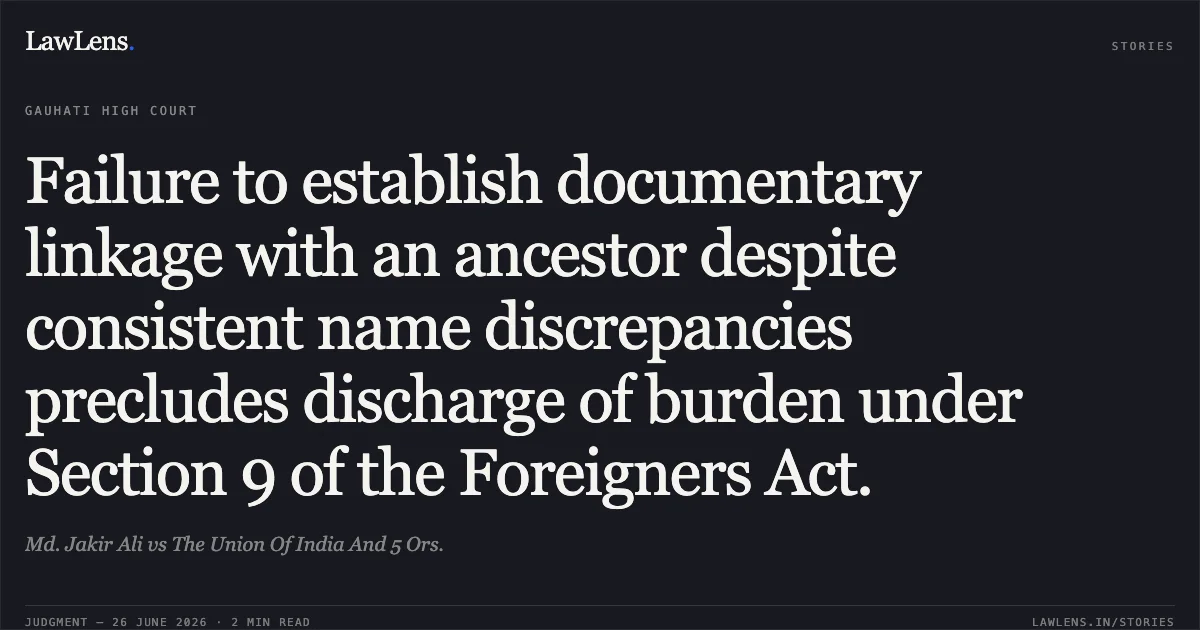
The petitioner, Md. Jakir Ali, challenged an opinion dated 09/05/2019 by the Foreigners Tribunal No. 2, Nalbari, which declared him a foreigner of the post-25/03/1971 stream
Source reference: p. 3The petitioner claimed Indian citizenship by birth, asserting his father, Rakmat Ali (alias Rahmat Ali), was recorded in the 1951 NRC and the 1966 voters list for village Nadia
Source reference: p. 3-4The petitioner appeared in the 1997 and 2014 voters lists but with name variations (“Jagir” vs “Jakir” and “Rahmat” vs “Rakmat”)
Source reference: p. 4, 6To explain these discrepancies, the petitioner submitted a self-affidavit (Exhibit 5) and testimony from a Gaon Bura (DW-2)
Source reference: p. 4The Tribunal found the documentary evidence insufficient to establish a linkage between the petitioner and the projected ancestor
Source reference: p. 3Issues
1. Whether the petitioner successfully discharged the burden of proof under Section 9 of the Foreigners Act, 1946, to establish his Indian citizenship
Source reference: p. 5/para. 142. Whether the discrepancies in names and the lack of voter records between 1966 and 1997 break the chain of linkage to the projected ancestor
Source reference: p. 6-7/para. 17-18Law Applied
Section 9 of the Foreigners Act, 1946, which mandates that the burden of proving that a person is not a foreigner lies upon that person
Source reference: p. 5The principle that citizenship must be proved through a clear documentary linkage to an ancestor present in India prior to the cutoff date of 25/03/1971
Source reference: p. 5Regarding name discrepancies, the court referenced Sirajul Hoque v. State of Assam & Ors. (2019), which allows minor spelling variations only if all other family details remain consistent
Source reference: p. 7Section 3 of the Indian Evidence Act to hold that a self-serving affidavit does not constitute legal evidence
Source reference: p. 6Basiron Bibi v. Union of India (2018) regarding the holistic appreciation of documentary evidence
Source reference: p. 8Reasoning
The court acknowledged that the documents from 1951 and 1966 (Exhibits 1 and 2) sufficiently proved that one "Rakmat Ali" was an Indian citizen
Source reference: p. 5-6However, the court found that the petitioner failed to prove he was the son of that specific Rakmat Ali.
Source reference: p. 6The 1997 voters list recorded the petitioner as “Jagir” and his father as “Rahmat”. The court noted that while minor spelling errors can sometimes be ignored, the petitioner provided no explanation for the "inordinate" and "crucial" gap between 1966 and 1997, which covers the 1971 cutoff date
Source reference: p. 6-7The court upheld the Tribunal’s decision to discard Exhibit 5 (the affidavit) because a sworn statement cannot substitute for primary evidence under the Evidence Act
Source reference: p. 6Furthermore, the testimony of the Gaon Bura (DW-2) was deemed ineffective as he failed to exhibit the certificate he purportedly issued and lacked personal knowledge of the petitioner’s birth
Source reference: p. 4Holding
The court answered in the negative, holding that the petitioner failed to discharge his burden under Section 9 of the Foreigners Act
The High Court upheld and confirmed the Tribunal's opinion, dismissed the writ petition, and vacated all interim orders
Source reference: p. 8Acts & Sections Cited
2 provisions across 2 statutes referred to in this judgment. Linked provisions open on LawLens.
Foreigners Act, 19461
Indian Evidence Act, 18721
Original Court PDF
Md. Jakir AlivsThe Union Of India And 5 Ors.
Click to open original judgment
Original judgment, available to read, download and summarize on LawLens.in