Facts
The parties married on 08.12.2020.
Source reference: para. 3The appellant (husband) filed for divorce under Section 13(1)(i-a) of the Hindu Marriage Act, 1955, alleging mental cruelty.
Source reference: para. 4He claimed the respondent (wife) pressured him to sell ancestral land to buy a flat in Hazaribagh, extorted ₹12,00,000 for a divorce agreement dated 13.01.2022, and underwent a forced abortion.
Source reference: paras. 4-5An earlier suit (O.S. Case No. 36/2023) was withdrawn following a mediation agreement for mutual divorce, which the wife subsequently refused to honor.
Source reference: paras. 7-8The wife denied all allegations, claiming the agreements were obtained under duress/fraud and that she wished to resume conjugal life.
Source reference: paras. 9-11The Family Court, Chatra, dismissed the suit on 18.12.2024, finding no proof of cruelty.
Source reference: para. 1, 13Issues
1. Whether the conduct of the respondent-wife amounted to mental cruelty justifying a decree of divorce under Section 13(1)(i-a) of the Hindu Marriage Act, 1955.
Source reference: para. 512. Whether the judgment of the Family Court was "perverse" due to erroneous consideration or exclusion of evidence.
Source reference: para. 52Law Applied
The court applied Section 13(1)(i-a) of the Hindu Marriage Act, 1955, regarding divorce on grounds of cruelty.
Source reference: para. 29It relied on Dr. N.G. Dastane v. Mrs. S. Dastane to define cruelty as conduct causing a reasonable apprehension of harm.
Source reference: para. 54The Court relied on Joydeep Majumdar v. Bharti Jaiswal Majumdar to distinguish "grave and weighty" conduct from "normal wear and tear" of marriage.
Source reference: para. 61The court further applied the doctrine of "perversity" as defined in Arulvelu v. State, where a finding is perverse if it ignores relevant material or defies logic.
Source reference: para. 52Principles from Shobha Rani v. Madhukar Reddi were used to establish that cruelty is a subjective question of fact depending on social and economic contexts.
Source reference: para. 57Reasoning
Regarding the ₹12,00,000 payment, the Court noted the appellant failed to prove the source of funds or file for recovery, and a subsequent agreement dated 23.05.2022 omitted any mention of this prior payment, casting doubt on its authenticity.
Source reference: para. 65The Court observed that the appellant’s own witnesses (PW-2, PW-3, PW-4) admitted they never personally witnessed the alleged cruelty.
Source reference: para. 70The wife provided medical evidence (Ext. B, C, C/1) proving an accident on 13.12.2023, which explained her failure to appear after the mediation, thereby rebutting the charge of bad faith in breaching the mediation settlement.
Source reference: para. 67The appellant’s admission in cross-examination that he was "ready to keep his wife" was found to be inconsistent with a claim that the marriage had irretrievably broken down due to cruelty.
Source reference: para. 70Holding
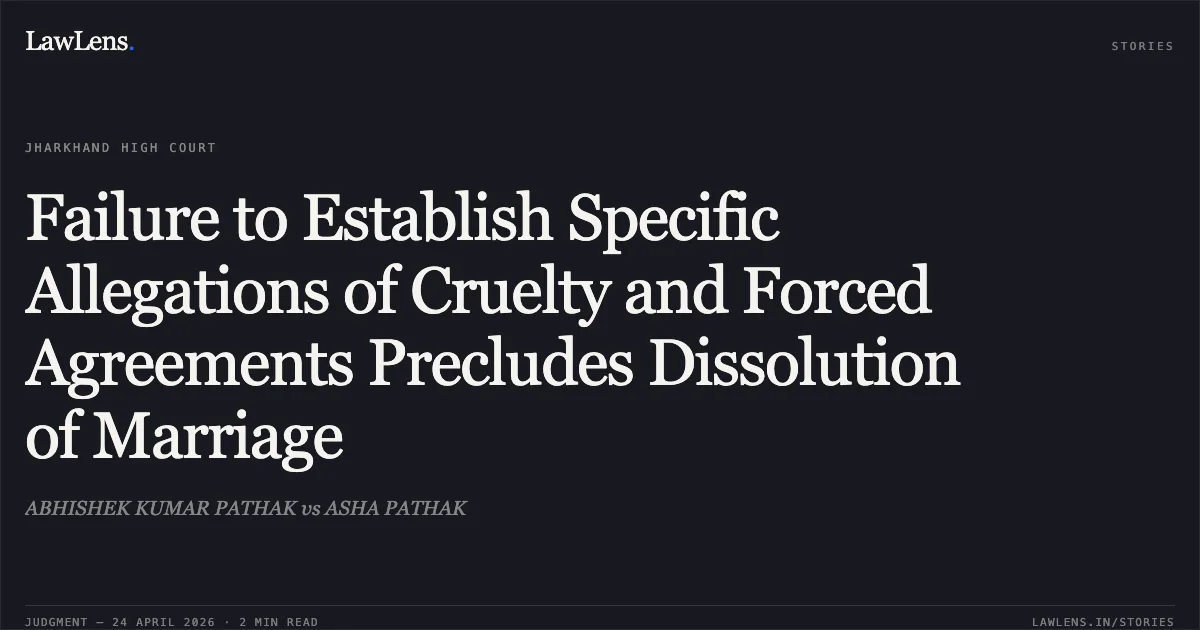
The High Court held that the appellant failed to prove cruelty within the meaning of Section 13(1)(i-a).
The Court concluded that the Family Court’s findings were not perverse as they were based on a proper appreciation of the lack of cogent evidence and the prayer for dissolution of marriage was denied.
Source reference: para. 74-75Acts & Sections Cited
2 provisions across 2 statutes referred to in this judgment. Each provision opens on LawLens.
Family Courts Act, 19841
Hindu Marriage Act, 19551
Original Court PDF
ABHISHEK KUMAR PATHAKvsASHA PATHAK
Click to open original judgment
Original judgment, available to read, download and summarize on LawLens.in