Facts
The plaintiff/appellant filed Original Suit No. 264 of 2001 for a permanent injunction to restrain the defendants from interfering with peaceful possession and construction on specific property
Source reference: para. 5The Trial Court (Civil Judge, Senior Division, Robertsganj) decreed the suit in favor of the plaintiff on 20.04.2023, based on ownership and possession findings
Source reference: para. 6-7Two defendants preferred separate civil appeals (No. 19 of 2023 and No. 22 of 2023)
Source reference: para. 8On 05.02.2026, the first appellate court (Additional District Judge, Court No. 1, Sonbhadra) allowed the appeals and remanded the matter to the Trial Court without framing specific points for determination
Source reference: para. 2, 9The appellant challenged this remand order before the High Court
Source reference: para. 3Issues
1. Whether the first appellate court is Mandatorily required to frame points for determination and state reasons for reversing a trial court decree under Order XLI Rules 30 and 31 of the CPC?
Source reference: para. 9, 112. Whether the first appellate court’s remand of the matter was legally sustainable in light of the procedure prescribed under Order XLI Rule 23 of the CPC?
Source reference: para. 12, 17Law Applied
Order XLI Rules 30 and 31 of the Code of Civil Procedure (CPC), 1908, which mandate that an appellate judgment must state points for determination, the decision thereon, and the reasons for such decision
Source reference: para. 10-11Order XLI Rule 23 (as amended by the Allahabad High Court), which governs the power of remand when a decree is reversed or where remand is necessary in the interest of justice
Source reference: para. 12B.V. Nagesh v. Sreenivasa Murthy (2010) 13 SCC 530, which establishes that the first appeal is a valuable right involving a re-hearing on fact and law, requiring the appellate court to reflect a "conscious application of mind" through reasoned findings on all issues
Source reference: para. 14Reasoning
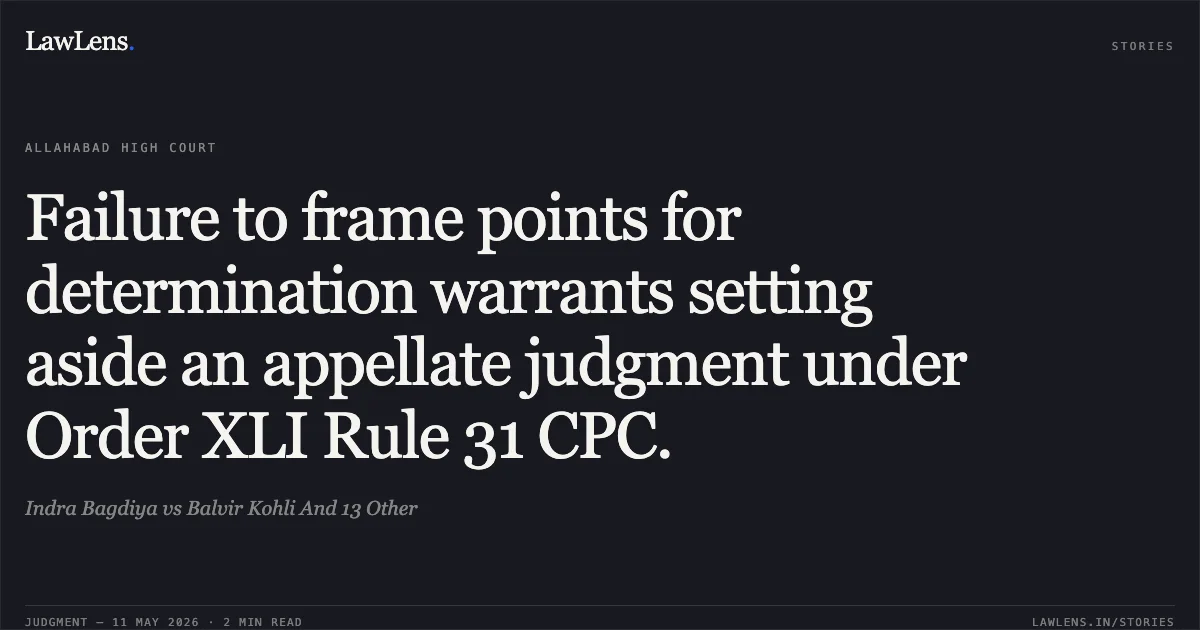
The High Court observed that the first appellate court failed to follow the essential procedural mandates of Order XLI Rule 31 of the CPC
Source reference: para. 13, 15The Court reasoned that without framing specific "points for determination," it is legally impossible for an appellate court to record a valid decision, assign proper reasons, or determine if the reversal of a trial court’s decree is justified
Source reference: para. 16The High Court noted that the original suit had been pending since 2001 and was decided by the Trial Court after exhaustive appreciation of evidence; therefore, the first appellate court could not summarily remand the matter without a thorough adjudication on the merits as required by law
Source reference: para. 13, 17Furthermore, the Court pointed out a clerical/jurisdictional error where the judge used the criminal designation "Additional Sessions Judge" for a civil proceeding
Source reference: para. 22Holding
The Court held that the failure to frame points for determination constitutes an "apparent illegality"
The High Court allowed both appeals (FAFO No. 1127/2026 and 1128/2026) and set aside the impugned judgment and order dated 05.02.2026. The first appellate court is directed to re-admit the appeals, frame specific points for determination, and decide the case afresh in strict compliance with the procedure under Order XLI Rules 30 and 31 of the CPC
Source reference: para. 18, 19, 20-21Original Court PDF
Indra BagdiyavsBalvir Kohli And 13 Other
Click to open original judgment
Original judgment, available to read, download and summarize on LawLens.in


![Subsequent exoneration does not retrospectively invalidate a finalized promotion select list.. UNNIKRISHNAN M vs M/o Environment And Forests. CAT - ['Ernakulam']. LawLens](/stories/thumbnails/subsequent-exoneration-does-not-retrospectively-invalidate-a-finalized-promotion-select-li-ce80a0e84f2f4887857271e8b4341c42.webp)