Facts
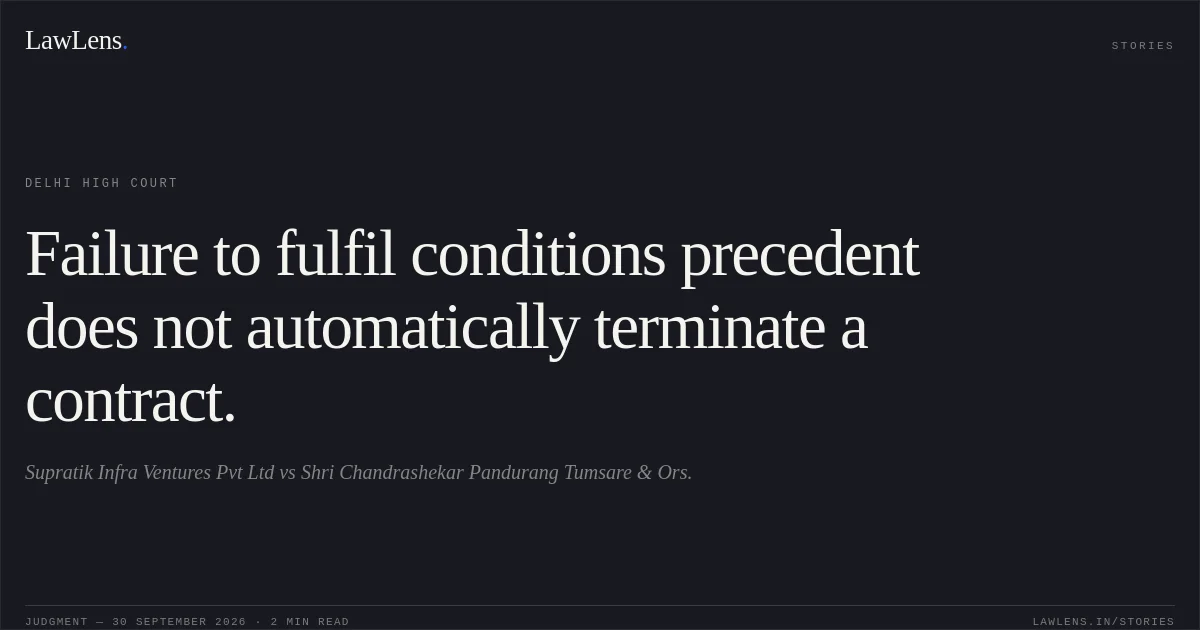
The dispute arose from a Development Rights Agreement dated 12 October 2010, under which the developer paid ₹3.50 crore to the landowners, subject to fulfilment of conditions precedent by the Closing Date of 15 November 2010.
Source reference: p. 1–2, paras. 3–4The conditions were not fulfilled. The developer sought performance or refund, with interest and damages; the landowners contended that the agreement had been superseded and that the claim was time-barred.
Source reference: p. 2, paras. 4–5The arbitrator held the claim time-barred because the cause of action arose in 2010 and no extension or continuing negotiations had been established.
Source reference: p. 2, para. 5In its Section 34 petition, the developer relied, among other things, on payment completed in 2013, an email from 2017, agreements to sell executed in 2018 and 2020, and a payment received in connection with one transaction.
Source reference: p. 2–4, paras. 7–13Issues
1. Whether the arbitrator’s conclusion that the refund claim became time-barred on 15 November 2010 was sustainable on the material before the tribunal
Source reference: p. 6, para. 21(i)2. Whether the arbitrator failed to consider documentary evidence relevant to accrual of the cause of action and the continued subsistence of the contractual relationship
Source reference: p. 6, para. 21(ii)Law Applied
Section 34 of the Arbitration and Conciliation Act, 1996 provides a limited basis for setting aside an arbitral award; the court does not ordinarily reappreciate evidence as an appellate court.
Source reference: p. 5, 10, paras. 20, 35Under Section 55 of the Indian Contract Act, 1872, failure to perform by a stipulated date may render a contract voidable at the promisee’s option rather than automatically terminate it.
Source reference: p. 9, para. 28Section 63 of the Contract Act permits a promisee to extend time, and Kailash Nath Associates v. DDA, (2015) 4 SCC 136, recognises that an extension may, depending on the contract, be established through conduct or forbearance and need not necessarily be in writing.
Source reference: p. 10, paras. 30–32Reasoning
Clause 5.2 gave the developer a right to terminate if the conditions precedent were not fulfilled; it did not provide for automatic termination on the Closing Date.
Source reference: p. 9–10, paras. 25–28Likewise, Clause 5.1 did not expressly require an extension to be in writing, although the developer still had to prove that it exercised its discretion to extend time.
Source reference: p. 10, paras. 29–33The later documents relied on by the developer were capable of bearing on whether the parties continued to treat the agreement as subsisting, and therefore could not be dismissed as mere post-expiry reminders or treated as irrelevant to limitation.
Source reference: p. 10–11, paras. 34–40The Court did not determine when the cause of action accrued; it held only that the award’s conclusion could not stand insofar as it treated 15 November 2010 as an automatic and conclusive accrual date without adequate consideration of the relevant material.
Source reference: p. 11–12, paras. 37–42Holding
The petition was allowed in part.
The award was set aside only insofar as it rejected Claim No. 2—the claim for refund of ₹3.50 crore—solely on the basis that the cause of action necessarily accrued on 15 November 2010 without adequate consideration of the subsequent documentary material.
Source reference: p. 12, paras. 43–44The issue was restored for fresh adjudication, including determination of the legal effect of the Closing Date under the agreement; there was no order as to costs.
Source reference: p. 13, paras. 45–47Acts & Sections Cited
3 provisions across 2 statutes referred to in this judgment. Each provision opens on LawLens.
Arbitration and Conciliation Act, 19961
Indian Contract Act, 18722
Original Court PDF
Supratik Infra Ventures Pvt LtdvsShri Chandrashekar Pandurang Tumsare & Ors.
Click to open original judgment
Original judgment, available to read, download and summarize on LawLens.in