Facts
The applicant filed an application under Section 482 of the Cr.P.C. to quash a cognizance order dated 10.03.2021 and criminal proceedings in a case under Section 376 of the IPC
Source reference: para. 4The informant alleged that marriage talks were initiated through her maternal aunt, and during this period, she met the applicant in hotels where he allegedly established physical relations on the promise of marriage
Source reference: para. 5The applicant subsequently refused to marry her after their families failed to agree
Source reference: para. 6A chargesheet was filed, and the Chief Judicial Magistrate, Dehradun, took cognizance
Source reference: para. 5The applicant contended the relationship was consensual and lacked any initial deceptive intent, noting the informant has since married another person
Source reference: para. 7 & 9Issues
1. Whether the physical relationship established on a promise of marriage that subsequently fails due to familial disagreement constitutes the offence of rape under Section 376 of the IPC.
Source reference: para. 122. Whether the applicant had a fraudulent intention from the inception of the relationship to deceive the informant into a sexual relationship.
Source reference: para. 12 & 14Law Applied
The Court primarily applied Section 376 of the Indian Penal Code regarding rape
Source reference: para. 4It relied on the legal distinction between a "false promise of marriage" made with the intention to deceive from the inception versus a "breach of promise" where a genuine promise could not be fulfilled later
Source reference: para. 14The Court applied precedents from the Supreme Court, including Pramod Suryabhan Pawar v. State of Maharashtra (2019), Maheshwar Tigga v. State of Jharkhand (2020), and Sonu @ Subhash Kumar v. State of Uttar Pradesh (2021), which establish that consent is only vitiated by a "misconception of fact" if the accused never intended to marry the prosecutrix at the time the promise was made
Source reference: para. 14Reasoning
The Court observed that both parties were consenting adults who entered into a relationship during active marriage negotiations between their families
Source reference: para. 11It reasoned that for an offence under Section 376 IPC to be made out, it must be proved that the victim’s consent was obtained solely through a promise that was false from the very beginning
Source reference: para. 12Upon reviewing the record, the Court found that the marriage talks were genuine and were facilitated by relatives, suggesting the relationship was consensual during the subsistence of these negotiations
Source reference: para. 13Since the failure of the marriage was due to the families not agreeing rather than a pre-meditated deception by the applicant, the Court held that the ingredients of rape were not prima facie disclosed
Source reference: para. 13-14Furthermore, the lack of medical evidence supporting forceful intercourse corroborated the consensual nature of the engagement
Source reference: para. 6Holding
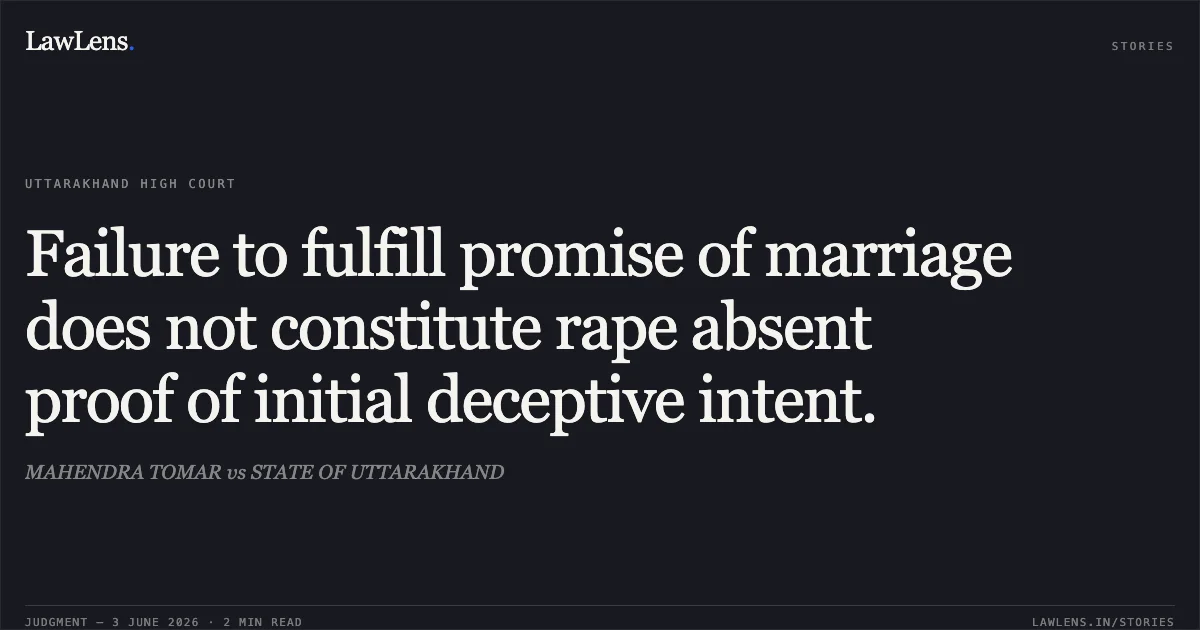
The Court answered the issues in the negative, holding that a mere breach of a promise to marry does not amount to rape unless there was fraudulent intent from the start
The Court concluded that the criminal proceedings were unsustainable in law. Consequently, the High Court allowed the C-482 application and quashed the cognizance order dated 10.03.2021 and the entire proceedings of Criminal Case No. 2139 of 2021
Source reference: para. 8, 15-16Acts & Sections Cited
1 provisions across 1 statute referred to in this judgment. Each provision opens on LawLens.
Indian Penal Code, 18601
Original Court PDF
MAHENDRA TOMARvsSTATE OF UTTARAKHAND
Click to open original judgment
Original judgment, available to read, download and summarize on LawLens.in


![Subsequent exoneration does not retrospectively invalidate a finalized promotion select list.. UNNIKRISHNAN M vs M/o Environment And Forests. CAT - ['Ernakulam']. LawLens](/stories/thumbnails/subsequent-exoneration-does-not-retrospectively-invalidate-a-finalized-promotion-select-li-ce80a0e84f2f4887857271e8b4341c42.webp)