Facts
The assessee, a manufacturer and trader, claimed a deduction under Section 35(2AB) of the Income-tax Act, 1961, for scientific research expenditure in AY 2017–18.
Source reference: p. 3–6In the assessment under Section 143(3), the Assessing Officer examined the claim and allowed it.
Source reference: p. 3–6The PCIT later invoked Section 263, reasoning that the assessee had not furnished Form 3CL under the amended Rule 6, effective from 1 July 2016, and set aside the assessment for de novo consideration.
Source reference: p. 3–6The Tribunal allowed the assessee’s appeal, noting the material submitted in support of the claim, the Assessing Officer’s inquiry, and the DSIR’s approval.
Source reference: p. 7–14The Revenue appealed under Section 260A.
Source reference: p. 1–2Issues
1. Whether the absence of Form 3CL under the amended provisions justified revision under Section 263 of the assessment allowing the Section 35(2AB) deduction
Source reference: p. 2, 14–162. Whether, in light of the Assessing Officer’s inquiry and the Tribunal’s finding that the DSIR had approved the expenditure, the assessment was both erroneous and prejudicial to the interests of the Revenue
Source reference: p. 16–17, 22Law Applied
Section 263 permits revision only where the assessment order is both erroneous and prejudicial to the interests of the Revenue; both conditions must be satisfied, as held in Malabar Industrial Co. Ltd. v. CIT, [2000] 243 ITR 83 (SC).
Source reference: p. 16Section 35(2AB) and Rule 6 of the Income-tax Rules, including the amendments effective from 1 July 2016, governed the claimed research deduction and the relevant DSIR documentation.
Source reference: p. 5–6The Court also relied on Principal Commissioner of Income Tax v. Schaeffler India Ltd., [2023] 155 taxmann.com 651 (Gujarat), which upheld the view that the failure or delay in furnishing Form 3CL does not, on the facts there considered, by itself justify denying the deduction where the research facility was approved and the assessment involved due inquiry.
Source reference: p. 17–22Reasoning
The Court accepted that the assessee had not furnished Form 3CL in the form required by the amended provisions.
Source reference: p. 16However, the Tribunal had found that the Assessing Officer made relevant inquiries, that the assessee provided supporting material including Form 3CM, and that the DSIR had approved the expenditure.
Source reference: p. 8–14, 22In those circumstances, the absence of Form 3CL did not establish that the assessment was prejudicial to the Revenue, even if the assessment could be regarded as erroneous for want of that document.
Source reference: p. 16–17, 22Since Section 263 requires both conditions to coexist, the PCIT’s revision was not justified.
Source reference: p. 16–17, 22Holding
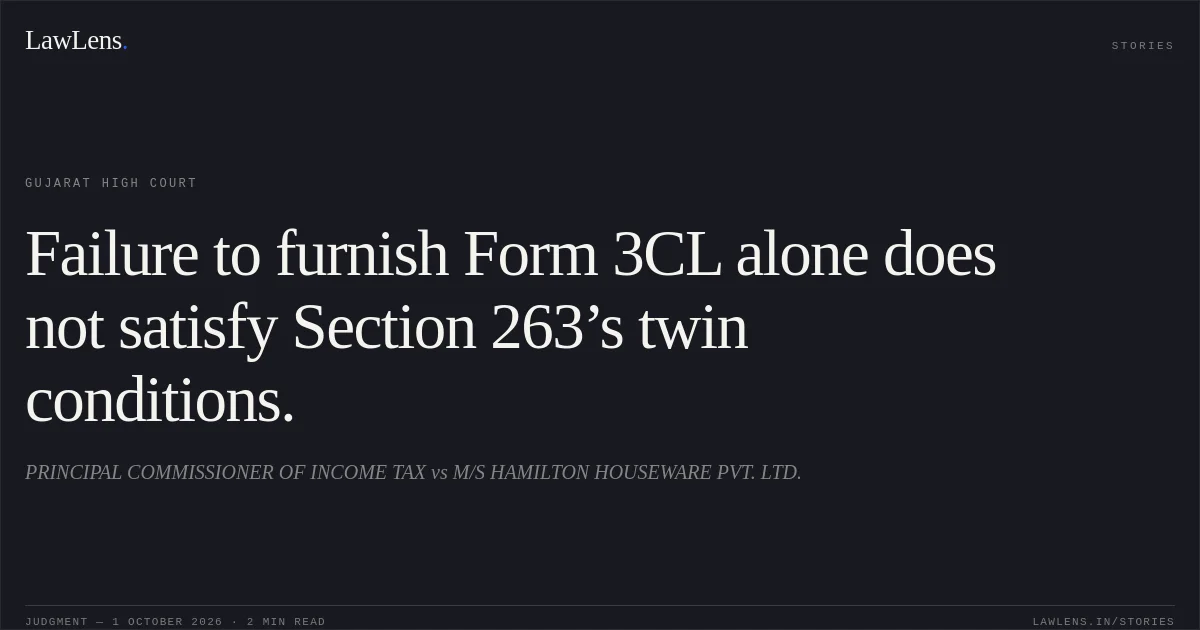
The Court held that the Tribunal was justified in setting aside the PCIT’s Section 263 order: the assessment was not shown to be both erroneous and prejudicial to the interests of the Revenue.
No substantial question of law arose, and the Revenue’s appeal was dismissed.
Source reference: p. 23Acts & Sections Cited
8 provisions across 1 statute referred to in this judgment. Linked provisions open on LawLens.
Income Tax Act, 19618
Original Court PDF
PRINCIPAL COMMISSIONER OF INCOME TAXvsM/S HAMILTON HOUSEWARE PVT. LTD.
Click to open original judgment
Original judgment, available to read, download and summarize on LawLens.in