01Facts
The writ petitioner’s father, an employee of Eastern Coalfields Limited (“ECL”), died in harness on 22 May 1998.
¶ 2ECL issued an appointment letter dated 7 November 2001 to the petitioner’s elder brother for provisional appointment as an underground loader, but he did not avail the employment.
¶ 2Thereafter, the petitioner applied for compassionate appointment in place of her brother.
¶ 2From 2010 onwards, ECL processed her claim, obtained relinquishment affidavits and no-objection certificates from the legal heirs, called for information from various authorities, and subjected her to medical examination, in which she was found fit for appointment.
¶ 3Despite prolonged consideration and recommendations by several senior officials, no appointment was ultimately granted.
¶ 3, 7–8After approximately fifteen years, the petitioner approached the writ court.
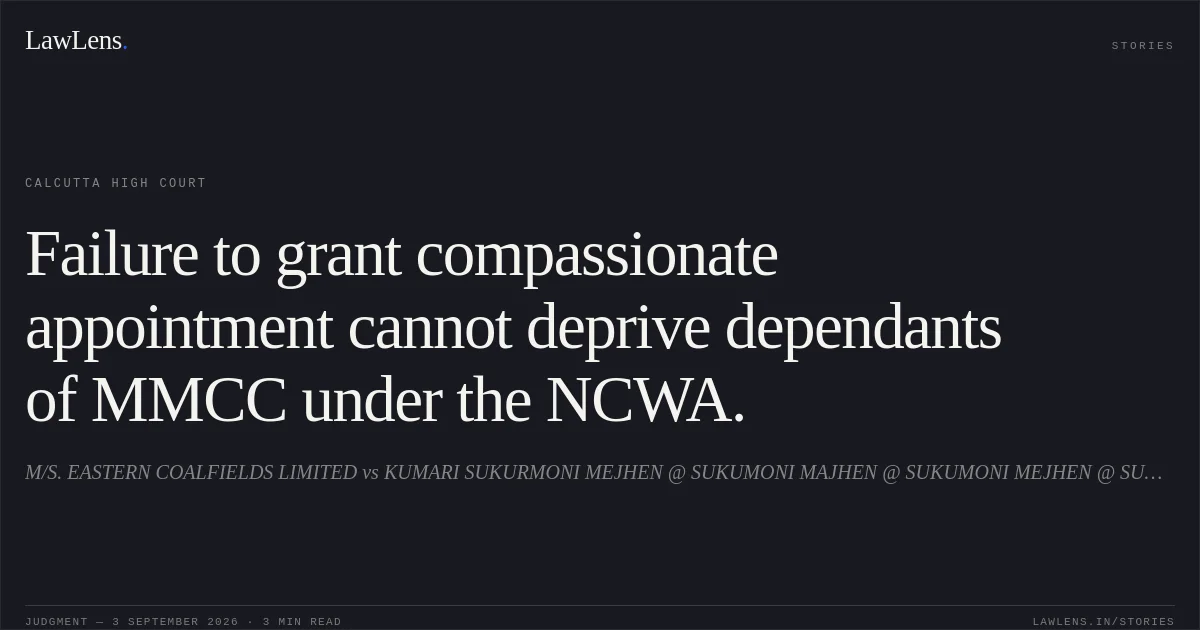
¶ 4The learned Single Judge directed ECL to pay her Monthly Monetary Cash Compensation (“MMCC”) under the National Coal Wage Agreement (“NCWA”) from 1 November 2010, the date of her application.
¶ 4ECL preferred the present intra-court appeal, contending that Clause 9.3.1 of the NCWA permitted compassionate appointment to only one dependant and that the earlier offer to the petitioner’s brother exhausted its obligation.
¶ 5–602Issues
i.Whether the issuance of an offer of compassionate appointment to one dependant under Clause 9.3.1 of the NCWA precluded the deceased employee’s family from claiming MMCC when that appointment was not availed and the petitioner’s subsequent claim remained pending?
¶ 5–6, 9–11ii.Whether the petitioner was entitled to MMCC notwithstanding that she was not entitled to a second compassionate appointment under Clause 9.3.1 of the NCWA?
¶ 10–15iii.Whether ECL could rely on its own prolonged failure to conclude the petitioner’s claim to deny her the benefit of MMCC?
¶ 1203Law Applied
The Court applied Clause 9.3.1 of the NCWA, which provides employment to one dependant of a worker who dies in service and therefore limits compassionate appointment to one dependant.
¶ 5, 11The Court further treated the NCWA as a beneficial settlement having the force contemplated under Section 18(3) of the Industrial Disputes Act, under which the deceased employee’s family was intended to receive the benefit of either compassionate appointment or MMCC.
¶ 11The Court applied the principle that an employer cannot take advantage of its own wrong, particularly where its prolonged inaction prevented the family from receiving the benefit of the scheme.
¶ 12It distinguished the unreported decision in Central Coal Fields Ltd. v. Sanjay Kumar, LPA No. 562 of 2014, High Court of Jharkhand, dated 3 May 2017, because that case concerned a subsequent claim for compassionate appointment, whereas the present relief was confined to MMCC.
¶ 13Provisions in the judgment · 1
Industrial Disputes Act, 1947 Section 18
04Reasoning
The Court accepted that Clause 9.3.1 restricted the grant of compassionate appointment to one dependant and that the learned Single Judge had not directed ECL to appoint the petitioner as a second compassionate appointee.
¶ 11However, the clause could not be used to deprive the deceased employee’s family of MMCC altogether.
¶ 11The elder brother’s failure to avail the appointment did not justify denying the family the alternative monetary benefit contemplated by the NCWA.
¶ 14ECL had itself processed the petitioner’s claim for approximately fifteen years, obtained the necessary documents, conducted medical examination, and found her eligible, yet failed to make a final appointment decision.
¶ 3, 7–8, 12Consequently, ECL could not rely on the unresolved status of its own proceedings to defeat the family’s entitlement to MMCC.
¶ 12The Court therefore upheld the direction to pay MMCC from the date of the petitioner’s application in November 2010, while noting that, if officials had improperly processed an ineligible claim, ECL could take action against them in accordance with law.
¶ 12, 14–1505Holding
The appeal was dismissed.
¶ 15The Court held that although Clause 9.3.1 of the NCWA barred a second compassionate appointment, it did not bar payment of MMCC where the family had not received the benefit of the scheme and ECL’s prolonged processing had left it without relief.
¶ 15The direction of the learned Single Judge requiring ECL to pay MMCC to the petitioner from November 2010, the date of her application, was affirmed.
¶ 4, 15Original Court PDF
M/S. EASTERN COALFIELDS LIMITEDvsKUMARI SUKURMONI MEJHEN @ SUKUMONI MAJHEN @ SUKUMONI MEJHEN @ SUKUMANI MEJHEN AND ORS.
Click to open original judgment
Original judgment, available to read, download and summarize on LawLens.in