Facts
On 8 July 2013, Satish was stabbed during an incident near Muthumariyamma Temple in Bengaluru and later died.
Source reference: pp. 2–4, paras. 1–4, 6–7The prosecution alleged that the appellant stabbed him and that other accused persons restrained him.
Source reference: pp. 2–4, paras. 1–4, 6–7The trial court convicted the appellant under Section 302 IPC, acquitted him of the charge under Section 307 IPC, and acquitted accused Nos. 3 and 4; the case against accused No. 2 had abated following his death.
Source reference: pp. 2–4, paras. 1–4, 6–7The appellant challenged his murder conviction, disputing, among other things, the eyewitness identifications, the absence of a test identification parade, inconsistencies in the testimony, and the recovery evidence.
Source reference: pp. 8–10, para. 12Issues
1. Whether the eyewitness evidence, including testimony from the injured complainant, reliably established that the appellant stabbed the deceased, notwithstanding the absence of a test identification parade and the alleged inconsistencies.
Source reference: pp. 8–10, 12–14, paras. 12–182. Whether the medical and recovery evidence sufficiently supported the prosecution case and the appellant’s conviction under Section 302 IPC.
Source reference: pp. 14–16, 19–24, paras. 19–24Law Applied
Section 302 IPC governs the offence of murder.
Source reference: no citationThe Court assessed the prosecution’s direct evidence by considering the testimony of the injured complainant and other eyewitnesses alongside the medical and forensic evidence.
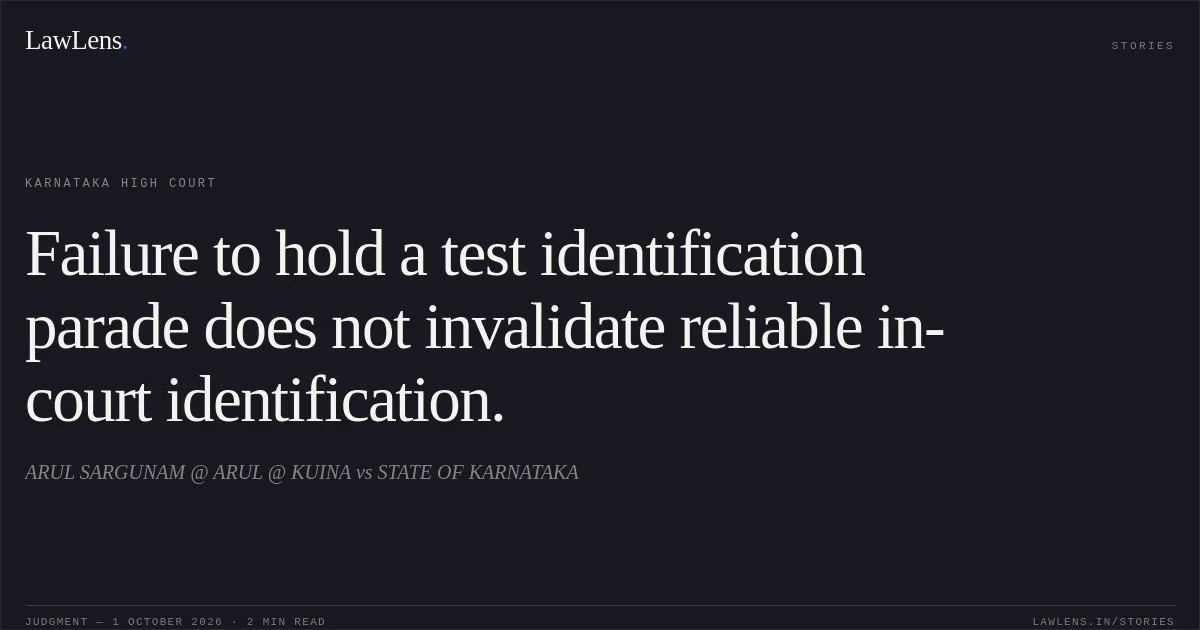
Source reference: no citationIt held that the absence of a test identification parade, by itself, was not a ground to reject eyewitness testimony where the witnesses identified the accused in court.
Source reference: p. 14, para. 18The judgment cites no precedent or separate statutory evidentiary provision.
Source reference: no citationReasoning
The Court accepted the complainant’s presence at the scene, noting his injuries were supported by the wound certificate and by other prosecution evidence, even though the trial court had found inconsistencies about who assaulted him and acquitted the appellant under Section 307 IPC.
Source reference: pp. 12–13, paras. 16–17It found that the complainant and eyewitnesses PWs. 4, 5 and 14 consistently identified the appellant as the person who stabbed Satish; the discrepancies raised by the defence did not undermine that evidence, and the lack of a test identification parade did not displace their in-court identifications.
Source reference: pp. 13–14, para. 18The post-mortem evidence established homicidal death, while the forensic evidence showed “A” group blood on the knife, the deceased’s clothes and the appellant’s clothing.
Source reference: pp. 14–16, paras. 19–22In light of the eyewitness and corroborative evidence, the Court found no basis to interfere with the trial court’s conviction.
Source reference: pp. 16–17, para. 24Holding
The High Court dismissed the appeal and declined to interfere with the appellant’s conviction under Section 302 IPC.
The trial court’s acquittals of the other accused and of the appellant under Section 307 IPC were not disturbed.
Source reference: no citationThe supplied judgment extract does not state the sentence imposed.
Source reference: no citationActs & Sections Cited
9 provisions across 2 statutes referred to in this judgment. Each provision opens on LawLens.
Code of Criminal Procedure, 19731
Indian Penal Code, 18608
Original Court PDF
ARUL SARGUNAM @ ARUL @ KUINAvsSTATE OF KARNATAKA
Click to open original judgment
Original judgment, available to read, download and summarize on LawLens.in