Facts
The workman was appointed as a supervisor by the employer on 1 March 1997 and claimed that, although designated a supervisor, he performed work of a workman. He asserted that the employer refused to permit him to resume duties from 17 January 1999 and subsequently terminated his services orally on 16 July 1999. The employer contended that the workman had voluntarily abandoned service from 17 January 1999 and failed to resume duties despite repeated communications and a show-cause notice. The dispute was referred to the Labour Court, Valsad, which held the termination illegal but awarded only ₹50,000 as lump-sum compensation in lieu of reinstatement. Both parties challenged the award before the High Court: the workman sought reinstatement, back wages and consequential benefits, while the employer sought dismissal of the reference.
Source reference: pp. 3–9; paras. 7–13During the proceedings, it emerged that the workman had resumed duties in February 2007, worked until March 2008, and was thereafter directed to report to the employer’s Mumbai office. The workman also reached the age of superannuation in 2025.
Source reference: pp. 11–15; paras. 14–16Issues
Whether the workman’s services were terminated by the employer or whether he voluntarily abandoned his employment?
Source reference: pp. 10–13; paras. 14–15Whether the workman was a “workman” within the meaning of Section 2(s) of the Industrial Disputes Act, 1947, despite being designated as a supervisor?
Source reference: pp. 13–14; para. 15Whether the termination was illegal for non-compliance with the mandatory requirements of Sections 25B and 25F of the Industrial Disputes Act, 1947?
Source reference: p. 13; para. 15Whether the workman was entitled to reinstatement, back wages, or lump-sum compensation in lieu of reinstatement?
Source reference: pp. 15–16; para. 16Law Applied
The Court applied Section 2(s) of the Industrial Disputes Act, 1947, under which the determination of whether an employee is a “workman” depends on the actual nature of duties performed and not merely on the nomenclature of the post.
Source reference: p. 14; para. 15It considered Sections 25B and 25F of the Act, holding that a workman who has completed the requisite period of continuous service is entitled to the statutory protection against retrenchment and that termination without compliance with Section 25F is illegal.
Source reference: p. 13; para. 15On abandonment, the Court applied the principle that the employer must establish voluntary abandonment through the parties’ conduct and correspondence; a mere allegation of abandonment is insufficient.
Source reference: no citationThe Court also considered the principle referred to in Gangaram K. Medekar v. Zenith Safe Mfg. Co., (1998) 111 LLJ 556 (Bom), that the burden of proving voluntary abandonment lies on the employer.
Source reference: p. 9; paras. 12–13Where reinstatement is impracticable because of superannuation, the Court may award monetary compensation in lieu of reinstatement, while back wages are not automatic and depend upon the facts, including gainful employment and the period of unemployment.
Source reference: pp. 15–16; para. 16Reasoning
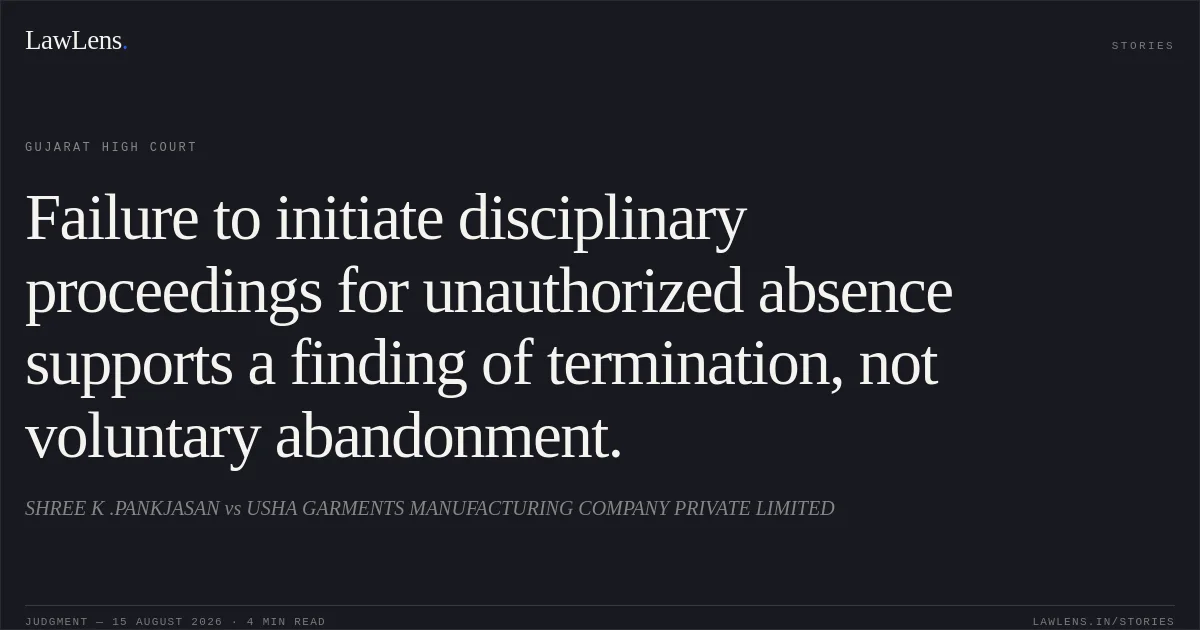
The Court found that the employer had issued a show-cause notice alleging unauthorised absence and had repeatedly called upon the workman to resume duty. However, despite expressly indicating before the Assistant Labour Commissioner that disciplinary proceedings would be initiated, the employer never commenced any such proceedings. This conduct, viewed alongside the workman’s response denying abandonment and his complaint before the Labour Commissioner, supported the conclusion that the workman had not voluntarily abandoned service and that the employer had terminated him.
Source reference: pp. 10–13; paras. 14–15The employer’s objection under Section 2(s) was rejected because it produced no evidence establishing that the workman exercised managerial or supervisory powers such as sanctioning leave, controlling the unit, or making policy decisions. The Court therefore treated the workman as falling within the statutory definition of “workman”.
Source reference: pp. 13–14; para. 15Since the employer did not dispute the workman’s completion of the requisite service for the relevant period, and the termination was effected without compliance with Section 25F, the termination was held illegal.
Source reference: p. 13; para. 15Nevertheless, reinstatement was no longer feasible because the workman had attained superannuation in 2025. The evidence also indicated that he had engaged in gainful activities, making a claim for back wages unjustified. Considering his total service of approximately three years, the Court enhanced the compensation from ₹50,000 to ₹2,00,000.
Source reference: pp. 15–16; para. 16Holding
The High Court dismissed the employer’s petition and allowed the workman’s petition. It upheld the finding that the workman was a “workman” under Section 2(s) of the Industrial Disputes Act and that his services had been illegally terminated rather than voluntarily abandoned.
Reinstatement and back wages were denied because the workman had superannuated and had been engaged in gainful activities. The Labour Court’s award was modified, directing the employer to pay ₹2,00,000 as lump-sum compensation in lieu of reinstatement and other benefits within eight weeks from receipt of the order. In default, the amount would carry interest at 5% per annum from the date of the Labour Court’s award until realization.
Source reference: p. 16; para. 17Acts & Sections Cited
3 provisions across 1 statute referred to in this judgment. Linked provisions open on LawLens.
Industrial Disputes Act, 19473
Original Court PDF
SHREE K .PANKJASANvsUSHA GARMENTS MANUFACTURING COMPANY PRIVATE LIMITED
Click to open original judgment
Original judgment, available to read, download and summarize on LawLens.in