Patna High CourtCriminal Procedure and EvidenceCriminal Law

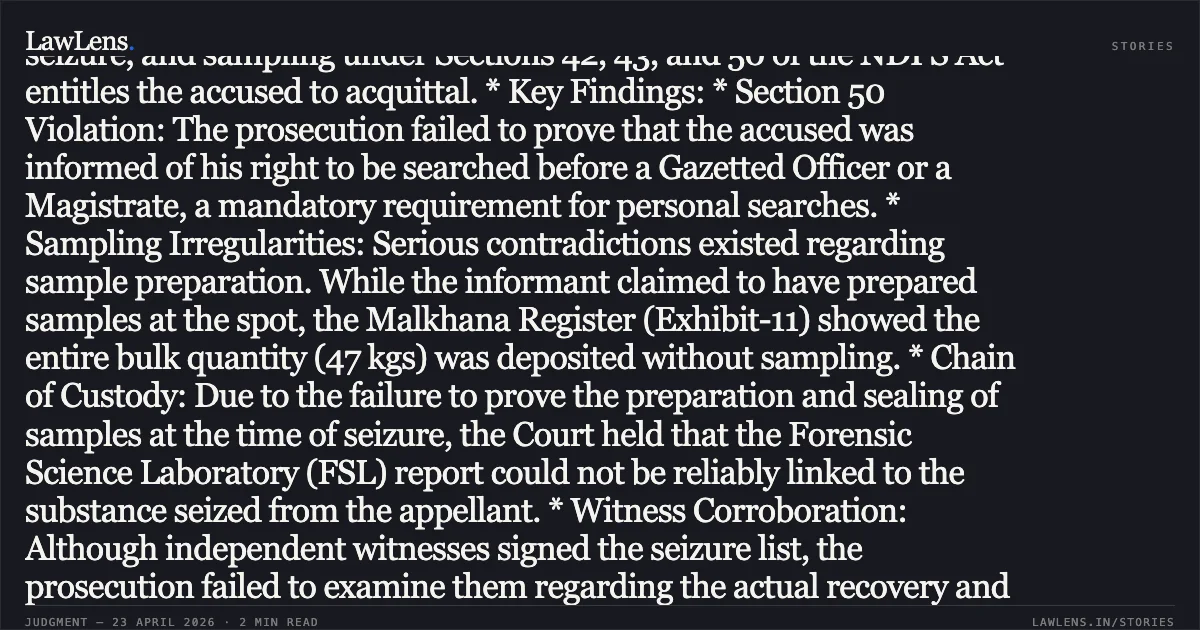
### Failure to Mandatorily Adhere to Search and Seizure Protocols Under NDPS Act Vitiates Conviction Legal Brief: * Core Issue: Whether the non-compliance with statutory procedures for search, seizure, and sampling under Sections 42, 43, and 50 of the NDPS Act entitles the accused to acquittal. * Key Findings: * Section 50 Violation: The prosecution failed to prove that the accused was informed of his right to be searched before a Gazetted Officer or a Magistrate, a mandatory requirement for personal searches. * Sampling Irregularities: Serious contradictions existed regarding sample preparation. While the informant claimed to have prepared samples at the spot, the Malkhana Register (Exhibit-11) showed the entire bulk quantity (47 kgs) was deposited without sampling. * Chain of Custody: Due to the failure to prove the preparation and sealing of samples at the time of seizure, the Court held that the Forensic Science Laboratory (FSL) report could not be reliably linked to the substance seized from the appellant. * Witness Corroboration: Although independent witnesses signed the seizure list, the prosecution failed to examine them regarding the actual recovery and apprehension, relying solely on police testimony. * Conclusion: The High Court set aside the conviction, ruling that fundamental procedural lapses in search and seizure create a reasonable doubt, necessitating the acquittal of the appellant.

Saurav Kumar @ Saurabh Kumarv.The State of Bihar

### Failure to Mandatorily Adhere to Search and Seizure Protocols Under NDPS Act Vitiates Conviction Legal Brief: * Core Issue: Whether the non-compliance with statutory procedures for search, seizure, and sampling under Sections 42, 43, and 50 of the NDPS Act entitles the accused to acquittal. * Key Findings: * Section 50 Violation: The prosecution failed to prove that the accused was informed of his right to be searched before a Gazetted Officer or a Magistrate, a mandatory requirement for personal searches. * Sampling Irregularities: Serious contradictions existed regarding sample preparation. While the informant claimed to have prepared samples at the spot, the Malkhana Register (Exhibit-11) showed the entire bulk quantity (47 kgs) was deposited without sampling. * Chain of Custody: Due to the failure to prove the preparation and sealing of samples at the time of seizure, the Court held that the Forensic Science Laboratory (FSL) report could not be reliably linked to the substance seized from the appellant. * Witness Corroboration: Although independent witnesses signed the seizure list, the prosecution failed to examine them regarding the actual recovery and apprehension, relying solely on police testimony. * Conclusion: The High Court set aside the conviction, ruling that fundamental procedural lapses in search and seizure create a reasonable doubt, necessitating the acquittal of the appellant.. Saurav Kumar @ Saurabh Kumar vs The State of Bihar. Patna High Court. LawLens
The LawLens card for this judgmentXLinkedInWhatsApp

In brief

The question

1. Whether the search and seizure conducted by the police complied with the mandatory statutory requirements under Sections 42, 43, and 50 of the NDPS Act

The court held

The Court held that the mandatory requirements of Sections 42, 43, and 50 of the NDPS Act were not met and the integrity of the seized contraband was compromised

It also directed

The appeal was allowed, the judgment of conviction and sentence dated 24.07.2018 was set aside, and the appellant was acquitted of all charges

The court directed the immediate release of the appellant and the refund of any deposited fine

01Facts

The appellant was convicted by the Trial Court under Sections 20B(ii)(C) and 22 of the NDPS Act and sentenced to 20 years’ rigorous imprisonment and a fine of Rs. 1 lakh

pp. 1-2

The prosecution alleged that on April 25, 2017, a police patrolling party apprehended the appellant after he fell from a speeding motorcycle.

pp. 2-3

Upon search, two packets of cannabis (Ganja) weighing 25 kg and 22 kg (total 47 kg) were recovered from his possession

pp. 2-3

The appellant challenged the conviction on grounds of non-compliance with statutory procedures regarding search, seizure, and sampling

pp. 4-5

02Issues

i.1. Whether the search and seizure conducted by the police complied with the mandatory statutory requirements under Sections 42, 43, and 50 of the NDPS Act

pp. 6-11

ii.2. Whether the prosecution successfully established the link between the seized contraband and the samples sent for chemical examination (FSL)

pp. 12-13

03Law Applied

Sections 42 and 43 of the NDPS Act, which govern the power of entry, search, seizure, and arrest without warrant, and Section 50, which mandates specific conditions for the search of a person, including the right to be searched before a Gazetted Officer or Magistrate

pp. 6-10

established criminal jurisprudence regarding the integrity of "case property," requiring that samples be properly sealed, recorded in the Malkhana register, and verified by the Station House Officer (SHO) to ensure no tampering occurs before reaching the Forensic Science Laboratory

pp. 11-12

Provisions in the judgment · 9 · Linked ones open on LawLens

Code of Criminal Procedure, 1973 Section 374Section 100

Narcotic Drugs and Psychotropic Substances Act, 1985 Section 20Section 22Section 42Section 43Section 50

Arms Act, 1959 Section 20Section 22

04Reasoning

First, there was no evidence in the FIR or testimony that the appellant was offered his right to be searched before a Gazetted Officer or Magistrate as per Section 50

p. 11

Second, while the informant (PW-1) claimed to have prepared two 25-gram samples at the spot, the FIR was silent on this, and the Malkhana Register (Exhibit-11) showed that the entire 47 kg of cannabis was deposited in bulk

p. 5, 12

The court noted that if the entire bulk remained in the Malkhana, the origin of the samples sent to the FSL became untraceable and suspicious

pp. 12-13

Furthermore, the independent seizure witnesses (PW-6 and PW-7) were not questioned by the prosecution to corroborate the recovery, despite being present

p. 6

This break in the chain of custody meant the FSL report could not be legally linked to the appellant

p. 13

05Holding

The Court held that the mandatory requirements of Sections 42, 43, and 50 of the NDPS Act were not met and the integrity of the seized contraband was compromised

p. 13

The appeal was allowed, the judgment of conviction and sentence dated 24.07.2018 was set aside, and the appellant was acquitted of all charges

pp. 13-14

The court directed the immediate release of the appellant and the refund of any deposited fine

p. 14
Patna High Court

Original Court PDF

Saurav Kumar @ Saurabh KumarvsThe State of Bihar

Patna High Court · April 20, 2026

Click to open original judgment

Original judgment, available to read, download and summarize on LawLens.in

Click to open original judgment