Facts
The UPSC (Respondent No. 1) invited applications for one post of Associate Professor (English) at the Army Cadet College Wing, Indian Military Academy (IMA), Dehradun, via Advertisement No. 3/14
Source reference: para. 3The applicant applied and was one of two candidates interviewed on September 11, 2014
Source reference: para. 4The other candidate, Ms. Ruby Gupta, was selected but did not join the post, as she accepted a Professor position elsewhere
Source reference: para. 4, 18The applicant secured 40 marks in the interview
Source reference: para. 5UPSC refused to recommend the applicant’s name, stating that the minimum qualifying marks for General category candidates was 50
Source reference: para. 10The applicant challenged the UPSC’s letter dated July 15, 2015, which rejected her representation for appointment, arguing that the selection should have followed UGC Regulations 2010 regarding a bifurcated marking scheme (API scores, domain knowledge, etc.) rather than a holistic interview score
Source reference: para. 1, 6, 8Issues
1. Whether the selection process was governed by the University Grants Commission (UGC) Regulations, 2010 or the Recruitment Rules framed under Article 309 of the Constitution
Source reference: para. 12, 222. Whether the applicant, having failed to secure the minimum qualifying marks in the interview, is entitled to appointment following the non-joining of the selected candidate
Source reference: para. 11, 23Law Applied
Recruitment processes are governed by the Recruitment Rules (RRs) framed under Article 309 of the Constitution, and external guidelines (such as UGC Regulations) are applicable only to the extent they are specifically incorporated into those RRs
Source reference: para. 12, 22The court relied on the principle that the fixation of cut-off marks is within the employer's domain and cannot be interfered with unless arbitrary
Source reference: para. 18It further applied the settled legal position from Pitta Naveen Kumar v. State of AP (2006) 10 SCC 261 and Jatinder Kumar v. State of Punjab AIR 1984 SC 1850, which establishes that mere participation in a selection process or the non-joining of a higher-ranked candidate does not confer an indefeasible right to appointment upon a candidate who fails to meet the minimum qualifying standards
Source reference: para. 18, 23Reasoning
The Tribunal found that the IMA, under the Ministry of Defence, is governed by its own Recruitment Rules dated March 8, 2010, rather than the full suite of UGC Regulations
Source reference: para. 13, 18The UPSC correctly adopted only specific UGC components, such as the API score for shortlisting, while maintaining its independent interview procedure for final selection
Source reference: para. 14, 22The Tribunal noted that the Interview Board evaluated candidates on a holistic scale of 0–100 as per established UPSC guidelines, where the minimum threshold for General candidates is 50 marks
Source reference: para. 10, 22Since the applicant secured only 40 marks, she was legally "unsuitable" for the post
Source reference: para. 10, 21The court reasoned that a vacancy does not obligate the state to appoint an unqualified candidate; the absence of a reserve list was justified because no other candidate met the minimum qualifying criteria
Source reference: para. 11, 23No evidence of mala fide or procedural irregularity was found to warrant judicial review
Source reference: para. 22, 24Holding
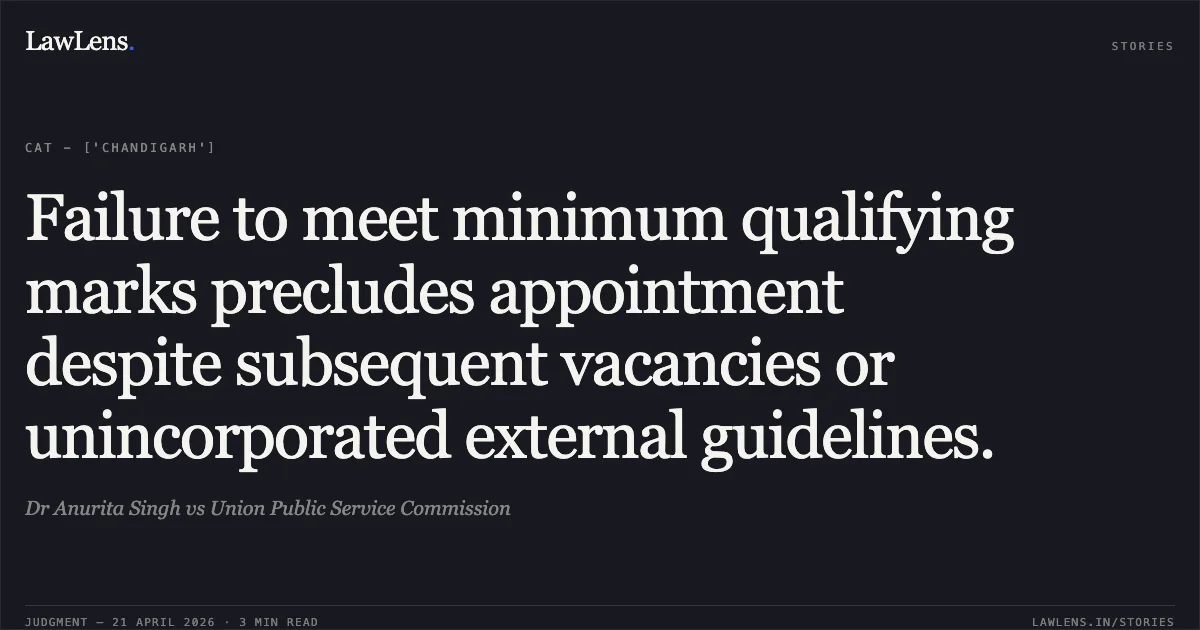
The Tribunal dismissed the Original Application, holding that the applicant had no right to be recommended for the post
It concluded that the UPSC’s refusal to forward the applicant's name was valid as she failed to achieve the mandatory qualifying marks of 50 in the interview
Source reference: para. 21, 23The selection process conducted under Article 309 RRs was upheld over the applicant's plea for UGC-mandated marking bifurcations
Source reference: para. 22No order as to costs was passed
Source reference: para. 25Acts & Sections Cited
1 provisions across 1 statute referred to in this judgment. Each provision opens on LawLens.
Administrative Tribunals Act, 19851
Original Court PDF
Dr Anurita SinghvsUnion Public Service Commission
Click to open original judgment
Original judgment, available to read, download and summarize on LawLens.in


![Subsequent exoneration does not retrospectively invalidate a finalized promotion select list.. UNNIKRISHNAN M vs M/o Environment And Forests. CAT - ['Ernakulam']. LawLens](/stories/thumbnails/subsequent-exoneration-does-not-retrospectively-invalidate-a-finalized-promotion-select-li-ce80a0e84f2f4887857271e8b4341c42.webp)