Facts
The appellant challenged the final decree of partition dated 20 December 2025 passed by the Civil Judge (Senior Division), Jhargram, in Title Suit No. 97 of 2018.
Source reference: p. 2, paras. 3–7The respondents initially objected that the appeal was not maintainable because the preliminary decree had been passed by consent.
Source reference: p. 2, paras. 3–7The Trial Court’s order sheet showed that, although the matter had been fixed for consideration of the Partition Commissioner’s report, the appellant neither filed objections nor appeared to oppose it.
Source reference: p. 3, paras. 9–11In appeal, the appellant contended that the portion allotted to him was not capable of construction and further alleged that his Trial Court advocate had also represented the plaintiffs, amounting to collusion.
Source reference: p. 3, para. 12; p. 4, paras. 18–19Issues
Whether an appeal against a final decree of partition is barred merely because the preliminary decree was passed on consent.
Source reference: p. 2, paras. 3–7Whether the Trial Court was required to independently scrutinise the Partition Commissioner’s allotment despite the appellant having raised no objection to the Commissioner’s report.
Source reference: p. 4, paras. 13–16Whether the appellant could raise, for the first time in appeal, an allegation that his Trial Court advocate had acted collusively by also representing the plaintiffs.
Source reference: p. 4–5, paras. 18–24Whether the final decree disclosed any illegality, irregularity, error of fact or law, or perversity warranting interference in first appeal.
Source reference: p. 5–6, paras. 22–28Law Applied
A preliminary decree in a partition suit ordinarily determines the parties’ title and respective shares, while the final decree determines the actual allotment and separation of those shares; therefore, consent to the preliminary decree does not necessarily constitute consent to the final decree.
Source reference: p. 2, paras. 5–7Where no objection is raised to a Partition Commissioner’s report, the Trial Court’s subsequent scrutiny is limited to whether the report is legally valid and in proper form; the Court is not required to independently reconsider the convenience or desirability of the allotments.
Source reference: p. 4, paras. 13–16A party alleging that proceedings before a particular court were incorrectly recorded must ordinarily approach that court for correction, preferably while the Presiding Officer remains available.
Source reference: p. 4–5, paras. 20–21Allegations of fraud or collusion must be properly pleaded and cannot ordinarily be introduced for the first time before the appellate court.
Source reference: p. 4–5, paras. 20–21Even in a first appeal, appellate interference is justified only where the impugned decision suffers from illegality, error of fact or law, or perversity; the appellate court cannot substitute its view merely because another view is possible.
Source reference: p. 5, paras. 22–23Reasoning
The High Court distinguished the consent preliminary decree from the contested final-decree process, holding that the appellant was entitled to challenge the final decree in principle because the actual allocation of property had not been determined at the preliminary stage.
Source reference: p. 2, paras. 5–7However, the appeal failed on merits because the order sheet established that the appellant had not objected to the Commissioner’s report despite having an opportunity to do so.
Source reference: p. 4, paras. 14–17The Trial Court was therefore not required to reassess whether the particular portion allotted to the appellant was convenient or capable of construction; the appellant’s dissatisfaction with the allotment did not establish legal invalidity in the report.
Source reference: p. 4, paras. 14–17The allegation of collusion was also rejected as a new case raised for the first time in appeal, without particulars of fraud or any prior challenge before the Trial Court.
Source reference: p. 5–6, paras. 20–26Since no error, illegality, irregularity, or perversity was demonstrated in the Trial Court’s acceptance of the report and preparation of the final decree, appellate interference was unwarranted.
Source reference: p. 5–6, paras. 20–26Holding
The Court held that the appeal was maintainable notwithstanding the consent preliminary decree, but found no merit in the challenge to the final decree.
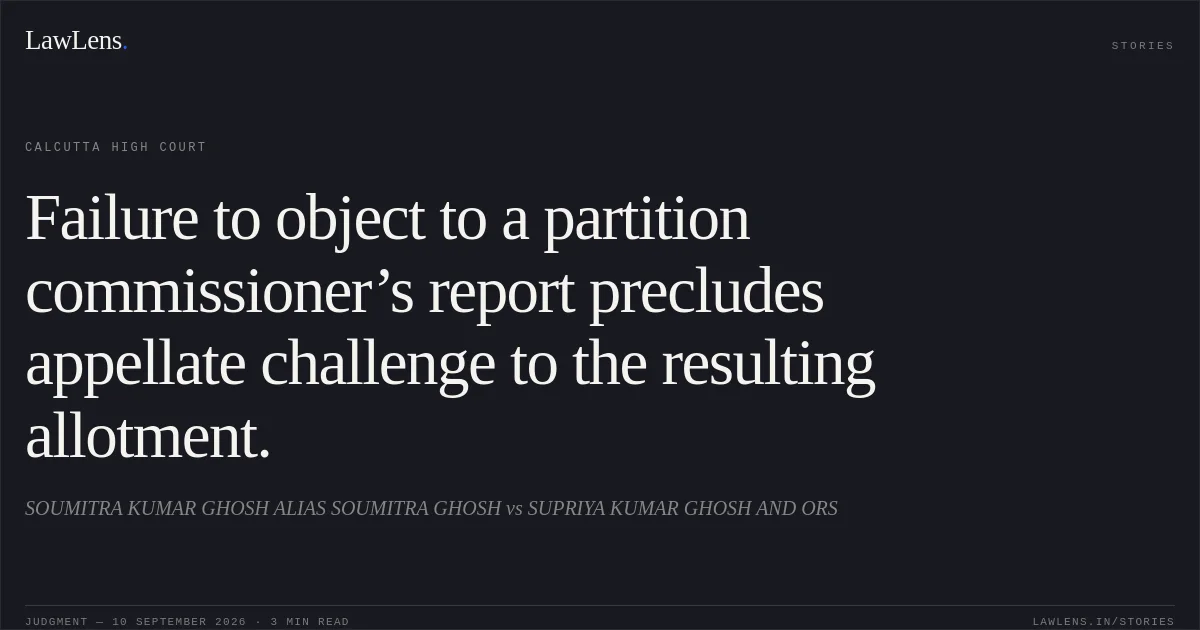
The appellant’s failure to object to the Partition Commissioner’s report precluded a later challenge based merely on dissatisfaction with the allotment, and the allegation of advocate collusion could not be raised for the first time in appeal.
Source reference: p. 6–7, paras. 27–34FA No. 133 of 2026 was dismissed on contest, and the final decree of partition dated 20 December 2025 was affirmed.
Source reference: p. 6–7, paras. 27–34CAN 1 of 2026 was disposed of, any interim order was vacated, and there was no order as to costs.
Source reference: p. 6–7, paras. 27–34The Court clarified that, if otherwise permissible in law, the appellant was not precluded from instituting an independent suit before the Trial Court alleging fraud by his advocate; such suit would be decided independently and without being influenced by the observations in the appeal.
Source reference: p. 6–7, paras. 30–31Original Court PDF
SOUMITRA KUMAR GHOSH ALIAS SOUMITRA GHOSHvsSUPRIYA KUMAR GHOSH AND ORS
Click to open original judgment
Original judgment, available to read, download and summarize on LawLens.in