01Facts
The applicant, a trader, was accused of purchasing soyabean produce from farmers through a commission agent (the complainant) and subsequently selling the produce to a private company in Rajasthan using forged bills and biltis from third-party entities.
¶ 7It was alleged that the applicant received payment through RTGS into those third-party accounts but failed to pay the farmers, effectively misappropriating approximately Rs. 31.5 lakhs.
¶ 7The police registered an FIR under Sections 316(5) (Criminal Breach of Trust), 338 (Forgery), 336(3) (Making false documents), and 61(2) (Criminal Conspiracy) of the Bharatiya Nyaya Sanhita (BNS), 2023.
¶ 1 & 7The applicant, in custody since January 13, 2026, sought regular bail on the grounds that the dispute was purely a civil business transaction.
¶ 1 & 402Issues
i.1. Whether the failure to pay consideration in a sale of goods transaction constitutes a criminal breach of trust or remains a civil dispute for the purpose of granting bail?
¶ 8-10ii.2. Whether the applicant is entitled to regular bail under Section 483 of the Bharatiya Nagarik Suraksha Sanhita (BNSS), 2023, considering the nature of the transaction and the progress of the investigation?
¶ 9-1103Law Applied
The court primarily applied Section 483 of the BNSS, 2023.
¶ 1It relied on the principle established by the Supreme Court in *Delhi Race Club (1940) Ltd. v. State of Uttar Pradesh* (2024), which clarifies that in a sale of movable property, ownership passes upon delivery under the Sale of Goods Act, 1930; therefore, without "entrustment" of property, a charge of criminal breach of trust cannot be maintained for mere failure to pay consideration.
¶ 8The court also referenced *Lalit Chaturvedi v. State of Uttar Pradesh* to distinguish between civil remedies for non-payment and criminal liability.
¶ 8Provisions in the judgment · 13 · Linked ones open on LawLens
Bharatiya Nagarik Suraksha Sanhita, 2023 Section 483Section 316Section 338Section 336Section 61Section 346
Bharatiya Nyaya Sanhita, 2023 Section 316Section 338Section 336Section 61
Sale of Goods Act, 1930 Section 20Section 24
Code of Criminal Procedure, 1973 Section 309
04Reasoning
The court observed that the dispute emerged from a continued business transaction where the applicant, as a purchaser, failed to pay the price of agricultural produce.
¶ 8Applying the Sale of Goods Act principles as cited in *Delhi Race Club*, the court reasoned that once goods are delivered in a sale, the property passes to the buyer, negating the element of "entrustment" necessary for criminal breach of trust under Section 316(5) of the BNS.
¶ 8Regarding the allegations of forgery and conspiracy, the court noted that the investigation regarding the applicant was largely complete, relevant seizures had been made, and further custodial interrogation was unnecessary.
¶ 4 & 7Given the applicant's socio-economic status, the lack of substantial criminal antecedents, and the prima facie merit in the argument that the matter was a commercial default, the court found no compelling reason to continue incarceration.
¶ 1005Holding
The Court allowed the application and granted regular bail to the applicant.
¶ 11The court held that while the prosecution's veracity would be tested at trial, the transaction appeared prima facie to be a business dispute.
¶ 9The applicant was ordered to be released subject to depositing a cash surety of Rs. 50,000, furnishing a personal bond of Rs. 2,00,000 with one solvent surety of the same amount, and adhering to standard conditions to ensure presence during trial and prevent witness tampering.
¶ 12Original Court PDF
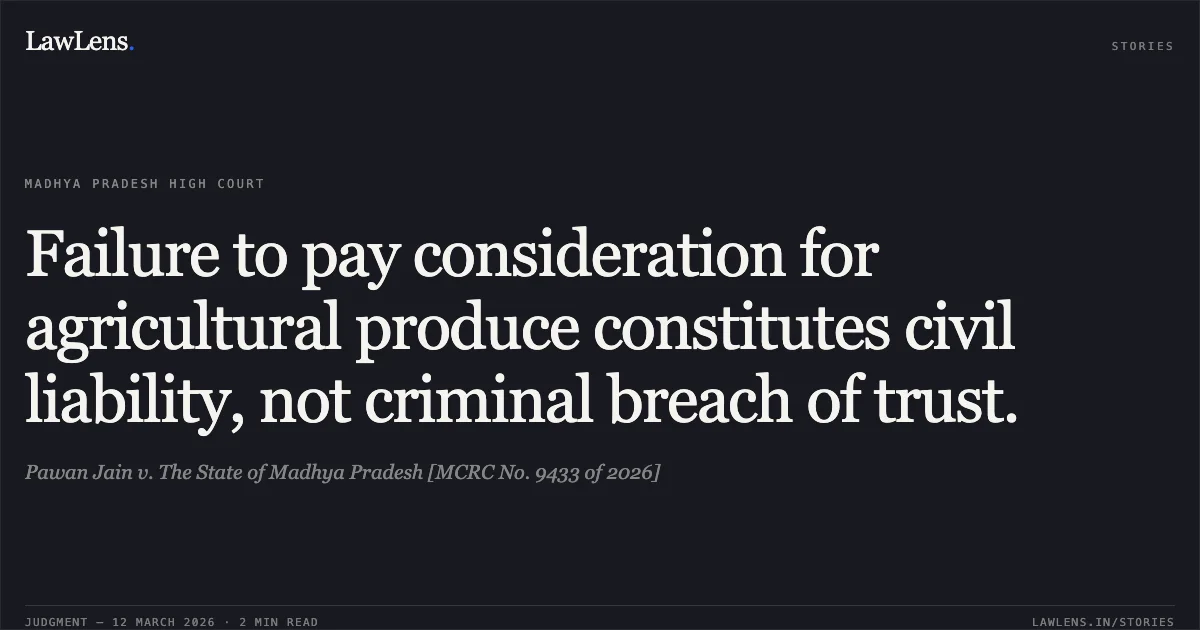
Pawan Jain v. The State of Madhya Pradesh [MCRC No. 9433 of 2026]
Click to open original judgment
Original judgment, available to read, download and summarize on LawLens.in