Facts
Lakshmi Devi was married to the appellant, Parmanand Yadav.
Source reference: no citationThe prosecution alleged that, after the appellant secured employment in the Army, he and his family demanded ₹2 lakhs as dowry and subjected the deceased to cruelty and harassment.
Source reference: p. 2, para. 3It was further alleged that the appellant contracted a second marriage and that, on 2 October 2004, the deceased became seriously ill and her dead body was concealed.
Source reference: p. 2, para. 3The appellant was prosecuted for offences under Sections 304-B, 201 and 120-B of the Indian Penal Code and relevant provisions of the Dowry Prohibition Act.
Source reference: p. 2, para. 3The Trial Court examined five prosecution witnesses and relied on evidence concerning the alleged marriage, dowry demand, harassment, illness and death of the deceased.
Source reference: p. 3, para. 4The defence produced documents relating to the appellant’s Army service and duty posting.
Source reference: p. 3, para. 4By judgment dated 13 April 2018 and order dated 17 April 2018, the Additional Sessions Judge, Banka convicted the appellant under Sections 304-B and 201 IPC and sentenced him to ten years’ rigorous imprisonment under Section 304-B and three years’ rigorous imprisonment with a fine under Section 201 IPC, with the sentences to run concurrently.
Source reference: p. 1, para. 2Issues
1. Whether the prosecution proved that the deceased’s death occurred within seven years of her marriage, thereby satisfying an essential ingredient of Section 304-B IPC?
Source reference: p. 5, para. 8; p. 6, para. 92. Whether the prosecution established that, soon before her death, the deceased was subjected to cruelty or harassment by the appellant in connection with a dowry demand?
Source reference: p. 5, para. 8; p. 6, para. 103. Whether the medical, defence and investigative evidence established the appellant’s connection with an unnatural death and the offence under Section 201 IPC beyond reasonable doubt?
Source reference: p. 7, paras. 11–12; p. 7, para. 13Law Applied
Section 304-B IPC requires the prosecution to prove: (i) the death of a woman by burns, bodily injury or otherwise than under normal circumstances; (ii) that the death occurred within seven years of marriage; and (iii) that soon before her death she was subjected to cruelty or harassment by her husband or his relatives in connection with a demand for dowry.
Source reference: p. 5, para. 8The presumption under Section 113-B of the Indian Evidence Act can arise only after these foundational facts are established by the prosecution.
Source reference: p. 5, para. 8; p. 7, para. 13The prosecution bears the burden of proving the ingredients of the charged offences beyond reasonable doubt; where material circumstances create reasonable doubt, the accused is entitled to its benefit.
Source reference: p. 7, para. 13Section 201 IPC likewise requires proof that the accused caused evidence of an offence to disappear or gave false information with the requisite knowledge and intention.
Source reference: p. 7, para. 13Reasoning
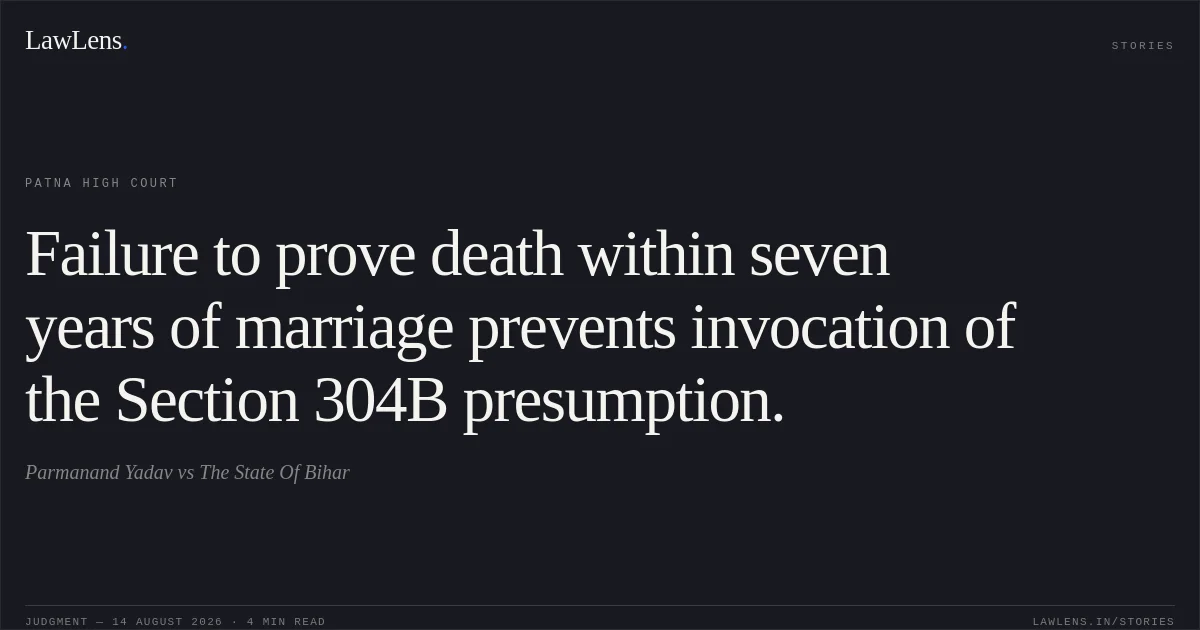
The Court found that the prosecution failed to establish the seven-year requirement under Section 304-B IPC.
Source reference: p. 6, para. 9The evidence regarding the year of marriage was inconsistent: one version placed the marriage in 1989, while another referred to 1998; the existence of a granddaughter aged approximately thirteen years also indicated that the marriage was much older than seven years before the occurrence.
Source reference: p. 6, para. 9The alleged demand for ₹2 lakhs was said to have arisen after the appellant obtained Army employment, but there was no reliable evidence of a dowry demand at or before the marriage, nor convincing proof of cruelty or harassment “soon before” the death in connection with dowry.
Source reference: p. 6, para. 10The medical evidence did not establish homicidal death or ante-mortem injuries caused by another person; instead, it indicated pregnancy-related complications, treatment and death while the deceased was being taken to Bhagalpur.
Source reference: p. 7, para. 11The Army communication showing that the appellant was on duty on 2 October 2004 was not satisfactorily displaced and raised doubt about his presence at the relevant time.
Source reference: p. 7, para. 12The non-examination of the Investigating Officer further deprived the defence of an opportunity to prove relevant omissions and contradictions arising from the investigation.
Source reference: p. 7, para. 12Taken cumulatively, these circumstances prevented the prosecution from establishing the foundational facts necessary to invoke Section 113-B and also failed to prove the charge under Section 201 IPC beyond reasonable doubt.
Source reference: p. 7, para. 13Holding
The Patna High Court held that the prosecution failed to prove the essential ingredients of Section 304-B IPC, particularly the requirement that the death occurred within seven years of marriage and that the deceased was subjected to dowry-related cruelty or harassment soon before her death.
The presumption under Section 113-B of the Evidence Act was therefore unavailable, and the charge under Section 201 IPC was also not proved beyond reasonable doubt.
Source reference: p. 7, para. 13The conviction dated 13 April 2018 and sentence dated 17 April 2018 were set aside; the appellant was acquitted of the charges and discharged from the liabilities of his bail bond.
Source reference: p. 8, paras. 14–16The appeal was allowed.
Source reference: p. 8, paras. 14–16Acts & Sections Cited
1 provisions across 1 statute referred to in this judgment. Each provision opens on LawLens.
Indian Penal Code, 18601
Original Court PDF
Parmanand YadavvsThe State Of Bihar
Click to open original judgment
Original judgment, available to read, download and summarize on LawLens.in