Facts
The State appealed against a judgment dated 19.12.2022 by the Special Judge (POCSO), Betul, which acquitted the respondents of several charges.
Source reference: para. 1The prosecution alleged that in 2016, the minor prosecutrix was lured away by respondents Rajesh and Maya, sold to Vishnu for ₹35,000, and subsequently raped by Vishnu, resulting in the birth of two children.
Source reference: para. 2During the trial, the prosecutrix (PW-3), her parents (PW-4, PW-6), and her brother (PW-8) were declared hostile.
Source reference: para. 10They testified that the prosecutrix went voluntarily, was approximately 18-19 years old at the time, and had married Vishnu.
Source reference: para. 10, 12The State contended the Scholar Register proved her minority, and a DNA report confirmed Vishnu’s paternity.
Source reference: para. 7Issues
1. Whether the prosecution successfully established that the prosecutrix was below 18 years of age at the time of the alleged offence to attract the provisions of the POCSO Act.
Source reference: para. 7, 112. Whether the acquittal of the respondents by the Trial Court was perverse or legally unsustainable despite the DNA evidence establishing paternity.
Source reference: para. 12, 13Law Applied
The Court applied Section 378(3) of the Cr.P.C. regarding leave to appeal against acquittal.
Source reference: para. 1The Court relied on established precedents governing appellate interference in acquittals, including H.D. Sundara v. State of Karnataka (2023), which dictates that if the Trial Court’s view is "possible," the High Court cannot overturn it merely because another view exists.
Source reference: para. 15It further applied principles from Babu Sahebagouda Rudragoudar v. State of Karnataka (2024) and Mallappa v. State of Karnataka (2024), emphasizing that appellate courts must only interfere if the judgment is perverse, based on a misreading of evidence, or suffers from a patent error of law.
Source reference: para. 16, 19Reasoning
The Court found no reason to interfere with the Trial Court’s findings. Regarding age, the Court noted that the Scholar Register entry lacked a verified source; the Transfer Certificate (TC) allegedly used was not produced, and the teacher responsible for the entry was not examined.
Source reference: para. 10Consequently, the Trial Court's finding that the prosecution failed to prove the prosecutrix was a minor was held to be legally sound.
Source reference: para. 11On the merits of the rape and kidnapping charges, the Court observed that all material witnesses (PW-3, PW-4, PW-6, PW-8) turned hostile and supported a narrative of voluntary marriage.
Source reference: para. 10, 12While the DNA report confirmed Vishnu's paternity (Ex. P-44), the Court reasoned that in the absence of proof of minority and given the prosecutrix’s testimony of a consensual marriage, the DNA evidence did not prove any criminal offence.
Source reference: para. 12Holding
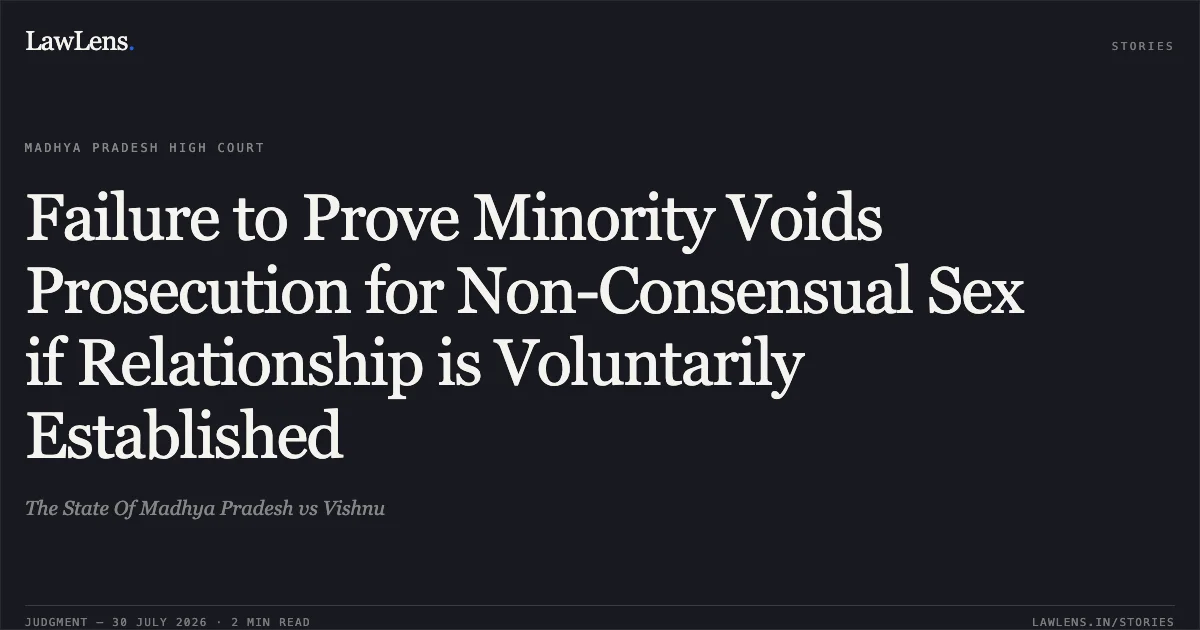
The High Court held that the Trial Court’s judgment did not suffer from perversity or illegality.
The Court answered both issues in the negative, affirming that when two views are possible, the view favoring the accused must prevail.
Source reference: para. 19The application for leave to appeal (I.A. No. 10368/2023) was dismissed, and the criminal appeal was subsequently dismissed. Vishnu and the other respondents remain acquitted.
Source reference: para. 21Acts & Sections Cited
12 provisions across 4 statutes referred to in this judgment. Each provision opens on LawLens.
Code of Criminal Procedure, 19734
Indian Penal Code, 18603
Protection of Children from Sexual Offences Act, 20124
Scheduled Castes and the Scheduled Tribes (Prevention of Atrocities) Act, 19891
Original Court PDF
The State Of Madhya PradeshvsVishnu
Click to open original judgment
Original judgment, available to read, download and summarize on LawLens.in


