Facts
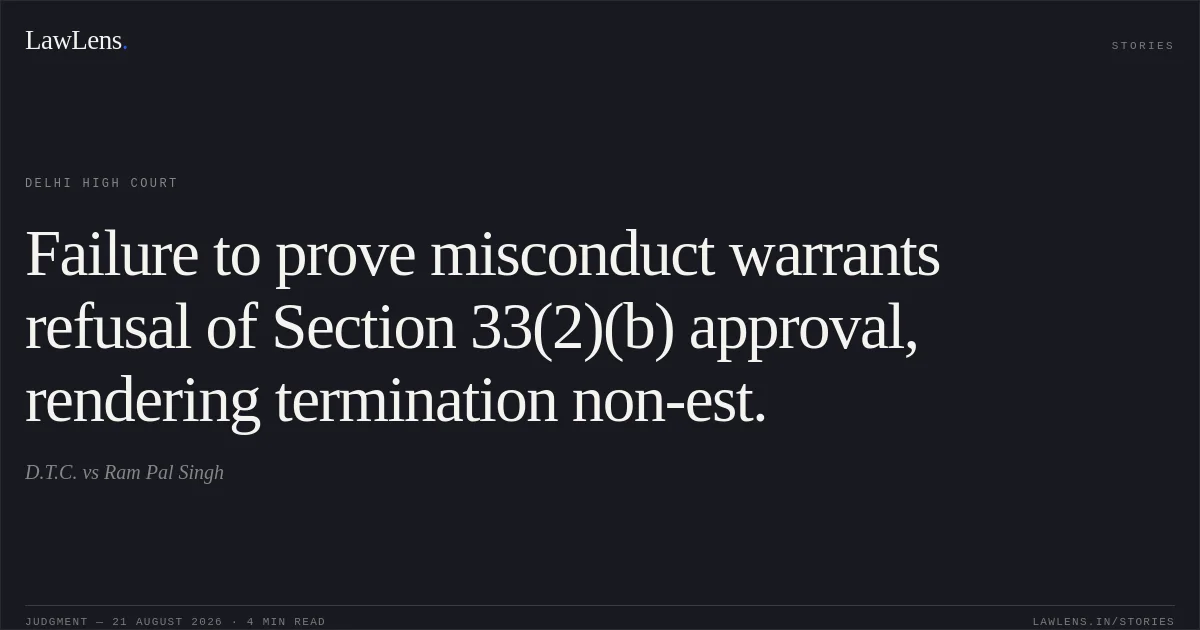
Ram Pal Singh was employed as a conductor with the Delhi Transport Corporation (“DTC”) from 1985. On 15 January 1989, while conducting Bus No. 3979, he allegedly collected ₹7.50 from five passengers travelling from Kalka More to Railway Station but issued tickets worth only ₹5, consisting of five ₹1 tickets. DTC alleged that, upon being confronted by the checking staff, Singh admitted his mistake and issued five unpunched 50-paise tickets towards the fare difference.
Source reference: para. 4; p. 2Singh was chargesheeted on 27 January 1989. Following a domestic enquiry, he was found guilty of misconduct and removed from service on 16 March 1990.
Source reference: para. 5; p. 2Since an industrial dispute was pending, DTC sought approval of the removal under Section 33(2)(b) of the Industrial Disputes Act, 1947 (“ID Act”). The Industrial Tribunal dismissed DTC’s approval application on 18 July 2001, holding that the enquiry violated natural justice and that the alleged misconduct had not been established.
Source reference: paras. 6–7; pp. 2–3DTC challenged the Tribunal’s order in W.P.(C) 2314/2003, while Singh filed W.P.(C) 2027/2003 seeking implementation of the order. This Court had stayed operation of the Tribunal’s order on 1 April 2003.
Source reference: paras. 2–3; p. 2Issues
Whether the Industrial Tribunal was justified in refusing approval under Section 33(2)(b) of the ID Act on the ground that the domestic enquiry was vitiated and the alleged misconduct was not prima facie established?
Source reference: paras. 10–17; pp. 4–6Whether DTC could rely upon the alleged statements, signatures and admission of guilt of the workman when the original documents were not produced and the workman was not cross-examined on those matters in the Section 33(2)(b) proceedings?
Source reference: paras. 7, 13–16; pp. 3, 5–6What relief was Singh entitled to after refusal of approval under Section 33(2)(b), particularly in view of his subsequent superannuation and receipt of Section 17B payments?
Source reference: paras. 18–20; p. 6Law Applied
The Court applied Section 33(2)(b) of the ID Act, under which an employer must obtain approval for dismissing or removing a workman during the pendency of relevant industrial proceedings. Proceedings under that provision are summary and are intended to protect workmen against punitive alteration of service conditions; the Tribunal must examine whether the domestic enquiry was fair, complied with natural justice, and disclosed a prima facie case of misconduct. Such proceedings are distinct from a full adjudication of the termination under Sections 10, 11(3) and 11-A of the ID Act.
Source reference: para. 11; p. 4The Court relied on John D’Souza v. Karnataka State Road Transport Corporation, (2019) 18 SCC 47, for the limited scope of proceedings under Section 33(2)(b).
Source reference: para. 11; p. 4In exercising jurisdiction under Article 226 of the Constitution, the High Court ordinarily does not reappreciate factual findings unless there is a material infirmity or perversity.
Source reference: para. 12; p. 4Refusal of approval under Section 33(2)(b) renders the termination non-est and ordinarily carries consequential benefits, although appropriate monetary compensation may be substituted in the circumstances of the case.
Source reference: para. 18; p. 6Reasoning
The Court declined to interfere with the Tribunal’s factual conclusion that the misconduct had not been established.
Source reference: paras. 10–17; pp. 4–6DTC relied substantially on the alleged admission of guilt by Singh, the passenger’s statement, the signatures on the documents and the unpunched tickets. However, DTC failed to produce the original documents before the Tribunal and did not cross-examine Singh regarding the alleged admission or his signatures on the passenger’s statement.
Source reference: paras. 7, 13; pp. 3, 5Consequently, those documents could not be used as conclusive proof of misconduct.
Source reference: paras. 13–16; pp. 5–6Further, Singh’s statement, read in context, indicated that he had issued the lower-value tickets mistakenly because of heavy passenger congestion, rather than admitting dishonest conduct.
Source reference: para. 14; p. 5The passenger, Jang Bahadur, was produced as a witness in the domestic enquiry but did not support DTC’s case; in the absence of reliable corroboration, DTC could not overcome the evidentiary consequence of its own witness failing to substantiate the allegation.
Source reference: para. 15; p. 6The checking staff merely repeated what the passengers had allegedly told them and therefore could not, by themselves, prove the misconduct.
Source reference: para. 16; p. 6Given the limited Article 226 jurisdiction and the absence of any legal or factual infirmity in the Tribunal’s order, the Court upheld the refusal of approval.
Source reference: para. 17; p. 6As to relief, although refusal of approval ordinarily makes the termination non-est with consequential benefits, the Court considered the long passage of time, Singh’s relatively short service of three years, his clean past record and his superannuation on 31 January 2023.
Source reference: paras. 18–19; p. 6Singh had already received ₹21,11,074 as Section 17B allowance from 18 July 2001 until superannuation.
Source reference: paras. 18–19; p. 6The Court therefore considered a lump-sum monetary award more appropriate than directing further consequential relief.
Source reference: paras. 18–20; p. 6Holding
The High Court dismissed DTC’s challenge and upheld the Industrial Tribunal’s order refusing approval of Singh’s removal under Section 33(2)(b) of the ID Act.
It held that DTC had failed to establish a prima facie case of dishonest misconduct through legally reliable evidence and could not rely on unproved documents or the alleged admission without producing the originals or cross-examining Singh on them.
Source reference: paras. 13–17; pp. 5–6Although the refusal of approval rendered the termination non-est, the Court substituted consequential relief with a lump-sum compensation of ₹2,00,000, payable by DTC to Singh within eight weeks from the date of the order.
Source reference: paras. 18–20; p. 6Both writ petitions were disposed of accordingly.
Source reference: paras. 21–22; p. 7Acts & Sections Cited
5 provisions across 1 statute referred to in this judgment. Linked provisions open on LawLens.
Industrial Disputes Act, 19475
Original Court PDF
D.T.C.vsRam Pal Singh
Click to open original judgment
Original judgment, available to read, download and summarize on LawLens.in