Facts
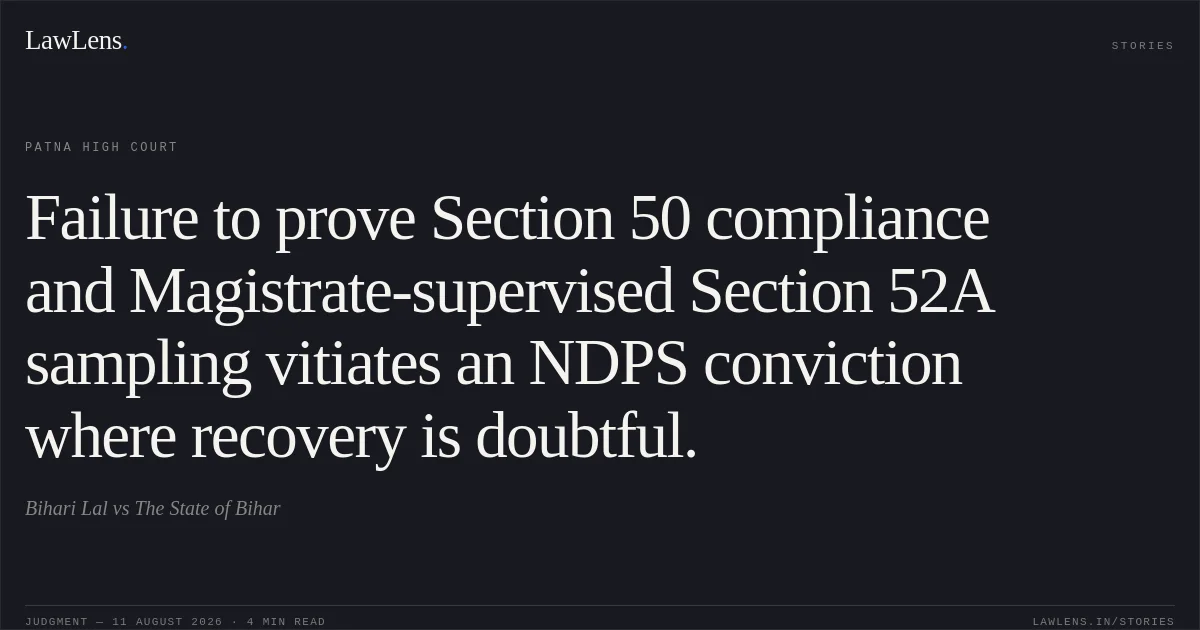
On 10 May 2018, SSB personnel allegedly intercepted the appellant, Bihari Lal, at Raxaul and recovered twenty slabs of suspected charas concealed in a black laptop bag. The total gross weight was stated to be 10 kilograms.
Source reference: paras. 3–4, 15–23; pp. 2–5, 10–12The appellant was allegedly searched in the presence of two independent witnesses after purported compliance with Section 50 of the NDPS Act. The NCB team subsequently reached the SSB camp on 11 May 2018, conducted a preliminary drug-detection test, drew two 25-gram samples, sealed the seized material, and forwarded one sample to CRCL, Kolkata.
Source reference: paras. 3–4, 15–23; pp. 2–5, 10–12The appellant was convicted by the Exclusive Special Judge-I, NDPS, East Champaran, under Sections 20(b)(ii)(C) and 23(c) of the NDPS Act and sentenced to concurrent terms of ten years’ rigorous imprisonment with fines of ₹1,00,000 under each count.
Source reference: para. 2; p. 1In appeal, he challenged the alleged non-compliance with Sections 50 and 52A, the doubtful seizure process, and the non-examination of the independent witnesses.
Source reference: paras. 12–12.2; pp. 7–8Issues
1. Whether the prosecution established compliance with the mandatory safeguards under Section 50 of the NDPS Act before conducting the appellant’s personal search?
Source reference: paras. 33–40; pp. 15–192. Whether the drawing of representative samples without the presence and supervision of a Magistrate, and the deficiencies in inventory certification, constituted fatal non-compliance with Section 52A of the NDPS Act in the circumstances of the case?
Source reference: paras. 41–54; pp. 20–293. Whether the prosecution could rely on the presumptions under Sections 35 and 54 of the NDPS Act despite the defects in the search, seizure, sampling, and proof of conscious possession?
Source reference: paras. 55–62; pp. 29–344. Whether the non-examination of the two independent witnesses and other material SSB officials materially weakened the prosecution case?
Source reference: paras. 28–32, 63–65; pp. 14–16, 35–36Law Applied
The Court held that a search conducted at a public place attracts Section 43 rather than Section 42 of the NDPS Act, although ordinary safeguards relating to seizure and independent witnesses remain relevant.
Source reference: para. 27; p. 14Under Section 50, where a personal search is undertaken, the accused must be clearly and meaningfully informed of the right to be searched before a Gazetted Officer or Magistrate; strict compliance is mandatory, and failure may render the recovery suspect and prevent reliance on the recovery for conviction or the Section 54 presumption, as explained in *Vijaysinh Chandubha Jadeja v. State of Gujarat* and *State of Punjab v. Baldev Singh*.
Source reference: paras. 38–39, 60; pp. 18–19, 31–34Section 52A requires procedural safeguards concerning inventory, photographs, and sampling in the presence and with certification of a Magistrate; under *Bharat Aambale v. State of Chhattisgarh*, mere procedural non-compliance is not invariably fatal, but the court must assess its effect cumulatively on the reliability of the physical evidence.
Source reference: para. 44; pp. 21–24The Court also relied on *Nadeem Ahamed v. State of West Bengal* for the principle that complete and unexplained non-compliance with Section 52A, when coupled with doubts regarding seizure and sampling, may render the prosecution case unsafe.
Source reference: paras. 47–48, 54; pp. 25–29Presumptions under Sections 35 and 54 arise only after the prosecution establishes reliable foundational facts, including conscious possession; non-examination of independent witnesses is not automatically fatal, but may be significant where the official evidence is otherwise doubtful.
Source reference: paras. 55–65; pp. 29–36Reasoning
The Court found that the prosecution evidence did not establish valid compliance with Section 50. PW-1 gave inconsistent accounts regarding where the notice was served, Exhibit-1 did not show that the appellant’s right was properly explained, and its recital that he consented to a search before a Head Constable was inconsistent with the statutory safeguard.
Source reference: paras. 34–40; pp. 16–19The two independent witnesses, who allegedly witnessed the interception, search, seizure, and sampling, were not examined, and no satisfactory explanation or serious effort to secure their attendance was shown. The Court also noted that the other SSB personnel and the Deputy Commandant before whom the alleged Section 50 procedure occurred were not examined.
Source reference: paras. 28–32, 64–65; pp. 14–16, 35–36Section 52A compliance was likewise defective: samples had been drawn before the appellant’s production before the Magistrate and outside the Magistrate’s presence; the inventory did not clearly account for the second sample or accurately describe the packaging; the recorded weight appeared overwritten without authentication; and the appellant’s presence during certification was not established.
Source reference: paras. 41–43, 48–51; pp. 20–28Although *Bharat Aambale* permitted the Court to overlook some procedural defects where independent evidence inspires confidence, the cumulative defects here—including the doubtful genesis of the seizure, non-compliance with Section 50, defective sampling, gaps in custody, and withheld witnesses—prevented the prosecution from proving reliable recovery or conscious possession beyond reasonable doubt.
Source reference: paras. 52–62; pp. 28–34Consequently, the foundational facts necessary to invoke Sections 35 and 54 were not established.
Source reference: paras. 52–62; pp. 28–34Holding
The appeal was allowed. The Court set aside the judgment of conviction dated 5 July 2024 and the order of sentence dated 9 July 2024, holding that the prosecution failed to prove compliance with Sections 50 and 52A of the NDPS Act and failed to establish the alleged recovery and conscious possession with sufficient reliability.
The appellant, being in judicial custody, was directed to be released forthwith unless required in connection with another case, and the trial-court record was ordered to be transmitted for compliance.
Source reference: paras. 70–71; p. 38Acts & Sections Cited
11 provisions across 2 statutes referred to in this judgment. Each provision opens on LawLens.
Narcotic Drugs and Psychotropic Substances Act, 1985
Code of Criminal Procedure, 19731
Original Court PDF
Bihari LalvsThe State of Bihar
Click to open original judgment
Original judgment, available to read, download and summarize on LawLens.in