Facts
The accused, Tapas Paul, was arrested on 27.02.2025 following the recovery of 9 Kgs of Yaba tablets (Methamphetamine) valued at ₹9.11 crores from a vehicle he was driving.
Source reference: para 2The accused applied for bail on two primary grounds: first, the slow pace of the trial, noting he had been in custody for 442 days with significant delays between witness examinations.
Source reference: para 5Second, that the mandatory constitutional requirement of communicating the grounds of arrest in his own language and to his family members was violated.
Source reference: para 6Issues
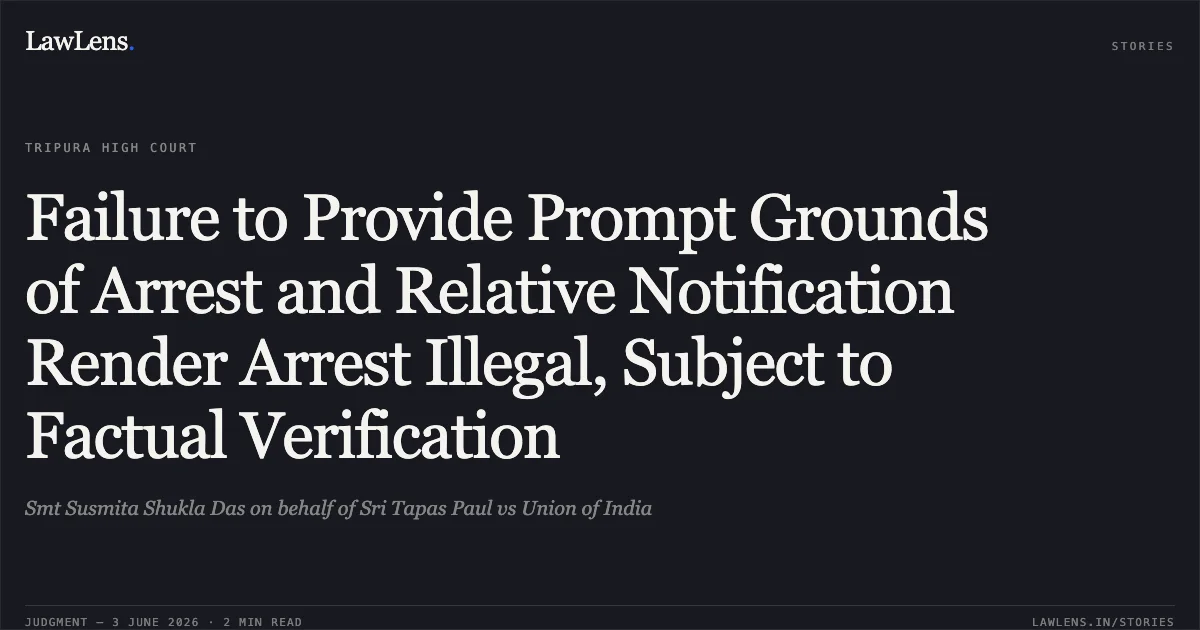
1. Whether the arrest of the accused was illegal due to non-compliance with the mandatory requirement of communicating the grounds of arrest under Article 22(1) of the Constitution and Section 48 of the BNSS.
Source reference: para 11/122. Whether the accused is entitled to bail on the grounds of prolonged incarceration and the slow pace of the trial.
Source reference: para 5/21Law Applied
Article 22(1) and Article 21 of the Constitution of India mandate that an arrestee must be informed of the grounds of arrest "as soon as may be".
Source reference: para 12Section 48 of the BNSS regarding the obligation to inform a nominated relative.
Source reference: para 10/13Doctrine from Vihaan Kumar v. State of Haryana (2025) and Kasireddy Upender Reddy v. State of Andhra Pradesh (2025) establishing that grounds of arrest must be communicated in writing, in a language the arrestee understands, and to their relatives to make the right to legal counsel meaningful.
Source reference: para 12-14Mihir Rajesh Shah v. State of Maharashtra (2026) regarding the timeline for providing written grounds.
Source reference: para 17Reasoning
The Court examined the arrest records and found that the grounds of arrest were communicated to the accused in writing and an endorsement was made by the arresting officer that the grounds were explained in the accused's own language.
Source reference: para 19Regarding the notification of family, the court noted that since the arrest occurred far from the accused’s residence, the officer informed the wife via telephone, which was documented in the arrest memo and signed by the accused.
Source reference: para 19The Court observed that the accused did not raise the issue of language or communication during initial remand proceedings or previous bail applications, suggesting the current plea was an "afterthought".
Source reference: para 19While the Court acknowledged the trial's slow progress (fixing dates three months apart), it determined that such procedural delays in a commercial quantity NDPS case did not automatically override the merits of the recovery.
Source reference: para 19/21Holding
The Court rejected the bail application, holding that the constitutional requirements of Article 22(1) were satisfactorily met.
The Court issued a mandatory directive to all Special Judges and Magistrates in Tripura to verify compliance with Article 22(1) and other safeguards during every production of an arrestee.
Source reference: para 21The Court directed the Special Judge, Khowai, to complete the trial within six months and ordered the prosecuting agency to ensure the timely production of witnesses.
Source reference: para 21Acts & Sections Cited
5 provisions across 3 statutes referred to in this judgment. Each provision opens on LawLens.
Narcotic Drugs and Psychotropic Substances Act, 19852
Bharatiya Nagarik Suraksha Sanhita, 20232
Code of Criminal Procedure, 19731
Original Court PDF
Smt Susmita Shukla Das on behalf of Sri Tapas PaulvsUnion of India
Click to open original judgment
Original judgment, available to read, download and summarize on LawLens.in