Facts
The petitioners, industrial effluent treatment societies, challenged two orders dated 07.07.2021 issued by the Delhi Pollution Control Committee (DPCC). These orders imposed environmental compensation on the petitioners under Section 33A of the Water (Prevention and Control of Pollution) Act, 1974.
Source reference: para. 1The DPCC had issued Show Cause Notices (SCN) to the petitioners, to which the petitioners replied. However, the DPCC passed the impugned orders stating that the replies were "not found satisfactory" without providing further reasoning.
Source reference: para. 3-4The petitioners approached the High Court contending that their replies were discarded without due consideration.
Source reference: para. 1Issues
1. Whether the DPCC’s orders imposing environmental compensation were legally sustainable given the lack of specific reasons for rejecting the petitioners' replies.
Source reference: para. 52. Whether the failure to record reasons in an administrative order violates the principles of natural justice.
Source reference: para. 6Law Applied
The court applied Section 33A of the Water (Prevention and Control of Pollution) Act, 1974, regarding the power to give directions.
Source reference: para. 1The principles of natural justice as articulated in Siemens Engg. Mfg. Co. of India Ltd. v. Union of India, which established that recording reasons is a basic tenet of natural justice.
Source reference: para. 6The doctrine from Union of India v. Ibrahim Uddin, holding that "reason is the heartbeat of every conclusion" and that the absence of reasons renders an order indefensible or unsustainable.
Source reference: para. 6Reasoning
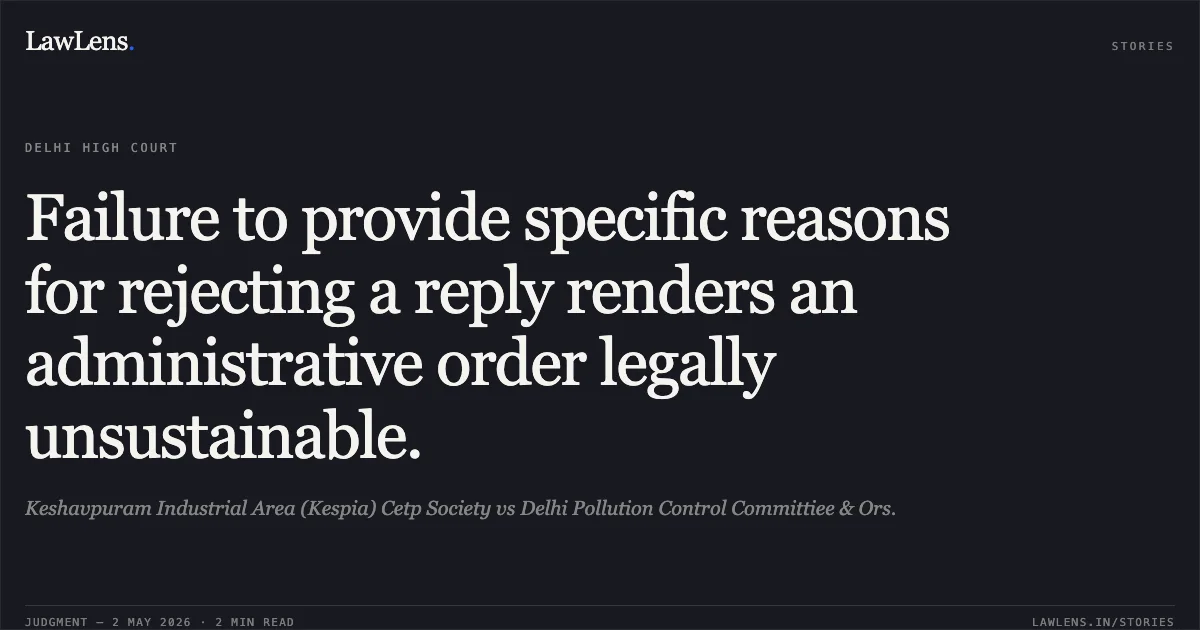
The Court observed that the DPCC’s orders were "mechanical and cryptic," merely recording that a reply was filed and deemed unsatisfactory without explaining why.
Source reference: para. 4-5, 7The Court reasoned that the requirement to pass a reasoned order is not a mere formality but an essential safeguard to ensure transparency, fairness, and the "due application of mind".
Source reference: para. 6Without recorded reasons, the petitioners are effectively precluded from seeking further legal remedies because the basis of the adverse decision remains unknown.
Source reference: para. 7The Court concluded that the impugned orders reflected a total non-application of mind, failing the "proper spirit" of compliance required for administrative adjudications.
Source reference: para. 6-7Holding
The Court held that an order lacking reasons is unsustainable in law.
The High Court allowed the writ petitions and set aside the impugned orders dated 07.07.2021, remitting the matters back to the DPCC for reconsideration with liberty to issue fresh Show Cause Notices and pass fresh, reasoned orders.
Source reference: para. 8-9Acts & Sections Cited
1 provisions across 1 statute referred to in this judgment. Linked provisions open on LawLens.
Water (Prevention and Control of Pollution) Act, 19741
Original Court PDF
Keshavpuram Industrial Area (Kespia) Cetp SocietyvsDelhi Pollution Control Committiee & Ors.
Click to open original judgment
Original judgment, available to read, download and summarize on LawLens.in