01Facts
The appellants were among the accused convicted by the Sessions Court for offences including Sections 143, 498-A, 302, 304-B, 201, 109 and 120-B read with Section 149 of the IPC; accused No. 1 was also convicted under Sections 3 and 4 of the Dowry Prohibition Act.
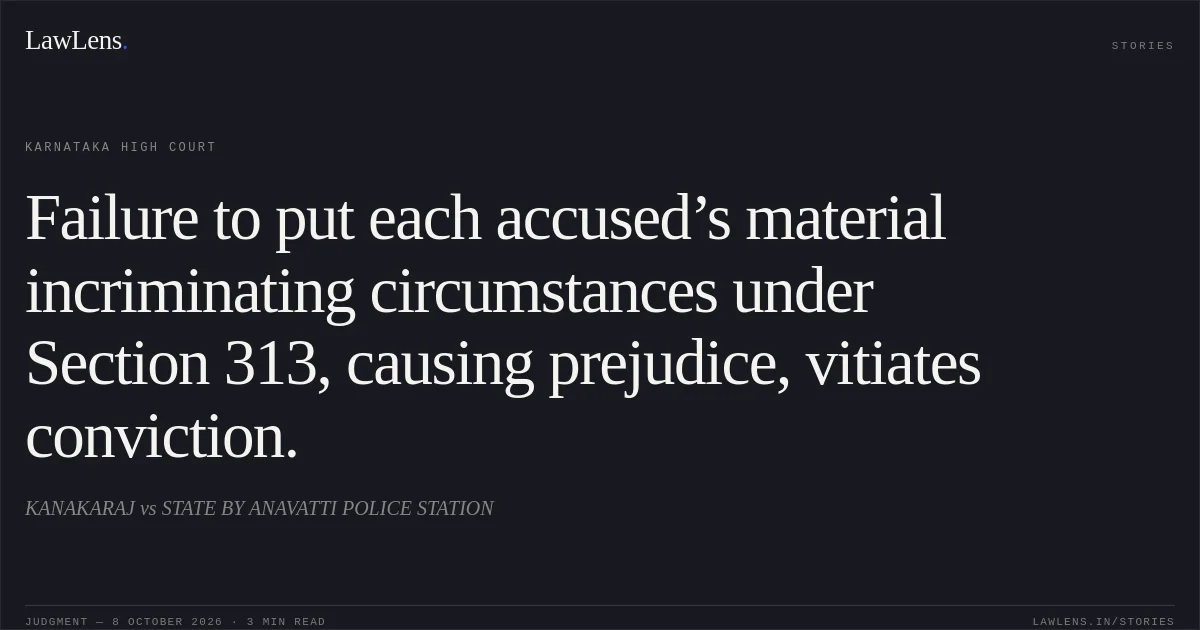
pp. 4–8In their appeals, they challenged, among other things, the framing of charges under both Sections 302 and 304-B IPC and the manner in which their statements under Section 313 Cr.P.C. had been recorded. The High Court found that the prosecution evidence had been put to each accused generally, without separately identifying the material incriminating circumstances relied on against that accused.
pp. 4–8, 1402Issues
i.1. Whether the failure to frame an alternative charge for offences under Sections 302 and 304-B IPC, without more, occasioned a failure of justice or prejudice to the accused
pp. 7–8ii.2. Whether recording the accused persons’ statements under Section 313 Cr.P.C. without putting the material incriminating circumstances to each accused specifically and separately caused prejudice warranting the setting aside of the convictions and remand
pp. 9–1603Law Applied
Under Section 313 Cr.P.C., each material circumstance relied on by the prosecution for conviction must ordinarily be put to the relevant accused specifically, distinctly and separately, so that the accused has a meaningful opportunity to explain it.
pp. 10–13An omission is a serious irregularity and vitiates the trial if it causes prejudice or a failure of justice; if curable, the appellate court may put the omitted circumstances to the accused or, where appropriate, remand the matter for supplementary examination.
pp. 10–13The court applied the principles stated in Rajkumar @ Suman v. State (NCT of Delhi*, (2023) 17 SCC 95, as referred to in Aejaz Ahmad Sheikh v. State of Uttar Pradesh, 2025 SCC OnLine SC 913.
pp. 10–13A defect in framing charges does not, by itself, invalidate a trial; the court must assess whether it caused prejudice or a failure of justice.
pp. 7–8Provisions in the judgment · 9 · Linked ones open on LawLens
Code of Criminal Procedure, 1973 Section 374Section 313
Indian Penal Code, 1860 Section 143Section 302Section 201Section 109Section 149
04Reasoning
The court held that an alternative charge would have been appropriate because Sections 302 and 304-B IPC concern distinct offences, but the charge irregularity alone had not caused a failure of justice: the accused understood the allegations, cross-examined prosecution witnesses and entered their defence.
pp. 7–8The Section 313 defect was more serious. Because the case involved multiple accused and allegations of conspiracy, abetment and liability under Section 149 IPC, the circumstances and alleged roles requiring explanation differed among the accused. Putting the prosecution evidence to them in a general manner did not provide each accused an effective opportunity to respond; the appellate court could not presume what their answers would have been.
pp. 14–16Given the nature of the case, the court considered it appropriate to remit the matter for fresh Section 313 examinations rather than conduct them for the first time on appeal.
pp. 15–1705Holding
The appeals were allowed. The convictions dated 15 February 2019 and sentences dated 1 March 2019 were set aside, and the case was remanded for fresh consideration from the stage of recording each accused’s statement under Section 313 Cr.P.C., with the relevant circumstances to be put individually and distinctly.
pp. 19–21The Sessions Court was directed to proceed in accordance with law and, preferably, conclude the matter within six months; the High Court expressed no view on the merits.
pp. 19–21Accused Nos. 2, 3, 6 and 8 were ordered released on bail subject to conditions imposed by the Sessions Court, while accused Nos. 1, 4 and 5 were to remain on bail on their existing terms.
pp. 17–18, 21Original Court PDF
KANAKARAJvsSTATE BY ANAVATTI POLICE STATION
Click to open original judgment
Original judgment, available to read, download and summarize on LawLens.in