Facts
The petitioner, a trader in ferrous and non-ferrous items, underwent a scrutiny assessment under Section 143(3) of the Income Tax Act, 1961, for A.Y. 2012-13, which concluded on 13.03.2015
Source reference: p. 2During that assessment, the petitioner provided details of "sundry debtors," including transactions with M/s. Shoryaraj Enterprise
Source reference: p. 2On 28.03.2019, nearly six years after the end of the A.Y., the Revenue issued a notice under Section 148 to reopen the assessment based on information from the Investigation Wing alleging that M/s. Shoryaraj Enterprise provided "accommodation entries"
Source reference: p. 3, 6The petitioner objected, noting that the Revenue possessed the statement of the proprietor of Shoryaraj Enterprise (recorded on 20.03.2014) prior to the original assessment and failed to quantify the escaped income
Source reference: p. 5, 9The objections were disposed of by the Revenue on 09.12.2019
Source reference: p. 3Issues
1. Whether the notice for reopening the assessment was valid under Section 149(1)(b) of the Act in the absence of specific quantification of the alleged escaped income exceeding Rs. 1,00,000
Source reference: p. 72. Whether the reopening of assessment constituted a mere "change of opinion" given that the transactions were examined during the original scrutiny assessment
Source reference: p. 5, 9Law Applied
The court applied Section 149(1)(b) of the Income Tax Act, 1961, which mandates that no notice under Section 148 can be issued after four years (but within six years) unless the income chargeable to tax which has escaped assessment is likely to amount to Rs. 1,00,000 or more
Source reference: p. 4, 7It relied on the precedent set by the Allahabad High Court in Mahesh Kumar Gupta v. CIT, which established that the Assessing Officer must explicitly state in the reasons recorded that the escaped income is Rs. 1 Lakh or more to satisfy the sanctioning authority and meet the statutory threshold for the extended limitation period
Source reference: p. 8Reasoning
The court found that the reasons recorded by the Assessing Officer merely listed debit and credit entries and alleged "high value transactions" without quantifying the specific amount of income that escaped assessment
Source reference: p. 7Since the notice was issued beyond the four-year mark, the failure to demonstrate that the escaped income met the Rs. 1,00,000 threshold under Section 149(1)(b) rendered the notice jurisdictionaly defective
Source reference: p. 8Furthermore, the court observed that the Revenue already possessed the incriminating statement of the third-party proprietor in 2014—a year before the original scrutiny assessment was finalized—yet the Assessing Officer chose not to make any additions at that time
Source reference: p. 9The court reasoned that reopening the case on the same facts, after they were previously disclosed and examined, amounted to an impermissible change of opinion, especially since the Revenue failed to explain when exactly the "new" information was received
Source reference: p. 9-10Holding
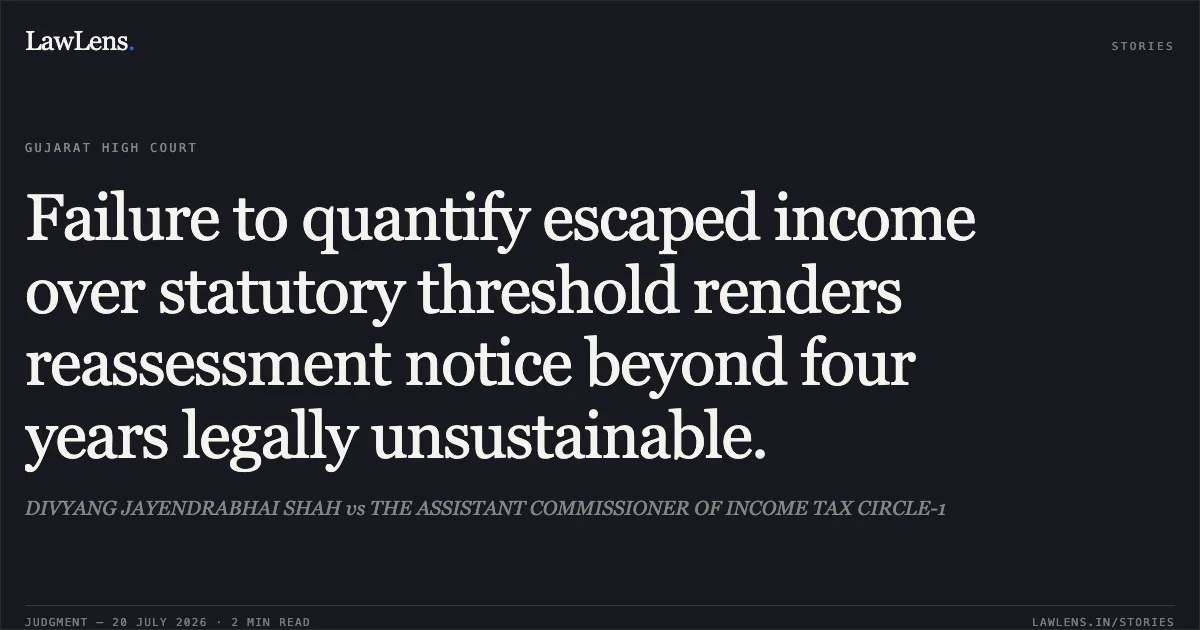
The Court held that the reopening was invalid for lack of quantification as required by Section 149(1)(b) and for being based on a mere change of opinion on facts already on record
The High Court allowed the writ petition and quashed the impugned notice dated 28.03.2019 and the subsequent order dated 09.12.2019
Source reference: p. 10Acts & Sections Cited
5 provisions across 1 statute referred to in this judgment. Linked provisions open on LawLens.
Income Tax Act, 19615
Original Court PDF
DIVYANG JAYENDRABHAI SHAHvsTHE ASSISTANT COMMISSIONER OF INCOME TAX CIRCLE-1
Click to open original judgment
Original judgment, available to read, download and summarize on LawLens.in


