Facts
The complainant alleged that the applicant borrowed ₹4,50,000 in cash as a hand loan and issued two Bank of Baroda cheques of ₹2,00,000 each, dated 25 April 2015 and 25 May 2015, towards repayment.
Source reference: p.2, paras. 2–2.1The cheques were repeatedly presented and dishonoured for “insufficient funds”; a statutory demand notice was thereafter served, but the applicant neither replied nor paid the amount.
Source reference: pp.2–3, paras. 2.1–2.2The complainant instituted proceedings under Section 138 of the Negotiable Instruments Act, 1881 (“NI Act”) in Criminal Case No. 7601 of 2015. The Trial Court convicted the applicant and sentenced him to six months’ simple imprisonment, imposed a fine of ₹2,500, and directed payment of compensation equivalent to the cheque amount.
Source reference: pp.5–6, paras. 7–9The appellate court dismissed Criminal Appeal No. 94 of 2017 and affirmed the conviction.
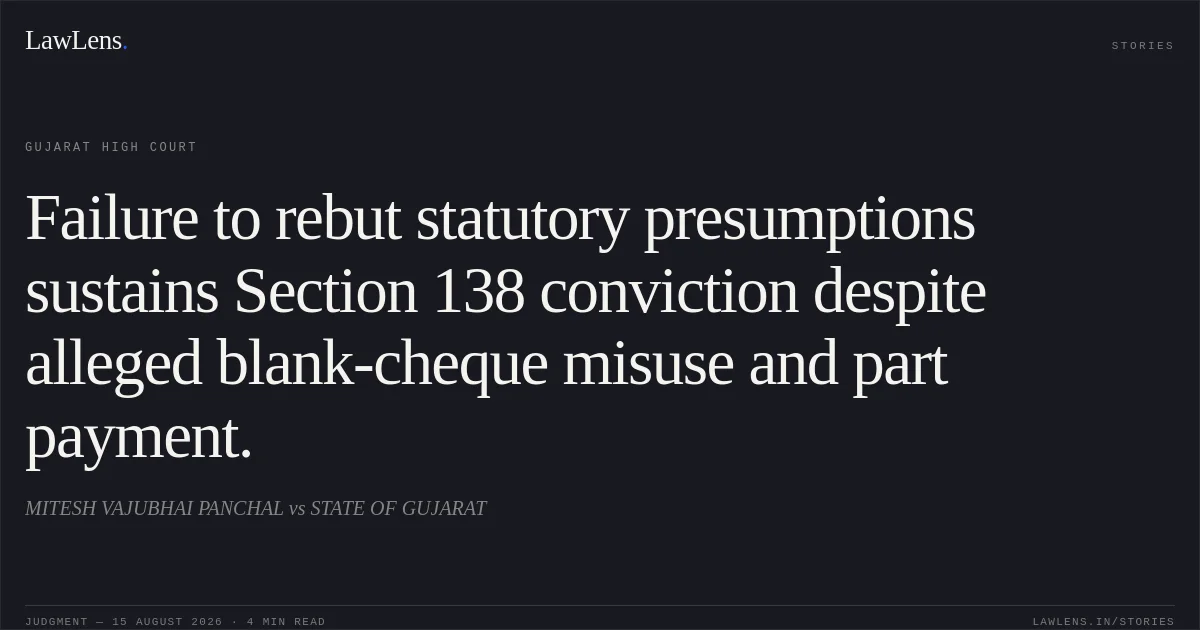
Source reference: p.7, paras. 10–11In revision under Sections 397 and 401 of the Code of Criminal Procedure, 1973, the applicant contended that the cheques were security/blank cheques, that part-payments had been made, and that inconsistencies existed regarding the loan amount and transaction.
Source reference: pp.9–10, para. 14During the revision proceedings, the applicant deposited the cheque amount, which was permitted to be withdrawn by the complainant subject to the outcome of the revision.
Source reference: p.8, para. 12Issues
1. Whether the concurrent findings that the disputed cheques were issued towards a legally enforceable debt or liability and that the offence under Section 138 of the NI Act was established suffered from any illegality, impropriety, or perversity warranting interference in revision.
Source reference: p.14, para. 172. Whether the applicant rebutted the presumptions under Sections 118 and 139 of the NI Act by establishing that the cheques were misused, issued as security/blank cheques, or did not represent the legally enforceable debt because of alleged part-payments and discrepancies in the complainant’s case.
Source reference: pp.15–18, paras. 19–233. Whether the applicant was entitled to relief on the ground that the cheque amount did not correspond with the alleged loan amount and that the statutory demand notice did not validly demand the “said amount” under Section 138 proviso (b).
Source reference: p.13, para. 16Law Applied
Section 138 of the NI Act criminalises dishonour of a cheque issued towards a legally enforceable debt or liability, subject to presentation, issuance of a statutory demand notice, and failure to make payment within 15 days of receipt of notice.
Source reference: p.14, para. 18Sections 118 and 139 create rebuttable presumptions that a cheque was drawn for consideration and received in discharge of a legally enforceable debt or liability once its execution/signature is admitted.
Source reference: pp.14–15, paras. 18–19Sections 20 and 87 of the NI Act recognise the legal effect of an incomplete or blank negotiable instrument delivered with authority; consistent with Bir Singh v. Mukesh Kumar, (2019) 4 SCC 197, a voluntarily signed blank cheque may attract the Section 139 presumption unless cogent evidence rebuts it.
Source reference: p.17, para. 22The Court also applied the principle that the accused may rebut the statutory presumptions on a preponderance of probabilities, but must place a credible defence or supporting material on record.
Source reference: no citationThe revisional jurisdiction under Sections 397 and 401 CrPC is limited and does not ordinarily warrant interference with concurrent findings absent an error of legality, propriety, or perversity.
Source reference: p.14, para. 17Reasoning
Since the applicant did not dispute his signatures or the handing over of the cheques, the presumptions under Sections 118 and 139 of the NI Act arose in favour of the complainant.
Source reference: pp.15–16, paras. 19–20The applicant relied on bank entries showing payments of ₹25,515 and ₹70,000, but the complainant’s admission of those entries did not establish that the payments were made towards the disputed loan transaction; the applicant neither pursued the relevant cross-examination nor produced further evidence connecting them to the liability underlying the cheques.
Source reference: pp.16–17, para. 21The defence of misuse or issuance of blank cheques was also unsupported by cogent evidence and therefore did not rebut the statutory presumption, particularly in light of Bir Singh.
Source reference: p.17, paras. 22–23The alleged inconsistencies concerning the cash withdrawals, the loan amount of ₹4,50,000, and the cheque claim of ₹4,00,000 were insufficient to dislodge the presumption or demonstrate that no legally enforceable liability existed.
Source reference: no citationThe dishonour of the cheques, service of the statutory notice, failure to pay within the prescribed period, and absence of a credible rebuttal established the ingredients of Section 138.
Source reference: p.18, para. 23Consequently, no perversity or legal infirmity was found in the concurrent judgments of the courts below warranting revisional interference.
Source reference: p.18, para. 24Holding
The Gujarat High Court dismissed the revision application and confirmed the judgments dated 25 March 2019 and 19 August 2017 convicting the applicant under Section 138 of the NI Act.
The applicant was directed to surrender before the concerned Magistrate to undergo the sentence of six months’ simple imprisonment.
Source reference: p.18, para. 24As the cheque amount had already been deposited and released to the complainant pursuant to the interim orders, no further direction regarding that amount was made.
Source reference: p.18, para. 24After pronouncement, the time for surrender was extended by six weeks from 14 August 2026.
Source reference: p.19, Further OrderActs & Sections Cited
11 provisions across 2 statutes referred to in this judgment. Each provision opens on LawLens.
Code of Criminal Procedure, 19736
Negotiable Instruments Act, 18815
Original Court PDF
MITESH VAJUBHAI PANCHALvsSTATE OF GUJARAT
Click to open original judgment
Original judgment, available to read, download and summarize on LawLens.in