Facts
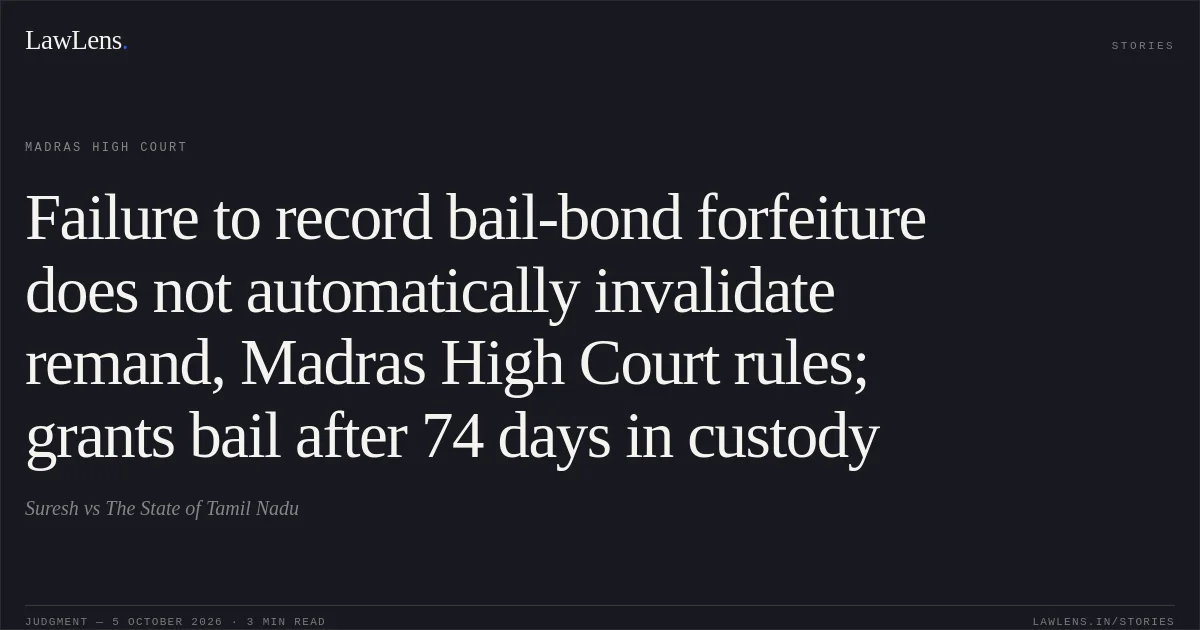
Following his arrest in Crime No. 27 of 2025, the petitioner was granted bail on 20 February 2025. After the case was taken on file as Spl.S.C.No.10 of 2025, he failed to appear, and the Special Court issued a Non-Bailable Warrant on 17 March 2026. The warrant was executed on 20 July 2026, and the petitioner was remanded to judicial custody.
Source reference: para. 2–4His subsequent bail application was dismissed; he withdrew an appeal against that dismissal with liberty to challenge the remand order. He then invoked Section 528 of the BNSS, contending that the remand was unlawful because the earlier bail had not been cancelled and the prescribed procedure for addressing his absence had not been followed.
Source reference: para. 2–4At the time of decision, he had been in custody for nearly 74 days.
Source reference: para. 20Issues
Whether the remand order was illegal or without jurisdiction because the trial court did not separately cancel the earlier bail order or expressly record the petitioner’s explanation, its reasons for rejecting it, and a finding of forfeiture of the bond.
Source reference: para. 4, 17–19Whether, despite declining to set aside the remand order, the High Court could order the petitioner’s release on bail under Section 528 BNSS, having regard to his period of custody and the circumstances of the case.
Source reference: para. 22–24Law Applied
Section 478(2) BNSS permits refusal of bail to an accused who has failed to comply with the attendance conditions of a bond, even in a bailable case; Sections 491 and 492 BNSS address bond forfeiture and cancellation following breach.
Source reference: para. 8, 15Under Pillappan @ Ravikumar v. State, 2018 (3) CTC 156, the accused should be given an opportunity to explain non-appearance and the court should consider that explanation and address forfeiture; however, omission to record those steps does not, by itself, render a subsequent remand void, and separate cancellation of the original bail order is not a prerequisite to remand.
Source reference: para. 10, 13–14, 17Talab Haji Hussain v. Madhukar Purshottam Mondkar, AIR 1958 SC 376, and Rasiklal v. Kishore, (2009) 4 SCC 446, establish that an earlier grant of bail does not entitle an accused to disregard attendance obligations and that breach may affect subsequent release.
Source reference: para. 6–7Section 528 BNSS preserves the High Court’s inherent jurisdiction to prevent abuse of process and secure the ends of justice, but it is not a substitute for ordinary bail or statutory appellate remedies.
Source reference: para. 22Reasoning
The petitioner had been granted bail, failed to appear, and was produced before the trial court after execution of an NBW. The Court held that the absence of a separate order cancelling bail, or of express findings in the remand order concerning the petitioner’s explanation and bond forfeiture, did not make the remand void: although the procedure in Pillappan ought to have been followed, neither that decision nor statute made such an omission fatal to the remand.
Source reference: para. 17–19Nevertheless, the petitioner had already spent nearly 74 days in custody, his presence had been secured, and further detention should not become punitive. In these particular circumstances, requiring another bail application and a possible further appeal would prolong custody without useful purpose; the Court therefore exercised its inherent jurisdiction to grant conditional bail.
Source reference: para. 20–24Holding
The Court declined to set aside the remand order but ordered the petitioner’s release on bail upon executing a bond of ₹25,000 with two sureties for the like sum.
Conditions included reporting to the trial court at 10:30 a.m. on every working day, not tampering with evidence or influencing witnesses, and not absconding; further consequences were specified for breach.
Source reference: para. 24–27The Criminal Original Petition was disposed of accordingly.
Source reference: para. 27Acts & Sections Cited
11 provisions across 4 statutes referred to in this judgment. Each provision opens on LawLens.
Bharatiya Nagarik Suraksha Sanhita, 20234
Bharatiya Nyaya Sanhita, 20234
Information Technology Act, 20001
Code of Criminal Procedure, 19732
Original Court PDF
SureshvsThe State of Tamil Nadu
Click to open original judgment
Original judgment, available to read, download and summarize on LawLens.in