Facts
The plaintiffs, daughters of Arera Devappa, sued in 1989 for partition and separate possession of family properties, alleging that the properties remained joint.
Source reference: para. 4–9Defendant No. 6 pleaded that the male family members had partitioned the properties in 1966 and 1974, followed by registered deeds, and that the plaintiffs knew of the partitions and separate enjoyment.
Source reference: para. 4–9He also pleaded that the husband of plaintiff No. 1 had participated in or attested the relevant transactions.
Source reference: para. 4–9The Trial Court dismissed the suit, holding it barred by limitation; the First Appellate Court reversed and granted the plaintiffs shares.
Source reference: para. 4–9The legal representatives of defendant No. 6 brought this second appeal.
Source reference: para. 4–9Issues
Whether the First Appellate Court was justified in granting the daughters equal shares in the joint-family properties
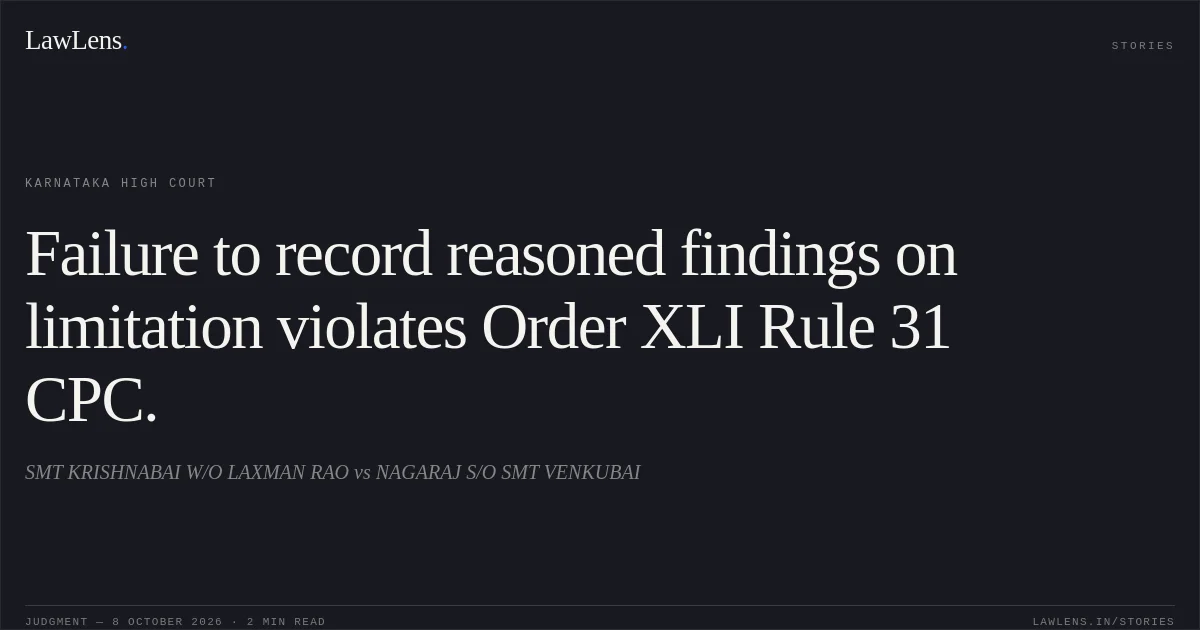
Source reference: para. 10Whether the First Appellate Court, in reversing the Trial Court, was required under Order XLI Rule 31 CPC to give independent, reasoned findings on limitation, and whether its failure to do so invalidated its judgment?
Source reference: para. 11Law Applied
Order XLI Rule 31 of the Code of Civil Procedure, 1908 requires a first appellate court to state the points for determination and provide reasoned findings on them.
Source reference: no citationThe court applied the established rule that a co-heir’s exclusive possession alone does not establish ouster; ouster requires clear and unequivocal assertion of hostile title and exclusive possession brought to the knowledge of the other co-heir, as explained in P. Lakshmi Reddy v. L. Lakshmi Reddy, AIR 1957 SC 314.
Source reference: para. 27The court also referred to Section 114, illustration (g), of the Indian Evidence Act, 1872, concerning adverse inferences from a party’s failure to testify.
Source reference: para. 32The court also noted that, upon a male coparcener’s death, succession to his interest was governed by the Hindu Succession Act, 1956, including Section 8 as applicable.
Source reference: para. 17Reasoning
The High Court found that the evidence, considered cumulatively, supported the defence of partition, separate possession and open assertion of exclusive ownership.
Source reference: para. 20–29, 35It relied on the partition arrangements and registered documents, subsequent alienations, construction and development, separate municipal assessments, and admissions in the evidence; it also noted that plaintiff No. 1’s husband had participated in or attested relevant transactions.
Source reference: para. 20–29, 35Plaintiff No. 1 did not testify, and the court drew an adverse inference in light of the material bearing on her knowledge and conduct.
Source reference: para. 30–32On that evidence, the court concluded that the plaintiffs had constructive knowledge of the partitions and that the suit, filed in 1989 to reopen the arrangements, was barred by limitation.
Source reference: para. 41It further held that the First Appellate Court had failed to give the required reasoned consideration to limitation and had erroneously assessed material evidence.
Source reference: para. 11–12, 41Holding
The High Court answered the additional substantial question of law in the affirmative, holding that the First Appellate Court’s failure to record specific, reasoned findings on limitation contravened Order XLI Rule 31 CPC.
The original substantial question concerning the daughters’ shares did not survive for consideration.
Source reference: para. 42The second appeal was allowed; the First Appellate Court’s decree was set aside, the Trial Court’s dismissal of the suit was restored, and no order as to costs was made.
Source reference: para. 43–44Acts & Sections Cited
2 provisions across 2 statutes referred to in this judgment. Each provision opens on LawLens.
Code of Civil Procedure, 19081
Hindu Succession Act, 19561
Original Court PDF
SMT KRISHNABAI W/O LAXMAN RAOvsNAGARAJ S/O SMT VENKUBAI
Click to open original judgment
Original judgment, available to read, download and summarize on LawLens.in