Facts
The complainant alleged that the petitioners induced him to enter into a sports-business partnership and advanced a total of ₹35 lakh to petitioner No. 1.
Source reference: para. 2–6The petitioners allegedly executed promissory notes and later issued cheques towards repayment; one cheque was dishonoured.
Source reference: para. 2–6The complainant also alleged that, when he demanded repayment, the petitioners assaulted and threatened him.
Source reference: para. 2–6Following investigation, a charge sheet was filed for offences under Sections 419, 420, 323 and 506 read with Section 34 IPC, and the Magistrate took cognizance.
Source reference: para. 6The petitioners sought to quash the proceedings under Section 482 CrPC, contending that the dispute was civil, the complaint was retaliatory, and the allegations lacked sufficient particulars.
Source reference: para. 7–10, 15–16The complainant had also pursued a money suit, which resulted in an ex parte decree, and a proceeding under Section 138 of the Negotiable Instruments Act, which ended in the accused’s acquittal.
Source reference: para. 21Issues
1. Whether the allegations concerning the loan, promissory notes and cheques disclosed the offences of cheating or cheating by personation, or were essentially part of a civil dispute.
Source reference: para. 16, 232. Whether the allegations of assault and criminal intimidation were sufficiently particularised to justify continuation of proceedings under Sections 323 and 506 IPC.
Source reference: para. 16, 243. Whether, in the circumstances, continuation of the criminal proceedings would amount to an abuse of process warranting exercise of the High Court’s inherent jurisdiction under Section 482 CrPC.
Source reference: para. 16, 21–22, 25Law Applied
Section 482 CrPC empowers the High Court to quash proceedings where continuation would amount to an abuse of process or where the complaint does not disclose the ingredients of an offence.
Source reference: para. 17–20Under Sections 419 and 420 IPC, cheating by personation requires impersonation, while cheating under Section 420 requires dishonest inducement and dishonest intention at the inception of the transaction; mere breach of contract, non-repayment or dishonour of a cheque does not, without more, establish that offence.
Source reference: para. 23The Court relied on V.Y. Jose v. State of Gujarat, (2009) 3 SCC 78, and Mohd. Ibrahim v. State of Bihar, (2009) 8 SCC 751, for the distinction between civil disputes and criminal offences, while recognising that a dispute may have both civil and criminal aspects.
Source reference: para. 17, 19It also relied on All Cargo Movers (I) (P) Ltd. v. Dhanesh Badarmal Jain, (2007) 14 SCC 776, and Mohd. Wajid v. State of U.P., (2023) 20 SCC 219, regarding consideration of admitted documents and surrounding circumstances when assessing mala fides or abuse of process.
Source reference: para. 18, 20–21The Court further applied Paramjeet Batra v. State of Uttarakhand, (2013) 11 SCC 673, on quashing criminal proceedings arising from civil transactions to prevent abuse of process.
Source reference: para. 22The Court further applied Ghanshyam Soni v. State (Govt. of NCT of Delhi), 2025 SCC OnLine SC 1301, concerning vague allegations lacking particulars such as time, date and place.
Source reference: para. 24Reasoning
The Court treated the transaction as a financial and business dispute involving promissory notes and subsequent cheques.
Source reference: para. 23Those documents indicated an asserted monetary liability, but the material did not prima facie show that the petitioners intended to deceive the complainant from the outset; later non-payment or dishonour was insufficient to establish Section 420 IPC.
Source reference: para. 23The complaint alleged no impersonation, so the essential basis for Section 419 IPC was absent.
Source reference: para. 23Although the allegations of assault and threats could, in substance, relate to Sections 323 and 506 IPC, the Court found them deficient in particulars concerning the time and place of the incident.
Source reference: para. 24In considering whether the proceedings were abusive, the Court also noted the complainant’s pursuit of civil and NI Act remedies and the broader circumstances of the dispute.
Source reference: para. 21–22Holding
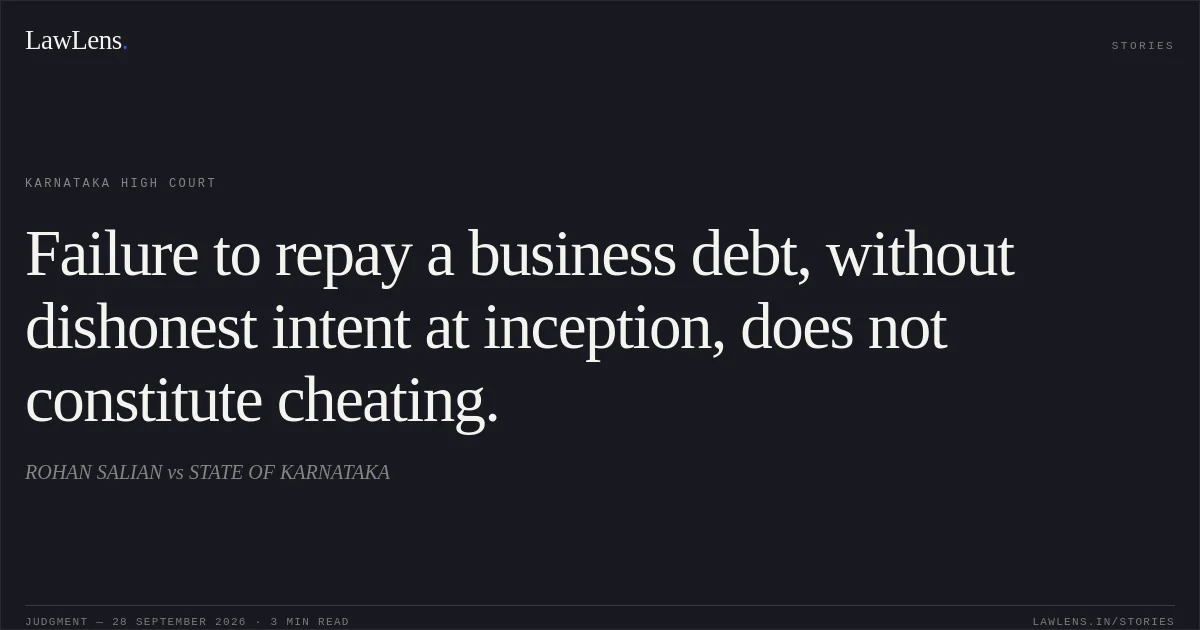
The Court allowed the petition and quashed the proceedings in C.C. No. 51763/2018 before the XI Additional Chief Metropolitan Magistrate, Bengaluru, for offences under Sections 419, 420, 323 and 506 read with Section 34 IPC.
Acts & Sections Cited
11 provisions across 3 statutes referred to in this judgment. Each provision opens on LawLens.
Indian Penal Code, 1860
Code of Criminal Procedure, 19731
Negotiable Instruments Act, 18811
Original Court PDF
ROHAN SALIANvsSTATE OF KARNATAKA
Click to open original judgment
Original judgment, available to read, download and summarize on LawLens.in
![Omission from service records alone cannot defeat a widow’s claim for compassionate-appointment consideration.. SMT ARISHI DEVI vs ORDNANCE FACTORY. CAT - ['Allahabad']. LawLens](/stories/thumbnails/omission-from-service-records-alone-cannot-defeat-a-widows-claim-for-compassionate-appoint-885232d4acd04973bf42ec35220c8374.webp)
![Compassionate appointment claims must receive a third consideration when previously considered only twice.. LALIT SHARMA vs D/o Post. CAT - ['Allahabad']. LawLens](/stories/thumbnails/compassionate-appointment-claims-must-receive-a-third-consideration-when-previously-consid-7df116bb81b1454bab2ecaddec606237.webp)
![Recovery of excess pay from Group C employees is impermissible absent fraud or misrepresentation.. Nand Kishor vs Ordnance Factory. CAT - ['Allahabad']. LawLens](/stories/thumbnails/recovery-of-excess-pay-from-group-c-employees-is-impermissible-absent-fraud-or-misrepresen-88f70f12f14a4437aa66e43a832afa9a.webp)