Facts
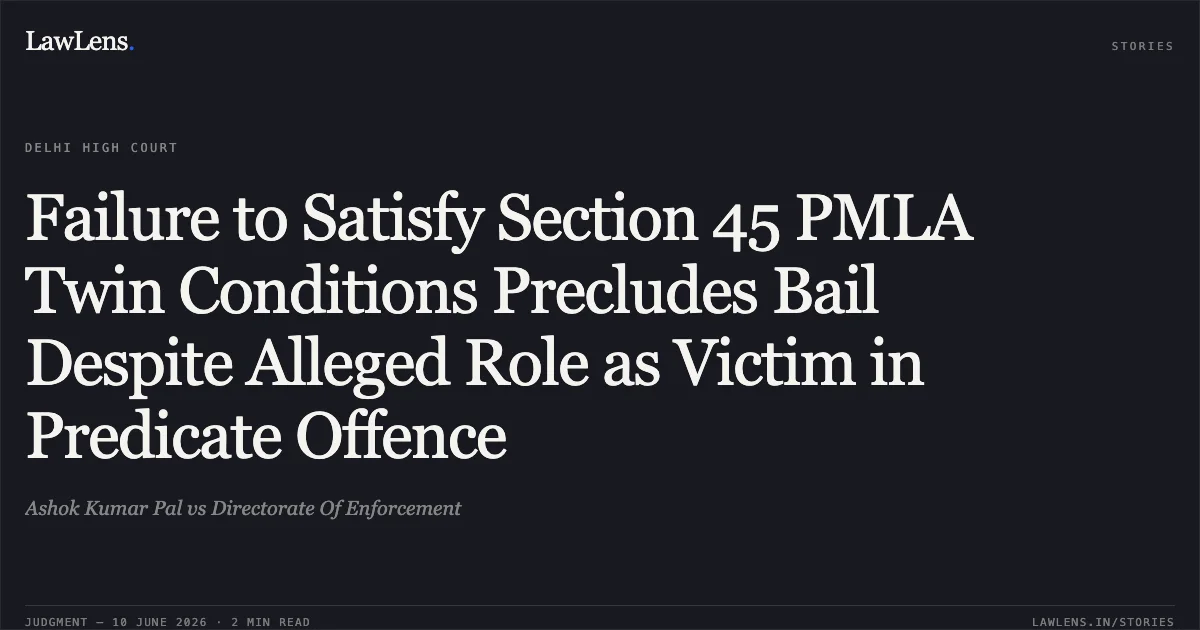
The Petitioner, former CFO of Reliance Power Limited (RPL), was arrested on 10.10.2025 by the Directorate of Enforcement (ED) in connection with ECIR/STF/14/2025.
Source reference: para. 3, 9The case originated from FIRs alleging that RPL, through its subsidiary, submitted forged Bank Guarantees (BGs) worth ₹68.20 Crores and fabricated SBI endorsements to the Solar Energy Corporation of India (SECI) for a tender.
Source reference: para. 6-7The ED alleged that ₹11.73 Crores constituted proceeds of crime channeled via agreements executed by the Petitioner.
Source reference: para. 21-22The Petitioner contended he was a victim of fraud by a third-party agent (BTPL) and had himself lodged the initial police complaint.
Source reference: para. 7, 14After the Trial Court dismissed his bail plea on 11.03.2026, he moved the High Court for regular bail.
Source reference: para. 11-12Issues
1. Whether the Petitioner satisfied the "twin conditions" for bail under Section 45 of the Prevention of Money Laundering Act (PMLA), 2002.
Source reference: para. 292. Whether the continued detention of the Petitioner for over eight months, considering the trial had not commenced, entitled him to bail on grounds of "pre-trial punishment".
Source reference: para. 13, 39Law Applied
The Court applied Section 45 of the PMLA, which mandates that bail can only be granted if there are "reasonable grounds" to believe the accused is not guilty and is unlikely to commit any offence while on bail.
Source reference: para. 29The Court acknowledged the burden of proof under Section 24 of the PMLA regarding proceeds of crime.
Source reference: para. 25The Court referenced Vijay Madanlal Choudhary v. Union of India regarding the constitutionality of Section 45.
Source reference: para. 25The Court referenced Pankaj Bansal v. Union of India regarding the requirements for a valid arrest.
Source reference: para. 17The Court noted the admissibility of statements recorded under Section 50 of the PMLA at the bail stage as per Rohit Tandon v. Directorate of Enforcement.
Source reference: para. 24Reasoning
The Court examined the ED’s evidence, specifically Section 50 statements and WhatsApp communications.
Source reference: para. 31-34The ED presented a statement from one Amar Nath Dutta alleging the Petitioner insisted on obtaining a hard copy of a BG despite knowing the issuing bank did not provide them.
Source reference: para. 33Electronic evidence suggested the Petitioner personally suggested modifications to the issuing bank's particulars and provided instructions for forged endorsements.
Source reference: para. 34-35While the Petitioner argued he acted in professional good faith and was the original complainant, the Court held that at the bail stage, it cannot ignore incriminating material or undertake a detailed trial-like appreciation of evidence.
Source reference: para. 38The Court found the electronic trail and statements established a prima facie link to the alleged conspiracy.
Source reference: para. 39Holding
The Court stated it was unable to record a satisfaction that there were reasonable grounds to believe the Petitioner was not guilty of the offence.
The Court dismissed the bail application, holding that the Petitioner failed to satisfy the "twin conditions" under Section 45 of the PMLA.
Source reference: para. 40-41The Court concluded that the period of eight months in custody was not sufficient grounds for bail given the seriousness of the economic offence.
Source reference: para. 25, 39Acts & Sections Cited
9 provisions across 3 statutes referred to in this judgment. Each provision opens on LawLens.
Bharatiya Nagarik Suraksha Sanhita, 20231
Bharatiya Nyaya Sanhita, 20235
Prevention of Money-Laundering Act, 20023
Original Court PDF
Ashok Kumar PalvsDirectorate Of Enforcement
Click to open original judgment
Original judgment, available to read, download and summarize on LawLens.in