Facts
The Plaintiff (Respondent 1) filed a suit for recovery of money claiming she entered into a sale agreement [Ex.A.1] with the 1st Defendant (Appellant) on 20.10.2007 for a total consideration of Rs. 12 Lakhs
Source reference: para 15She alleged payment of an initial advance of Rs. 5 Lakhs, followed by an additional Rs. 1 Lakh on 19.02.2008, recorded via an endorsement on the reverse of the agreement
Source reference: para 15-16Both the Trial Court and First Appellate Court concurrently decreed the suit for the full Rs. 6 Lakhs plus interest
Source reference: para 1, 4.2Issues
1. Whether the findings of the Courts below regarding the genuineness of Ex.A.1 (Sale Agreement) and the endorsement for Rs. 1 Lakh are sustainable in law given the contradictions in oral evidence
Source reference: para 2(i) (vi)2. Whether the Defendant's general denial in the written statement satisfies the requirements of specific denial under the Code of Civil Procedure
Source reference: para 2(iv) 233. Whether the Courts below were justified in casting the burden of proof on the Defendant when the Plaintiff failed to specifically prove the endorsement
Source reference: para 2(iii)Law Applied
The Court primarily applied Order VIII Rules 3, 4, and 5 of the Civil Procedure Code (CPC), which mandate that a defendant must deal specifically with each allegation of fact and not deny them evasively.
Source reference: para 23Specifically, Rule 4 stipulates that in money recovery suits, a defendant must not simply deny receiving a sum but must deny the substance of the receipt or set out how much was received.
Source reference: para 23The Court also applied the principle that in the absence of specific pleadings, evidence cannot be looked into to support a new defense
Source reference: para 25Reasoning
Regarding the Rs. 1 Lakh, the Court found that the Plaintiff failed to mark the endorsement as a separate exhibit or provide a plausible reason why the Defendant signed in both English and Tamil only on the endorsement and not on the main agreement
Source reference: para 16-17As the endorsement was not witnessed and its validity was not properly established by P.W.1 or P.W.3, the Court set aside the recovery for this amount
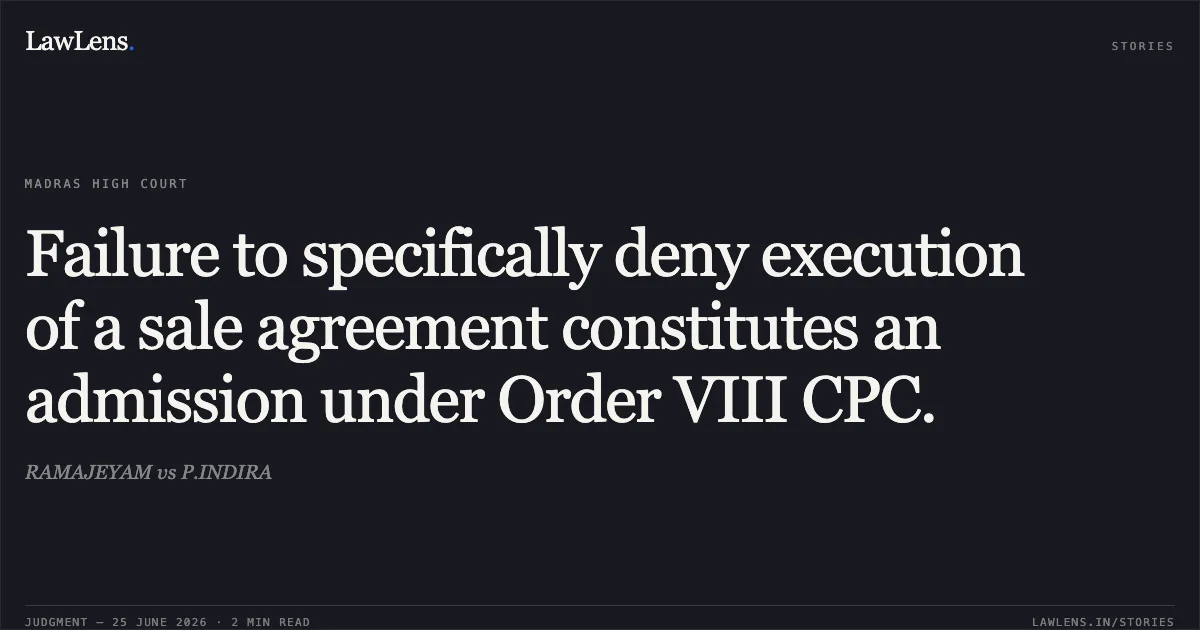
Source reference: para 17-18Regarding the initial Rs. 5 Lakh, the Court emphasized that the Defendant failed to specifically deny the execution of the agreement or receipt of the advance in his written statement
Source reference: para 10, 24Under Order VIII Rules 3-5 of the CPC, this "evasive denial" amounted to an admission by omission
Source reference: para 23-24Consequently, the Defendant could not lead evidence or argue against the genuineness of the core agreement as there was no foundational pleading for such a defense
Source reference: para 25Holding
The High Court partly allowed the Second Appeal. It held that the Plaintiff failed to prove the additional payment of Rs. 1 Lakh
However, it upheld the concurrent findings regarding the initial Rs. 5 Lakh advance due to the lack of specific denial in the Defendant's pleadings
Source reference: para 25The decree was modified to grant the Plaintiff (Respondent 1) a sum of Rs. 5 Lakhs with 6% interest per annum from the date of the plaint until realization, along with proportionate costs
Source reference: para 27Acts & Sections Cited
1 provisions across 1 statute referred to in this judgment. Each provision opens on LawLens.
Code of Civil Procedure, 19081
Original Court PDF
RAMAJEYAMvsP.INDIRA
Click to open original judgment
Original judgment, available to read, download and summarize on LawLens.in


