Facts
The Appellant, the Mahant (Mathadhipathi) of Sri Swamy Hathiramji Mutt, was removed from his office by the Dharmika Parishad via an order dated 24.11.2023.
Source reference: para. 21This followed a 2023 resolution where the Parishad simultaneously decided to frame charges and suspend the Appellant.
Source reference: para. 14An inquiry committee, composed of three members of the Parishad itself, conducted an ex-parte inquiry on 19.07.2023 after purportedly serving the charge memo by affixing it to the Mutt’s door—despite the fact that the State had already physically seized the premises and the Appellant’s residence.
Source reference: para. 15, 31The Appellant’s requests for documents and time to reply were ignored.
Source reference: para. 18-19The High Court of Andhra Pradesh affirmed the removal, finding that the Appellant "must have" had the documents because he provided detailed replies to the show-cause notice.
Source reference: para. 22Issues
1. Whether the proceedings culminating in the removal order suffered from a breach of the principles of natural justice due to non-supply of documents and lack of reasonable opportunity.
Source reference: para. 262. Whether the inquiry conducted by members of the adjudicating body (Dharmika Parishad) violated the principle of nemo judex in causa sua.
Source reference: para. 24.6, 35Law Applied
The Court applied Section 51 of the Andhra Pradesh Charitable and Hindu Religious Institutions and Endowments Act, 1987, which mandates a fair opportunity to meet charges, test evidence, and adduce evidence before a Mathadhipathi is removed.
Source reference: para. 29It relied on the constitutional guarantee of audi alteram partem under Article 14, as interpreted in Canara Bank v. V. K. Awasthy, emphasizing that notice must be precise and provide adequate time for representation.
Source reference: para. 27The Court cited Kashinath Dikshita v. Union of India to establish that non-supply of relied-upon documents vitiates an inquiry.
Source reference: para. 28Additionally, it invoked Article 142 of the Constitution to provide a "supplementary" remedy where statutory frameworks are structurally unfit to provide justice, as seen in BCCI v. Cricket Association of Bihar.
Source reference: para. 43-44Reasoning
The Court found the service of the charge memo by affixation "legally absurd" because the State had already dispossessed the Appellant of the premises; thus, he could not be presumed to have seen the notice.
Source reference: para. 31-32It rejected the "prejudice" argument, holding that Section 51(2) is a mandatory public interest provision that requires substantive compliance.
Source reference: para. 30The Court observed that the Dharmika Parishad showed "apparent bias" through a pre-decisional resolution to remove the Appellant before charges were even framed.
Source reference: para. 14, 36, 37Furthermore, the Court critiqued Rule 26 of the 2009 Rules, noting that using members of the adjudicating Parishad to act as investigators created an inherent conflict of interest.
Source reference: para. 35The High Court’s appellate review was deemed flawed for assuming the Appellant had documents merely because he attempted a "minute" rebuttal without them.
Source reference: para. 34Holding
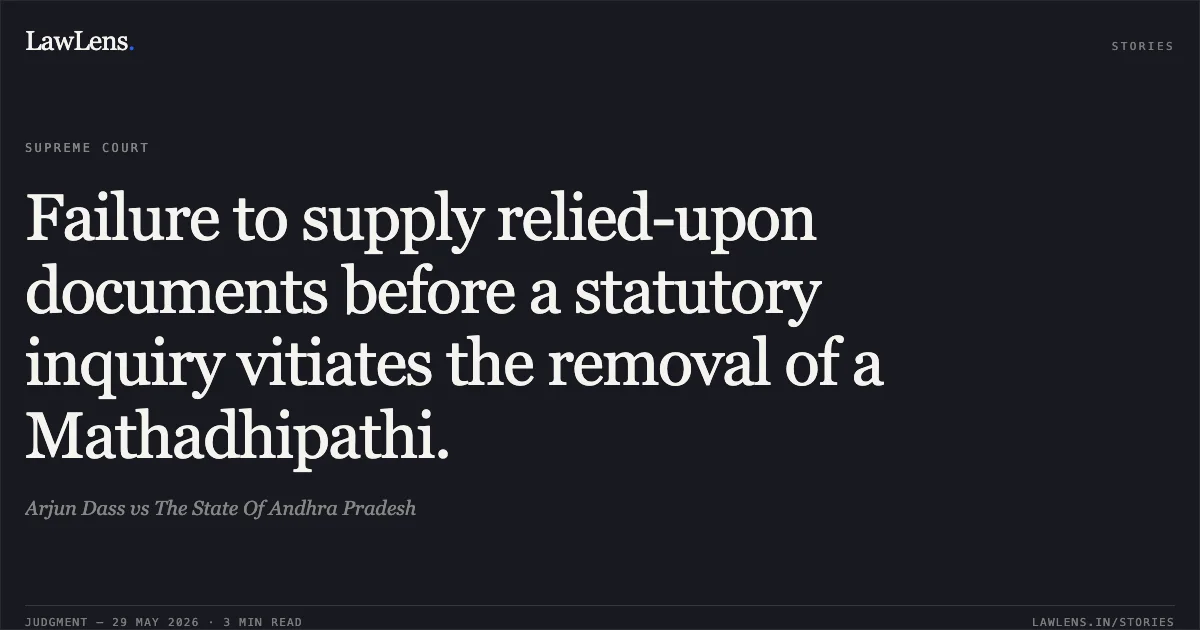
The Supreme Court held that the entire process was "coram non judice" and pre-determined.
The Supreme Court allowed the appeal, setting aside the High Court judgment and the removal order. Exercising its plenary powers under Article 142, the Court appointed a one-man independent inquiry committee (a retired District Judge) to conduct a de novo inquiry and a six-member Administrative Committee (chaired by a retired High Court Judge) to supervise the Mutt’s secular affairs in the interim. The Appellant was restored to his office as Mathadhipathi with directions to cooperate with the committees and refrain from alienating property.
Source reference: para. 48, 49-51, 53, 54Acts & Sections Cited
8 provisions across 2 statutes referred to in this judgment. Each provision opens on LawLens.
Andhra Pradesh Charitable and Hindu Religious Institutions and Endowments Act, 1987.7
Code of Civil Procedure, 19081
Original Court PDF
Arjun DassvsThe State Of Andhra Pradesh
Click to open original judgment
Original judgment, available to read, download and summarize on LawLens.in


