01Facts
The parties married on 12.06.2010 but faced matrimonial discord primarily due to their inability to conceive despite prolonged fertility treatments
¶ 3The respondent-husband instituted a divorce petition under Section 13(1)(ia) and (ib) of the Hindu Marriage Act (HMA), alleging mental cruelty and desertion, claiming the wife humiliated him regarding his fertility
¶ 5, 14The appellant-wife alleged dowry demands, physical assault, and coercion for his second marriage, leading to her filing Mahila P.S. Case No. 20 of 2018 (Sections 498A, 307 IPC)
¶ 4The Family Court, Rohtas, granted the divorce on 19.03.2021
¶ 1During the pendency of this appeal, the husband was acquitted of all criminal charges by the High Court
¶ 8he contracted a second marriage before the expiry of the appeal limitation period
¶ 10802Issues
i.1. Whether the respondent established "cruelty" and "desertion" under Section 13(1)(ia) and (ib) of the HMA
¶ 10ii.2. Whether the acquittal in the criminal case (Section 498A/307 IPC) impacts the determination of matrimonial cruelty
¶ 10iii.3. Whether the husband’s remarriage during the pendency of the appeal affects the maintainability of the appeal or the validity of the decree
¶ 10iv.4. Whether the wife is entitled to permanent alimony under Section 25 of the HMA
¶ 19103Law Applied
The court applied Section 13(1)(ia) (Cruelty) and 13(1)(ib) (Desertion) of the HMA, interpreting "mental cruelty" per Samar Ghosh v. Jaya Ghosh [(2007) 4 SCC 511], which emphasizes the cumulative impact of conduct
¶ 69It relied on Mangayakarasi v. M. Yuvaraj [(2020) 3 SCC 786] regarding false criminal proceedings as cruelty
¶ 70For desertion, it applied the dual test of factum deserdendi and animus deserendi from Bipinchandra Jaisinghbhai Shah v. Prabhavati [AIR 1957 SC 176]
¶ 92Section 15 of the HMA and Anurag Mittal v. Shaily Mishra Mittal [(2018) 9 SCC 691] were applied to hold that remarriage during an appeal is subject to the appeal’s outcome
¶ 112, 129Section 25 HMA and Rajnesh v. Neha [(2021) 2 SCC 324] governed the determination of permanent alimony
¶ 195Provisions in the judgment · 6 · Linked ones open on LawLens
Family Courts Act, 1984 Section 19
Hindu Marriage Act, 1955 Section 13Section 15Section 25Section 28
Indian Penal Code, 1860 Section 307
04Reasoning
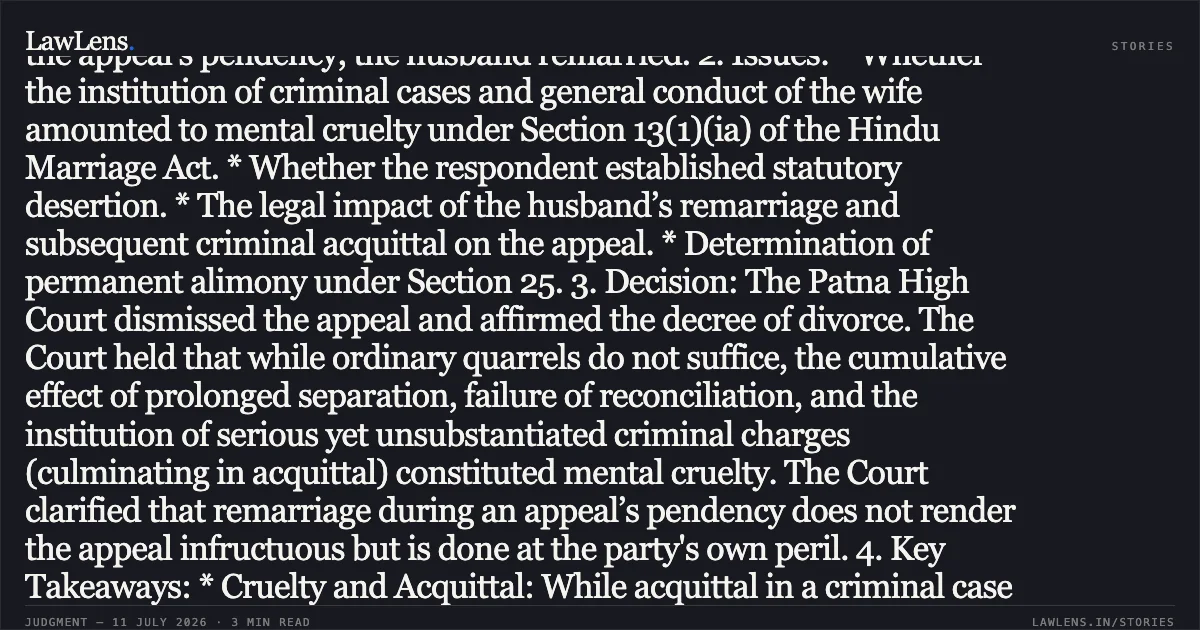
The Court found that while infertility itself is not a ground for divorce, the resulting emotional strain led to a complete breakdown of trust
¶ 74The Court observed that the wife’s institution of a criminal case involving serious charges (Section 307 IPC), which ended in a reasoned acquittal, caused significant mental agony and social damage to the husband, constituting mental cruelty
¶ 151-157Regarding remarriage, the Court held that since the husband remarried before the appeal period expired, he did so at his own peril under Section 15 of the HMA; however, this did not bar the Court from upholding the divorce on its merits
¶ 132-135On desertion, the Court found the evidence inconclusive regarding unilateral abandonment but held that the decree was independently sustainable on the ground of cruelty
¶ 167-168considering the husband’s monthly income of ₹86,900 and his assets, the Court applied a "one-third" rule to determine just alimony
¶ 20105Holding
The Court dismissed the Miscellaneous Appeal and affirmed the decree of divorce dated 01.04.2021 on the ground of cruelty
¶ 186-187It held that the husband's remarriage did not render the appeal infructuous but was a violation of the statutory period under Section 15
¶ 133Under Section 25 HMA, the Court directed the respondent-husband to pay the appellant-wife a total of ₹34,76,000/- as permanent alimony in two equal installments within 75 days
¶ 201-203Original Court PDF
Sunita PandayvsBinod Kumar Panday
Click to open original judgment
Original judgment, available to read, download and summarize on LawLens.in