Facts
The petitioner’s parents had purchased Plot No. G-3/20, Phase-I, DLF City, Gurugram, through a sale deed dated 21 September 1994.
Source reference: pp. 2–6; paras. 1–4The petitioner allegedly represented to the complainant that he had become the exclusive owner of the property pursuant to a relinquishment deed executed by his sisters, and agreed to sell it for ₹5,55,11,000.
Source reference: pp. 2–6; paras. 1–4The complainant paid ₹41,00,000 by cash and cheque.
Source reference: pp. 2–6; paras. 1–4When the complainant subsequently verified the title, the property was found to remain in the petitioner’s father’s name, and the petitioner’s sisters denied executing the alleged relinquishment deed.
Source reference: pp. 2–6; paras. 1–4An FIR was registered under Section 420 IPC, and although Sections 406, 467 and 471 IPC were initially invoked, only the Section 420 charge remained.
Source reference: pp. 2–6; paras. 1–4After investigation, the petitioner sought discharge under Section 239 CrPC, corresponding to Section 262 BNSS, but the Judicial Magistrate dismissed the application and framed a charge under Section 420 IPC on 7 March 2026.
Source reference: pp. 2–6; paras. 1–4Issues
Whether the material collected during investigation disclosed a prima facie case or strong suspicion against the petitioner for the offence of cheating under Section 420 IPC, such that the charge could not be considered groundless.
Source reference: pp. 6–8, 10–11; paras. 8–11Whether the petitioner’s defence—that the dispute was civil in nature, the complainant had failed to arrange the balance consideration, and the alleged relinquishment deed was not the basis of the transaction—could be accepted at the stage of discharge.
Source reference: pp. 9–11; paras. 12–14Whether the Magistrate erred in dismissing the discharge application and framing the charge under Section 420 IPC.
Source reference: p. 12; para. 15Law Applied
Section 262 BNSS, corresponding to Section 239 CrPC, requires discharge only where the charge is found to be groundless after considering the police report and accompanying material.
Source reference: pp. 5–6; para. 8At the discharge or charge-framing stage, the court may sift and weigh the material for the limited purpose of determining whether a prima facie case or strong suspicion exists, but it must not conduct a mini-trial, undertake detailed appreciation of evidence, or assess the probable outcome of the prosecution.
Source reference: pp. 6–8; para. 10This principle was drawn from Union of India v. Prafulla Kumar Samal, (1979) 3 SCC 4; P. Vijayan v. State of Kerala, (2010) 2 SCC 398; State of Gujarat v. Dilipsinh Kishorsinh Rao, 2023 SCC OnLine SC 1294; State of Maharashtra v. Som Nath Thapa, (1996) 4 SCC 659; State of M.P. v. Mohan Lal Soni, (2000) 6 SCC 338; and Vishnu Kumar Shukla v. State of Uttar Pradesh, 2024 AIR SC 90.
Source reference: pp. 6–8; para. 10Section 420 IPC applies where deception and dishonest or fraudulent inducement cause the person deceived to deliver property or part with money; whether dishonest intention existed and whether the representation induced payment are ordinarily matters for trial when supported by prima facie material.
Source reference: no citationReasoning
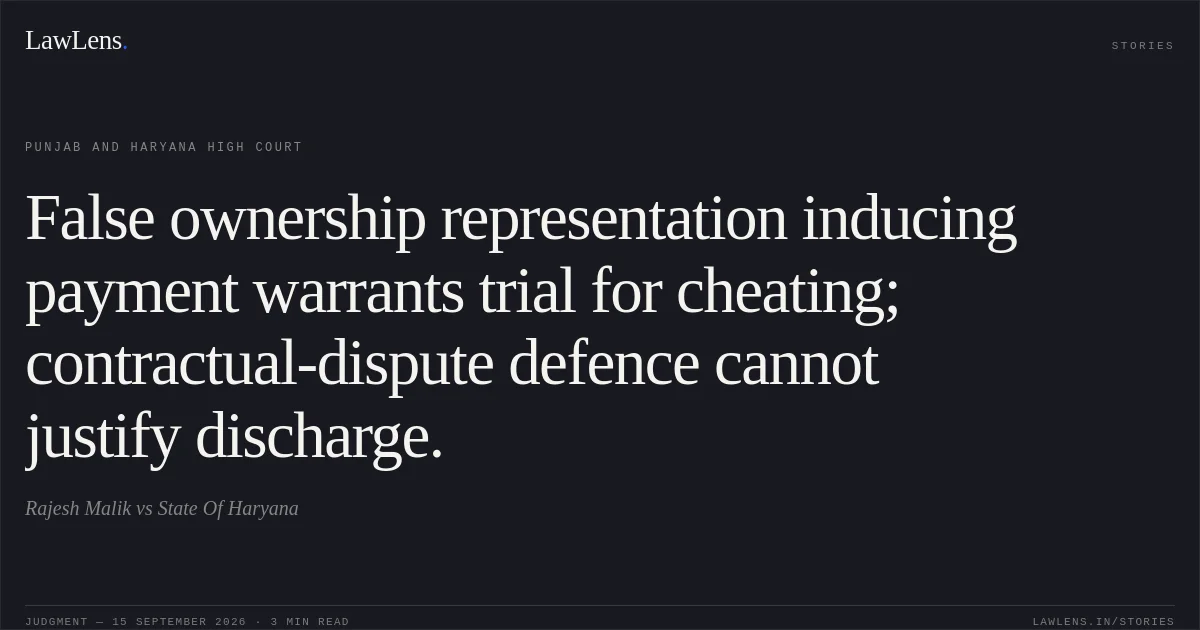
The Court held that the prosecution case was not merely one of failure to perform an agreement to sell.
Source reference: pp. 8–10; paras. 11–12The petitioner was specifically alleged to have represented that he was the exclusive owner of the property, relying on a relinquishment deed whose execution was denied by the persons shown as executants.
Source reference: pp. 8–10; paras. 11–12On that representation, the complainant allegedly entered into the transaction and paid ₹41,00,000.
Source reference: pp. 8–10; paras. 11–12These allegations, considered with the investigation material, prima facie disclosed deception, inducement and delivery of property, thereby warranting a trial under Section 420 IPC.
Source reference: pp. 8–10; paras. 11–12The petitioner’s assertions concerning the complainant’s inability to arrange the balance consideration, extension of the sale-deed date, the complainant’s subsequent agreement with a third party, the affidavits of the petitioner’s sisters, and the deletion of the other offences were treated as matters of defence requiring evidentiary assessment.
Source reference: pp. 9–11; paras. 12–14Accepting those assertions at the discharge stage would amount to weighing rival versions and conducting a mini-trial, which was impermissible.
Source reference: pp. 9–11; paras. 12–14The Court also distinguished the authorities relied upon by the petitioner because, unlike cases involving only subsequent non-performance of a promise, the present allegations concerned a false representation regarding title at the inception of the transaction.
Source reference: pp. 10–11; para. 13Holding
The Court answered the issues against the petitioner.
It held that the charge under Section 420 IPC was not groundless and that the material raised sufficient prima facie suspicion regarding the petitioner’s alleged deception and inducement of the complainant to pay ₹41,00,000.
Source reference: pp. 10–12; paras. 14–15The Magistrate had therefore correctly dismissed the discharge application and framed the charge.
Source reference: p. 12; para. 15Finding no illegality, perversity or irregularity in the impugned order, the High Court dismissed the revision petition.
Source reference: p. 12; para. 15Acts & Sections Cited
7 provisions across 3 statutes referred to in this judgment. Each provision opens on LawLens.
Indian Penal Code, 18604
Code of Criminal Procedure, 19731
Bharatiya Nagarik Suraksha Sanhita, 20232
Original Court PDF
Rajesh MalikvsState Of Haryana
Click to open original judgment
Original judgment, available to read, download and summarize on LawLens.in


![Subsequent exoneration does not retrospectively invalidate a finalized promotion select list.. UNNIKRISHNAN M vs M/o Environment And Forests. CAT - ['Ernakulam']. LawLens](/stories/thumbnails/subsequent-exoneration-does-not-retrospectively-invalidate-a-finalized-promotion-select-li-ce80a0e84f2f4887857271e8b4341c42.webp)