01Facts
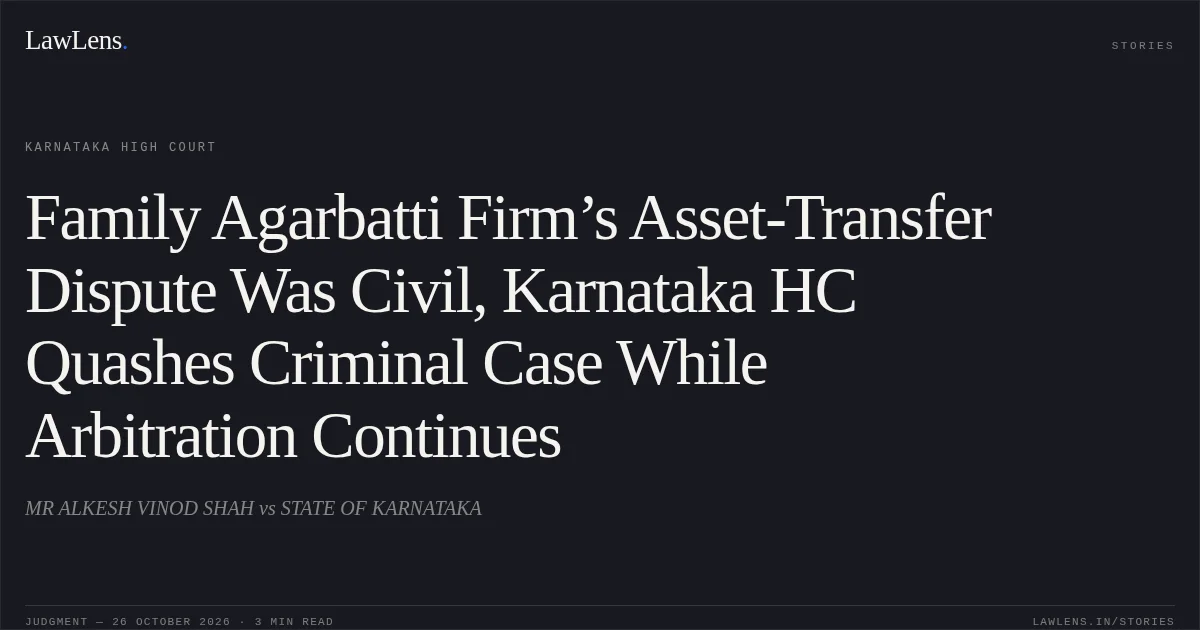
The complainant, a former partner in Shalimar Agarbatti Company, alleged that the accused had conspired to transfer the firm’s business and assets under a Business Transfer Agreement dated 24 January 2018, thereby depriving him of his rights.
pp. 6–8, 11–15The complainant was already pursuing arbitration concerning the firm, including a claim that the Agreement was not binding on him or the firm.
pp. 6–8, 11–15A private complaint led to registration of Crime No. 50 of 2021, later renumbered as Crime No. 7522 of 2021, alleging offences including cheating, criminal breach of trust, forgery and conspiracy.
pp. 16–17Accused No. 4’s petition was granted interim protection, limited to him; police investigation against the other accused continued and resulted in a ‘B’ report.
pp. 17–20The Magistrate rejected that report and took cognizance on 27 December 2023.
pp. 17–20The accused filed petitions seeking to quash the criminal proceedings.
pp. 17–20The Court also noted that six other crimes between the parties had been closed following settlements, while the arbitration remained pending.
p. 2002Issues
i.Whether the allegations, considered alongside the pending arbitration and the nature of the Business Transfer Agreement dispute, disclosed criminal offences or were essentially civil in nature.
pp. 20–21, 47ii.Whether continuation of the FIR and proceedings following rejection of the ‘B’ report and taking of cognizance would constitute an abuse of process warranting the High Court’s inherent jurisdiction.
pp. 18–20, 47–4803Law Applied
The Court exercised its inherent jurisdiction under Section 482 of the Code of Criminal Procedure (and referred to Section 528 of the Bharatiya Nagarik Suraksha Sanhita) to prevent abuse of process and secure the ends of justice.
p. 5Applying State of Haryana v. Bhajan Lal, it considered whether the allegations, taken at face value, disclosed an offence and whether the proceedings were manifestly attended by mala fides or an ulterior purpose.
pp. 28–30, 46–47It also relied on the principles in Indian Oil Corporation v. NEPC India Ltd. and the other Supreme Court authorities discussed in the judgment: a civil or commercial dispute does not, by itself, justify quashing, but criminal proceedings may be quashed where the complaint does not disclose the essential ingredients of an offence or uses criminal process to pursue a civil claim.
pp. 21–47For cheating, dishonest or fraudulent intention must exist when the inducement is made; for criminal breach of trust, entrustment and dishonest misappropriation or use in breach of the relevant obligation must be shown.
pp. 33–43Provisions in the judgment · 22 · Linked ones open on LawLens
Code of Criminal Procedure, 1973 Section 482Section 200Section 156Section 155Section 250
Bharatiya Nagarik Suraksha Sanhita, 2023 Section 528
Indian Penal Code, 1860 14 provisions
Section 379Section 380Section 403Section 405Section 406Section 415Section 417Section 420Section 423Section 467Section 468Section 469Section 470Section 471Negotiable Instruments Act, 1881 Section 138
Arbitration and Conciliation Act, 1996 Section 34
04Reasoning
The Court treated the dispute as arising from the Business Transfer Agreement and the complainant’s claims to the partnership firm’s assets, matters already raised in arbitration.
pp. 20–21, 47–48It concluded that the complaint’s allegations, viewed in that context, did not warrant the use of criminal proceedings to resolve the parties’ commercial and financial claims.
pp. 20–21, 47–48The pending arbitration, the history of related proceedings and settlements, and the absence of a sufficient criminal basis brought the case within the Bhajan Lal categories concerning allegations that do not disclose an offence and proceedings instituted with an ulterior motive.
pp. 20–21, 47–48The Court therefore considered continuation of the prosecution an abuse of process.
pp. 20–21, 47–4805Holding
The Court allowed both criminal petitions.
p. 48It quashed the order dated 19 April 2021 and the consequential registration of FIR No. 50 of 2021, renumbered as Crime No. 7522 of 2021; it also quashed the order dated 27 December 2023 and the proceedings in PCR No. 6431 of 2021.
p. 48Original Court PDF
MR ALKESH VINOD SHAHvsSTATE OF KARNATAKA
Click to open original judgment
Original judgment, available to read, download and summarize on LawLens.in