Facts
The petitioner (father) challenged an interim order dated 13.08.2024 passed by the Family Court, Satna, which awarded ₹2,000 per month as maintenance pendente lite to Respondent No. 2, his major unmarried daughter.
Source reference: p.1The Family Court had refused maintenance to the Respondent No. 1 (wife) on the prima facie ground that she was not legally wedded.
Source reference: p.1The petitioner contended that an application under Section 125 of the Cr.P.C. is not maintainable for a major daughter unless she suffers from a physical or mental abnormality, and that she had allegedly assaulted him.
Source reference: p.1-2Issues
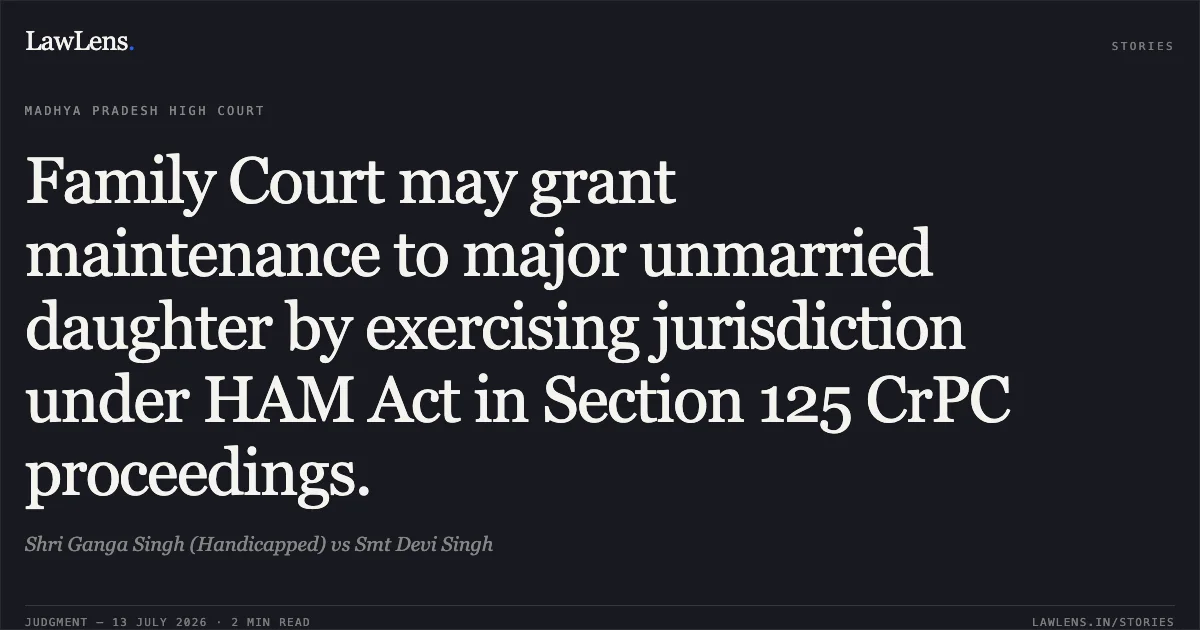
1. Whether a major unmarried daughter can be granted maintenance by a Family Court in an application filed under Section 125 Cr.P.C. by invoking Section 20(3) of the Hindu Adoption and Maintenance Act (HAM Act).
Source reference: p.2 / para. 32. Whether the mentioning of an incorrect legal provision (Section 125 Cr.P.C. instead of Section 20 of the HAM Act) vitiates the grant of maintenance.
Source reference: p.5 / para. 8Law Applied
Section 20 of the Hindu Adoption and Maintenance Act, 1956, which mandates that a Hindu is bound to maintain an unmarried daughter if she is unable to maintain herself out of her own earnings.
Source reference: p.6, para. 10The Supreme Court precedent of Abhilasha v. Parkash and others (2021), which established that while a Magistrate under Section 125 Cr.P.C. cannot grant maintenance to a major daughter, a Family Court exercising jurisdiction under both Cr.P.C. and the HAM Act can do so to avoid multiplicity of proceedings.
Source reference: p.4, para. 7The principle from N. Mani v. Sangeetha Theatre (2004) and The Patna Municipal Corporation v. M/s Tribro Ad Bureau (2024) that quoting a wrong provision of law does not invalidate an order if the source of power exists.
Source reference: p.5, para. 8Reasoning
The Court reasoned that although Section 125 Cr.P.C. strictly limits maintenance for children to minors (unless disabled), the Family Court possesses composite jurisdiction to decide claims under both the Cr.P.C. and Section 20(3) of the HAM Act.
Source reference: p.4, para. 7The Judge observed that Respondent No. 2 is an unmarried daughter who pleaded an inability to maintain herself, fulfilling the substantive requirements of Section 20(3) of the HAM Act.
Source reference: p.7, para. 11-12The Court dismissed the petitioner’s technical objection regarding the "wrong provision," noting that procedural technicalities should not thwart justice when the court has the requisite jurisdiction to grant the relief under a different statute.
Source reference: p.5-6The Court also noted that the petitioner had failed to clear existing arrears.
Source reference: p.8, para. 14Holding
The High Court dismissed the criminal revision and upheld the interim maintenance order.
It held that a major unmarried daughter is entitled to maintenance from her father under Section 20(3) of the HAM Act if she cannot maintain herself, regardless of whether she has a disability.
Source reference: p.7, para. 11The Court directed the Family Court to take strict action, including potentially striking out the petitioner's defence, if arrears are not cleared.
Source reference: p.8, para. 14It further advised the respondents to amend the pending application to include Section 20(3) of the HAM Act to resolve technical objections.
Source reference: p.8, para. 15Acts & Sections Cited
2 provisions across 2 statutes referred to in this judgment. Each provision opens on LawLens.
Code of Criminal Procedure, 19731
Hindu Adoptions and Maintenance Act, 19561
Original Court PDF
Shri Ganga Singh (Handicapped)vsSmt Devi Singh
Click to open original judgment
Original judgment, available to read, download and summarize on LawLens.in


