Facts
The petitioners were the widow of a deceased government teacher and her physically handicapped son.
Source reference: no citationThe deceased employee died in harness on 5 September 1998, after which respondent no. 7, his elder son, obtained compassionate appointment as an Assistant Teacher, allegedly on the undertaking that he would maintain his mother and disabled brother.
Source reference: para. 4, para. 6The widow was also sanctioned family pension under PPO No. S/89445.
Source reference: para. 7On her complaint regarding non-payment of maintenance by respondent no. 7, the District Programme Officer (Establishment), Bhagalpur, passed an order dated 6 October 2023 directing payment of Rs.10,000 per month to the petitioners.
Source reference: para. 5, para. 7The authority apparently considered respondent no. 7’s salary and the petitioner’s family pension together and apportioned the aggregate amount among seven family members.
Source reference: para. 5, para. 7The petitioners contended that the widow’s family pension, earlier approximately Rs.19,000 per month, had thereby been impermissibly reduced to Rs.10,000 per month.
Source reference: para. 8During the proceedings, the State disclosed that the District Programme Officer had recommended revision of the family pension and forwarded the original service book to the competent authority by Letter No.186 dated 1 March 2024.
Source reference: para. 9Issues
Whether the District Programme Officer (Establishment) had jurisdiction to club respondent no. 7’s salary with the widow’s family pension and apportion the aggregate amount among the family members?
Source reference: paras. 11–14Whether the widow’s sanctioned family pension could be reduced or appropriated without authority under the applicable pension rules and without an order of the competent pensionary authority?
Source reference: paras. 12–13, 17–19Whether the undertaking given by respondent no. 7 to maintain his mother and disabled brother could be enforced by reducing or redistributing the widow’s family pension?
Source reference: paras. 15–16, 22Law Applied
Family pension is a statutory pensionary entitlement governed by the applicable pension rules and the sanction of the competent pensionary authority; it is not a common family income capable of being pooled and apportioned at an administrative authority’s discretion.
Source reference: paras. 12–13Any alteration, reduction, withholding, or adjustment of family pension must be authorised by a specific statutory provision or applicable rule and undertaken by the competent authority.
Source reference: paras. 12–14, 17–18The salary earned by a family member through compassionate appointment and the family pension sanctioned to the widow operate in distinct legal fields and cannot be clubbed in the absence of express statutory authority.
Source reference: para. 14An undertaking to maintain family members may create an independent obligation enforceable before the competent forum, but it does not authorise an administrative officer to curtail a pensionary entitlement without statutory sanction.
Source reference: paras. 15–16, 22No specific statute, rule, circular, or governmental instruction authorising the impugned apportionment was identified in the order under challenge.
Source reference: paras. 11–13Reasoning
The Court found that the District Programme Officer had undertaken an arithmetical pooling of respondent no. 7’s salary and the widow’s family pension and had distributed the combined amount among family members, without identifying any legal source of power for doing so.
Source reference: paras. 11–13, 17The authority also made no finding that the widow had ceased to satisfy any condition for continuation of family pension or that the pension had been lawfully reduced by the competent pension-sanctioning authority.
Source reference: para. 13Since respondent no. 7’s salary and the widow’s family pension were legally distinct entitlements, his receipt of salary could not, by itself, justify reduction of her pension.
Source reference: para. 14Although the undertaking relating to maintenance could potentially be enforced through an appropriate legal proceeding, it could not be used as a basis for administratively reducing or redistributing the widow’s pension.
Source reference: paras. 15–16, 22The subsequent recommendation for revision of the pension further demonstrated that any revision had to be considered by the competent pensionary authority under the applicable rules, not imposed through the impugned order.
Source reference: para. 18Holding
The Court held that the order dated 6 October 2023, Memo No.2588, was legally unsustainable insofar as it reduced or appropriated the widow’s family pension, and accordingly set it aside.
Petitioner no. 1 was held entitled to family pension in accordance with the sanction or order of the competent pensionary authority, including any revised pension and consequential arrears, subject to verification, sanction by the Accountant General, Bihar, and compliance with the applicable pension rules.
Source reference: para. 20The pension could not be reduced, adjusted, or apportioned on the basis of respondent no. 7’s salary unless expressly authorised by the applicable statutory rules and undertaken by the competent authority in accordance with law.
Source reference: para. 21The petitioners were left at liberty to approach the competent authority or court for enforcement of respondent no. 7’s alleged maintenance obligation.
Source reference: para. 22The writ petition was allowed to that extent, with no order as to costs.
Source reference: paras. 23–24Original Court PDF
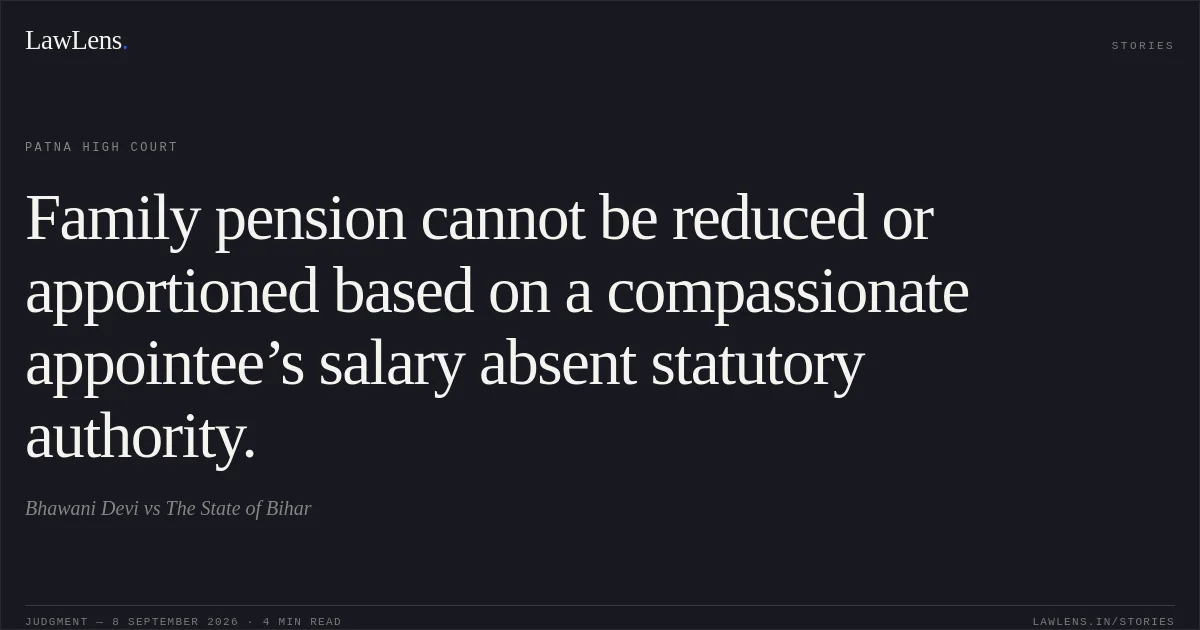
Bhawani DevivsThe State of Bihar
Click to open original judgment
Original judgment, available to read, download and summarize on LawLens.in