Facts
The applicants are the widow (Sheela. S.) and daughter (Shibi. B.S.) of late G. Babu, a retired Chief Travelling Ticket Inspector.
Source reference: no citationG. Babu took voluntary retirement on 30.09.2016.
Source reference: p.4The first applicant had previously initiated legal proceedings in Family Court for recovery of gold ornaments, maintenance for the daughter, and marriage expenses.
Source reference: p.2An ex-parte decree was passed on 25.07.2018 against Babu, directing him to pay Rs. 5,75,000/- for gold ornaments, Rs. 50,000/-, past and future maintenance for the daughter, and Rs. 10 Lakh for marriage expenses, with these amounts being a charge on his property.
Source reference: p.3The day after the decree, Babu applied to set aside the ex-parte order.
Source reference: p.3Babu later filed O.A.309/2021 before the Tribunal seeking the release of his gratuity and commuted pension, which were withheld due to the pending family court case.
Source reference: p.4The Tribunal in O.A.309/2021, on 26.10.2023, directed the release of these amounts, as it was informed that the O.P. was disposed of, without disclosure of the application to set aside the ex-parte order.
Source reference: p.4, p.17Babu passed away on 06.11.2022, before the amounts were released.
Source reference: p.4On 17.11.2022, a total of Rs. 26,96,742/- (DCRG and commuted value of pension) was disbursed to Babu's bank account.
Source reference: p.7, p.12The respondents claimed they were unaware of Babu's death until 21.11.2022.
Source reference: p.8The applicants contend that the disbursement was illegal due to Babu's death and their 2/3rd share in the benefits.
Source reference: p.4, p.5They have filed a criminal complaint regarding alleged misappropriation and the respondents have refused to process the first applicant's family pension application, allegedly to coerce them to withdraw their claims.
Source reference: p.11, p.13, p.5, p.8Issues
1. Whether the respondents are obligated to grant family pension to the first applicant?
Source reference: p.2, p.142. Whether the applicants are entitled to a 2/3rd share of the DCRG and commuted value of pension disbursed to Late G. Babu after his death?
Source reference: p.2, p.53. Whether the respondents' disbursal of DCRG and commuted value of pension to the deceased Babu's bank account after his death constitutes a valid discharge and whether the pendency of the application to set aside the ex-parte order in the Family Court affected the release of benefits?
Source reference: p.4, p.5, p.6, p.7, p.9, p.10Law Applied
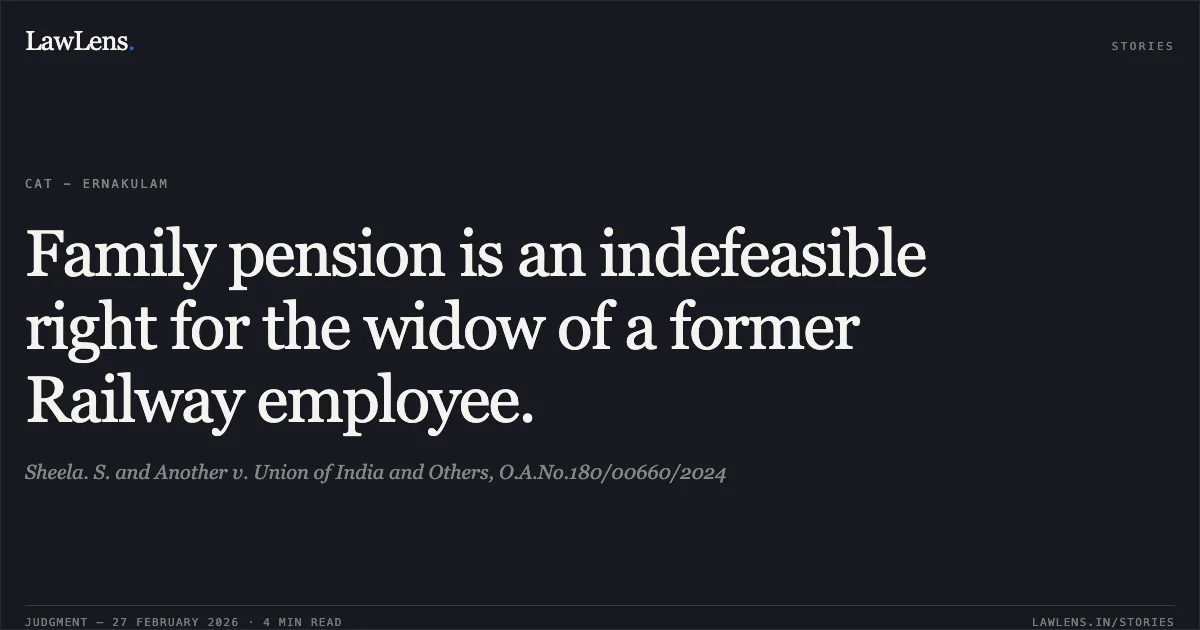
The Tribunal applied the principle that family pension is an indefeasible right of the widow of a former Railway employee, granted on account of status upon the death of the husband, and does not form part of the deceased's estate.
Source reference: p.14, p.15It relied on the decision in *Jodh Singh v. Union of India [(1980) 4 SCC 306]* which clarified that family pension is not payable during the lifetime of the deceased and cannot be disposed of by testamentary disposition, thus emphasizing its nature as a benefit for the widow becoming entitled on the event of death.
Source reference: p.15The Tribunal also implicitly referred to Rule 10(c) of the Railway Services (Pension) Rules concerning the withholding of benefits during judicial proceedings, although it found the application to set aside the ex-parte order not to be a 'lis' in this context.
Source reference: p.4, p.10Reasoning
The Tribunal determined that the first applicant, as the widow of Late G. Babu, has an indefeasible right to family pension, regardless of whether her name was included in his service records.
Source reference: p.14, p.15, p.19This right accrues immediately upon the death of the husband.
Source reference: p.15Citing *Jodh Singh v. Union of India*, the Tribunal underscored that family pension is a benefit arising from status, not an inheritance from the deceased's estate.
Source reference: p.15The respondents' arguments regarding the pending criminal complaint or other claims were deemed irrelevant to the first applicant's right to family pension.
Source reference: p.13, p.16However, concerning the DCRG and commuted value of pension, the Tribunal declined to adjudicate the inter-se dispute among Babu's legal heirs due to disputed facts and the existence of ongoing criminal proceedings and other legal actions by the applicants in different forums.
Source reference: p.19While acknowledging the applicants' claim of a 2/3rd share and the potentially improper withdrawal of funds by the nominee, the Tribunal found that this specific issue concerning the division of the disbursed funds was outside its jurisdiction and better suited for other appropriate authorities.
Source reference: p.19The Tribunal noted the non-disclosure of the application to set aside the ex-parte order in the Family Court during the prior O.A.309/2021 proceedings, but held that such an application did not constitute a 'lis' under the doctrine of lis pendens.
Source reference: p.17, p.18Holding
The Original Application is allowed in part.
The Tribunal directed the respondents to release the family pension along with arrears to the first applicant within 60 days from the date of receipt of the order.
Source reference: p.20Any delay beyond this period will incur an interest of 8% per annum.
Source reference: p.20The Tribunal explicitly stated that the issue regarding the 2/3rd share of DCRG and commuted value of pension involves disputed questions of fact and inter-se disputes among legal heirs, which is not the proper forum for adjudication, and directed the applicants to agitate this before appropriate authorities.
Source reference: p.19, p.20Acts & Sections Cited
5 provisions across 2 statutes referred to in this judgment. Each provision opens on LawLens.
Transfer of Property Act, 18821
Indian Penal Code, 18604
Original Court PDF
Sheela. S. and Another v. Union of India and Others, O.A.No.180/00660/2024
Click to open original judgment
Original judgment, available to read, download and summarize on LawLens.in