01Facts
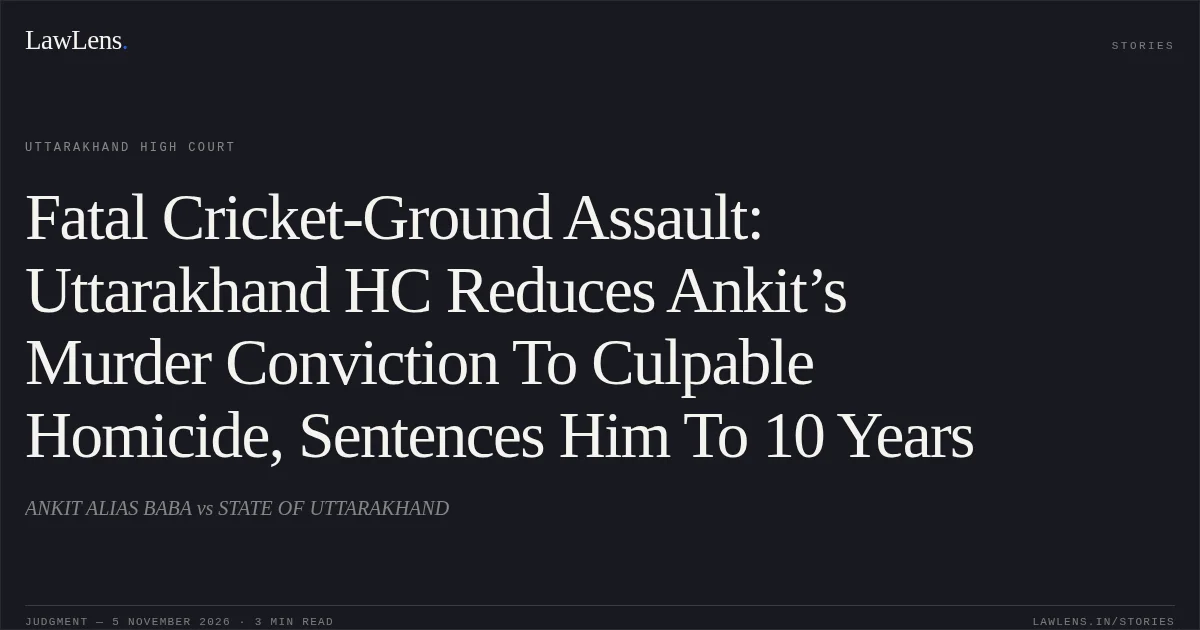
On 15 December 2010, a dispute arose while Varun Joshi and his brother Tarun were playing cricket at S.G.R.R. Ground, Dehradun. The prosecution alleged that the appellant and others assaulted them with cricket equipment. Varun sustained a fractured elbow, and Tarun suffered a head injury and died during treatment on 20 December 2010.
¶ 2, 7 · pp. 1–3, 5The Sessions Court convicted the appellant under Sections 302/34, 307/34, 504/34 and 506/34 IPC. On appeal under Section 374(2) CrPC, the appellant challenged the sufficiency of the evidence, attribution of the fatal assault, and application of Section 34 IPC; he also sought treatment of the homicide as culpable homicide not amounting to murder.
¶ 1, 19 · pp. 1, 6–702Issues
i.1. Whether the evidence, particularly the testimony of the injured witness and other eyewitnesses, was sufficient to sustain the appellant’s convictions
¶ 19–23 · pp. 6–9ii.2. Whether the appellant’s conviction for murder under Section 302/34 IPC should be modified to culpable homicide not amounting to murder under Section 304 Part II/34 IPC
¶ 24–25 · pp. 9–10iii.3. Whether common intention under Section 34 IPC was established so as to sustain the appellant’s liability for the offences
¶ 26 · p. 10iv.4. Whether the conviction under Section 307/34 IPC should be altered to Section 308/34 IPC
¶ 28 · p. 1103Law Applied
Section 34 IPC imposes joint liability where a criminal act is done by several persons in furtherance of their common intention; the Court held that the appellant’s conduct and the involvement of the co-accused supported its application.
¶ 26 · p. 10Sections 299 and 300 IPC distinguish culpable homicide from murder by reference to the offender’s intention and knowledge; where the conduct establishes knowledge that death is likely, but not an intention to cause death or the relevant bodily injury, the Court may find the offence falls under Section 299 rather than Section 300.
¶ 24–25 · pp. 9–10The Court also applied the principle that an injured witness’s evidence ordinarily carries substantial evidentiary value, while minor contradictions or embellishments do not require rejection of the testimony; it relied on Tahsildar Singh v. State of U.P., AIR 1959 SC 1012, as cited in the judgment.
¶ 21 · pp. 7–8It further relied on Sat Pal v. Delhi Administration, (1976) 1 SCC 727, for the rule that a hostile witness’s testimony is not automatically discarded and may be acted upon to the extent it is credible and corroborated.
¶ 22 · p. 8Provisions in the judgment · 12 · Linked ones open on LawLens
Code of Criminal Procedure, 1973 Section 374Section 313
Indian Penal Code, 1860 10 provisions
Section 34Section 299Section 300Section 302Section 304Section 307Section 308Section 325Section 504Section 50604Reasoning
The Court accepted the injured witness’s account as credible and found that the eyewitnesses’ inconsistencies concerning the weapons and precise blows were not material enough to displace the prosecution case.
¶ 21–23 · pp. 7–9It nevertheless concluded that the appellant’s conduct showed knowledge that his acts were likely to cause death, but did not establish an intention to kill or to inflict bodily injury likely to result in death; it therefore classified the homicide under Section 299 rather than Section 300 IPC.
¶ 25 · p. 10The Court considered common intention established from the conduct of the accused and the subsequent findings against the juvenile co-accused.
¶ 26 · p. 10On that basis, it substituted the relevant homicide and injury offences while maintaining the convictions under Sections 504/34 and 506/34 IPC.
¶ 28 · p. 1105Holding
The appeal was partly allowed.
¶ 28 · p. 11The conviction was modified from Section 302/34 to Section 304 Part II/34 IPC, with ten years’ rigorous imprisonment and a fine of ₹5,000, and from Section 307/34 to Section 308/34 IPC, with seven years’ rigorous imprisonment and a fine of ₹2,000.
¶ 28 · p. 11The convictions and sentences under Sections 504/34 and 506/34 IPC were left undisturbed; all sentences were ordered to run concurrently.
¶ 28 · p. 11The appellant, who was on bail, was directed to surrender before the trial court; his bail bonds were cancelled and the sureties discharged.
¶ 28 · p. 11Original Court PDF
ANKIT ALIAS BABAvsSTATE OF UTTARAKHAND
Click to open original judgment
Original judgment, available to read, download and summarize on LawLens.in