Facts
The petitioner sought a writ of habeas corpus under Article 226 of the Constitution read with Section 528 of the Bharatiya Nagarik Suraksha Sanhita, 2023, seeking production and custody of his two minor children.
Source reference: pp. 1–3; paras. 1–5, 7The children were born on 1 September 2022 to the petitioner and his deceased wife.
Source reference: pp. 1–3; paras. 1–5, 7Following the wife’s suicide on 20 November 2022, FIR No. 711/2022 was registered, and the petitioner was accused of her murder under Section 302 IPC.
Source reference: pp. 1–3; paras. 1–5, 7He remained in custody until his release on bail in June 2026.
Source reference: pp. 1–3; paras. 1–5, 7Since the mother’s death, the children had remained in the custody of respondent no. 3, their maternal grandmother.
Source reference: pp. 1–3; paras. 1–5, 7The maternal grandfather had also instituted guardianship proceedings before the competent court.
Source reference: pp. 1–3; paras. 1–5, 7Issues
Whether the High Court should exercise its extraordinary jurisdiction under Article 226 to grant the petitioner custody of his minor children through a writ of habeas corpus merely because he is their natural guardian.
Source reference: pp. 1, 3–4; paras. 1, 8–13Whether the question of the children’s custody and welfare should instead be determined in the pending guardianship proceedings before the competent court.
Source reference: pp. 2–5; paras. 4, 8, 13–14Law Applied
The Court applied Article 226 of the Constitution and Section 528 of the Bharatiya Nagarik Suraksha Sanhita, 2023, governing the High Court’s extraordinary jurisdiction and the remedy of habeas corpus.
Source reference: pp. 3–4; paras. 8–11Relying on Tejaswini Gaud v. Shekhar Jagdish Prasad Tewari, (2019) 7 SCC 42, the Court held that habeas corpus in child-custody matters is ordinarily available only where the minor’s detention is illegal or by a person without lawful authority; questions requiring a detailed inquiry into the child’s welfare should ordinarily be adjudicated under the Hindu Minority and Guardianship Act, 1956 or the Guardians and Wards Act, 1890.
Source reference: pp. 3–4; paras. 8–11The Court also considered Vivek Kumar Chaturvedi v. State of U.P., (2025) 4 SCC 342, which recognizes the father’s status as natural guardian and holds that grandparents do not automatically have a superior claim, while distinguishing it on its facts.
Source reference: pp. 3–4; paras. 8–11The governing consideration in custody matters remains the welfare of the child.
Source reference: pp. 3–4; paras. 8–11Reasoning
Although the petitioner relied on his status as the children’s natural guardian, the Court found that the children had been continuously in the maternal grandmother’s custody almost from birth, while the petitioner had remained incarcerated for nearly four years and was facing trial for the alleged murder of their mother.
Source reference: pp. 3–5; paras. 7–13His present release on bail did not resolve the concerns regarding his circumstances or establish that the children’s custody with the grandmother was illegal.
Source reference: pp. 3–5; paras. 7–13Since the maternal grandfather’s guardianship petition was already pending, determining the children’s welfare required a detailed inquiry better suited to the competent court rather than the summary and extraordinary jurisdiction under Article 226.
Source reference: pp. 3–5; paras. 7–13The precedents relied upon by the petitioner involved materially different circumstances and therefore did not justify intervention in the present case.
Source reference: pp. 3–5; paras. 7–13Holding
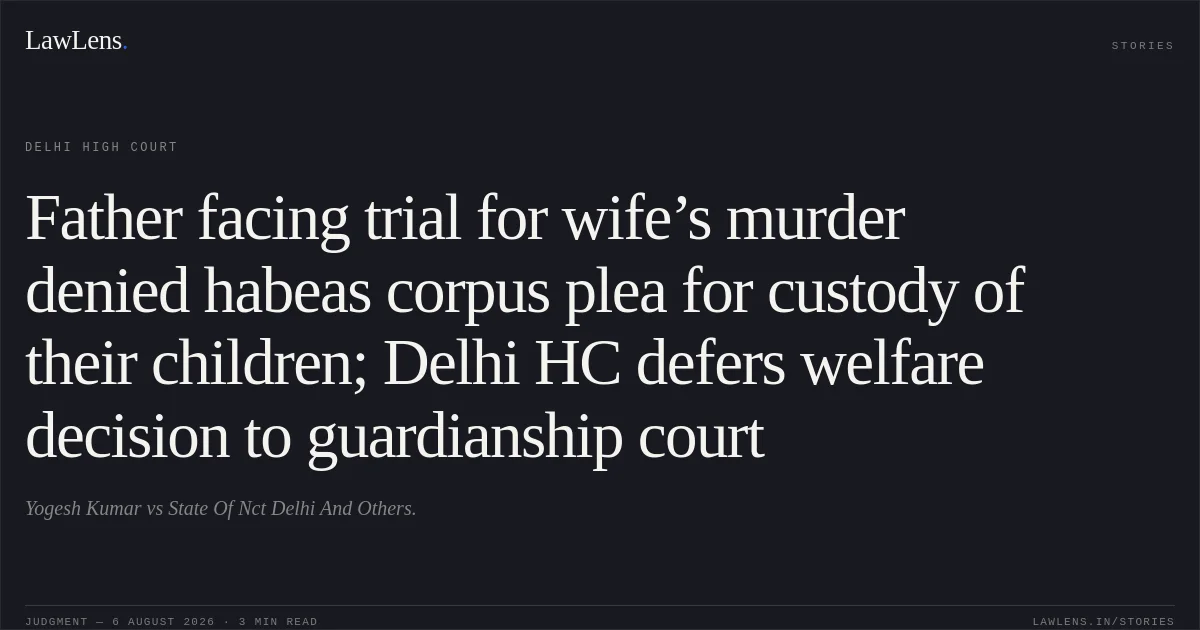
The Court held that this was not a fit case for exercising its extraordinary jurisdiction through a writ of habeas corpus.
The petition was dismissed, with liberty to the petitioner to assert his custody and guardianship rights before the competent court in the pending proceedings.
Source reference: p. 5; para. 14The Court clarified that its prima facie observations would not influence the adjudication of the guardianship matter.
Source reference: p. 5; para. 14Original Court PDF
Yogesh KumarvsState Of Nct Delhi And Others.
Click to open original judgment
Original judgment, available to read, download and summarize on LawLens.in