Facts
The parties, who married in 2016, have one son, born in 2017.
Source reference: para. 2–4, 6After the parents separated in February 2022, the child remained with the father, while the mother sought custody under Section 25 of the Guardians and Wards Act.
Source reference: para. 2–4, 6The Family Court ordered that custody be transferred to the mother and granted the father visitation and vacation custody; the father appealed, arguing, among other things, that a transfer would harm the child, who had not lived with the mother for several years.
Source reference: para. 5–8During the appeal, the High Court arranged for contact between the mother and child and directed counselling. The child initially refused to speak with the mother, but later spent time with her on two occasions.
Source reference: para. 13–16The High Court found that the father had influenced the child against the mother, while also noting that he had been meeting the child’s material needs and was better placed to provide for them.
Source reference: para. 17–19Issues
1. Whether the Family Court’s direction transferring custody to the mother served the child’s welfare, in light of the child’s prolonged residence with the father and reluctance to interact with the mother.
Source reference: para. 7, 9, 11, 192. Whether the child’s welfare required the father to retain custody while the mother received substantial parenting time.
Source reference: para. 12, 17–19Law Applied
Under the Guardians and Wards Act, 1890, including Section 25, the child’s welfare is paramount in determining custody; parental rights and allegations between the parents are secondary to that consideration.
Source reference: para. 4, 9, 11The Family Court relied on Vivek Singh v. Romani Singh, AIR 2017 SC 929, concerning a child’s inability to assess the benefits of a parent’s company when deprived of that relationship, and Nithya Anand Raghavan v. State (NCT of Delhi), (2017) 8 SCC 454, concerning maternal custody of a young girl absent circumstances making it harmful.
Source reference: para. 5The High Court emphasised that a child needs the love and affection of both parents and that neither parent should turn the child against the other.
Source reference: para. 12Reasoning
The High Court found no basis to disturb the Family Court’s findings that the father had not proved his allegations against the mother.
Source reference: para. 10However, custody had remained with the father for more than three years, and the child’s refusal to engage with the mother made an immediate transfer likely to cause psychological shock rather than serve the child’s welfare.
Source reference: para. 14–19The Court also considered the father’s provision for the child’s material needs, but concluded that the mother should have substantial parenting time and that the father must actively help restore the child’s relationship with her.
Source reference: para. 18–19Holding
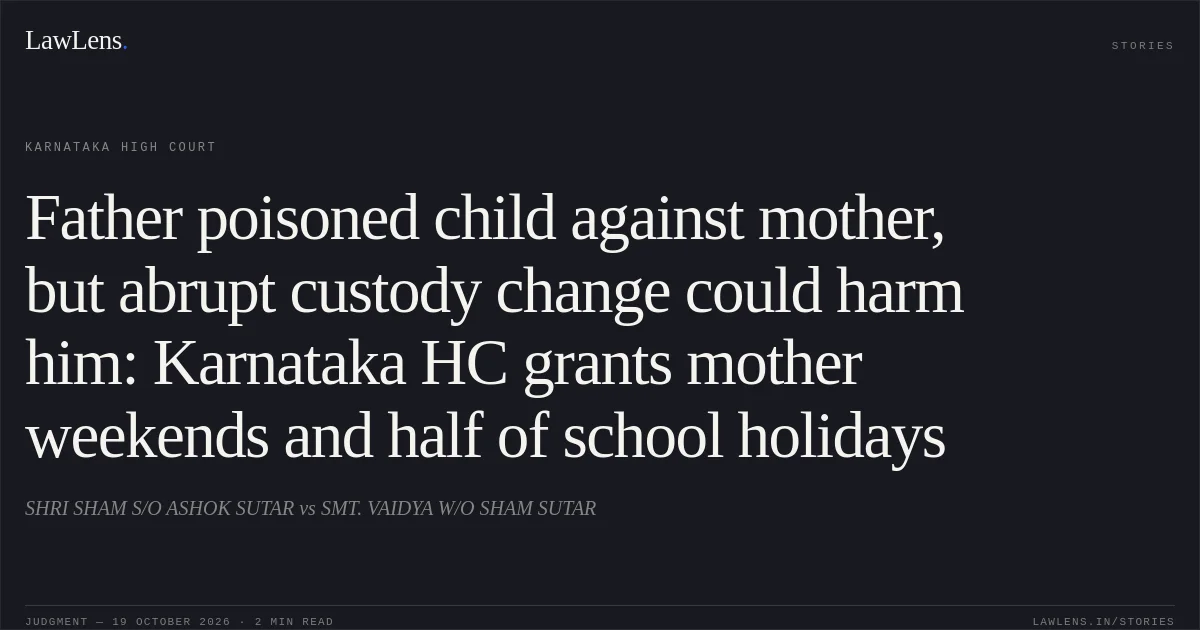
The Court allowed the child to remain in the father’s custody, directing the father to meet the child’s financial, medical and educational needs and to foster the child’s relationship with the mother.
The mother was granted custody during the child’s entire weekend holidays and 50% of school vacations. She may seek modification if the father remarries, becomes negligent, or continues to turn the child against her.
Source reference: para. 19Acts & Sections Cited
2 provisions across 1 statute referred to in this judgment. Each provision opens on LawLens.
Guardians and Wards Act, 18902
Original Court PDF
SHRI SHAM S/O ASHOK SUTARvsSMT. VAIDYA W/O SHAM SUTAR
Click to open original judgment
Original judgment, available to read, download and summarize on LawLens.in