Facts
The petitioner-mother and respondent-father were married in 2015 and had a daughter, Kum. Samanvi S., born in 2019. They were residing separately. The mother instituted M.C. No. 4991/2025 seeking divorce, while the father filed G. & W.C. No. 319/2025 seeking permanent custody of the child.
Source reference: p. 3–4The Family Court initially granted the father specified audio/video communication, visitation, and overnight custody rights by order dated 17 April 2026. In W.P. No. 19158/2026, the High Court modified that arrangement on 22 July 2026, permitting the father to have custody once a month for two days, with the child to be collected from and returned to the mother at Pune.
Source reference: p. 5According to the mother, on 18 July 2026, the father took the child from the Family Court premises without authority and failed to return her. Although the police brought the father and child to the police station, the father allegedly took the child away again without informing the police.
Source reference: p. 5–6The mother consequently filed I.A. No. VII under Section 12 of the Guardians and Wards Act, 1890, read with Section 151 of the Code of Civil Procedure, 1908, seeking production and restoration of custody. The Family Court dismissed the application, holding that it did not survive for consideration.
Source reference: p. 6, 11–12Issues
Whether the father’s unilateral removal and continued retention of the child, contrary to the visitation and custody arrangements ordered by the Family Court and the High Court, could be sustained in law?
Source reference: p. 10–12Whether the Family Court erred in dismissing the mother’s application under Section 12 of the Guardians and Wards Act, 1890, seeking production and restoration of custody of the minor child?
Source reference: p. 6, 11–12Whether the child’s dignity, security, participation, and other rights under Article 21 of the Constitution were violated by the manner in which custody was taken?
Source reference: p. 8–10Law Applied
The Court exercised its supervisory jurisdiction under Article 227 of the Constitution of India to correct the Family Court’s legally unsustainable order.
Source reference: p. 2, 12It applied Section 12 of the Guardians and Wards Act, 1890, which enables the court to make interim orders for the production and protection of a minor, read with Section 151 CPC, preserving the court’s inherent power to pass orders necessary in the interests of justice.
Source reference: p. 2The Court held that custody disputes must be decided with the child’s welfare, dignity, security, and best interests as the controlling considerations, and that a parent cannot unilaterally take custody in disregard of subsisting judicial orders.
Source reference: p. 8–10It further treated the child’s right to dignity, protection from abuse, participation in family-related decisions, and a secure living environment as integral to the right to life under Article 21.
Source reference: p. 8–10Reasoning
The High Court found that the father’s conduct was not a lawful exercise of parental rights but a unilateral act contrary to the existing custody arrangement.
Source reference: p. 10–12The High Court’s order dated 22 July 2026 expressly contemplated that the father would collect the child from Pune and return her to the mother at Pune; therefore, the father was required to comply with that arrangement or approach the Family Court for appropriate modification if he believed that the child was unsafe with the mother or that relocation to Pune was detrimental.
Source reference: p. 10–11His decision to remove and retain the child without obtaining any further order violated both the Family Court’s and the High Court’s directions.
Source reference: p. 10–12The Court also criticised the manner in which the child was taken, observing that the child was treated as an object without being given an opportunity to express her wishes or adjust to the situation.
Source reference: p. 8–10Such conduct was inconsistent with the child’s constitutional rights to dignity, security, protection, and meaningful participation in matters affecting her.
Source reference: p. 8–10Since the Family Court had directed the parties to honour the High Court’s modified order, custody ought to have remained with the mother pending the lawful exercise of the father’s visitation rights. The Family Court therefore erred in holding that I.A. No. VII did not survive for consideration.
Source reference: p. 11–12Holding
The writ petition was allowed, and the Family Court’s order dated 29 July 2026 on I.A. No. VII in G. & W.C. No. 319/2025 was set aside.
The father was directed to produce Kum. Samanvi S. before the II Additional Principal Judge, Family Court, Bengaluru, at 10:30 a.m. on 25 August 2026, and the Family Court was directed to hand over the child’s custody to the mother.
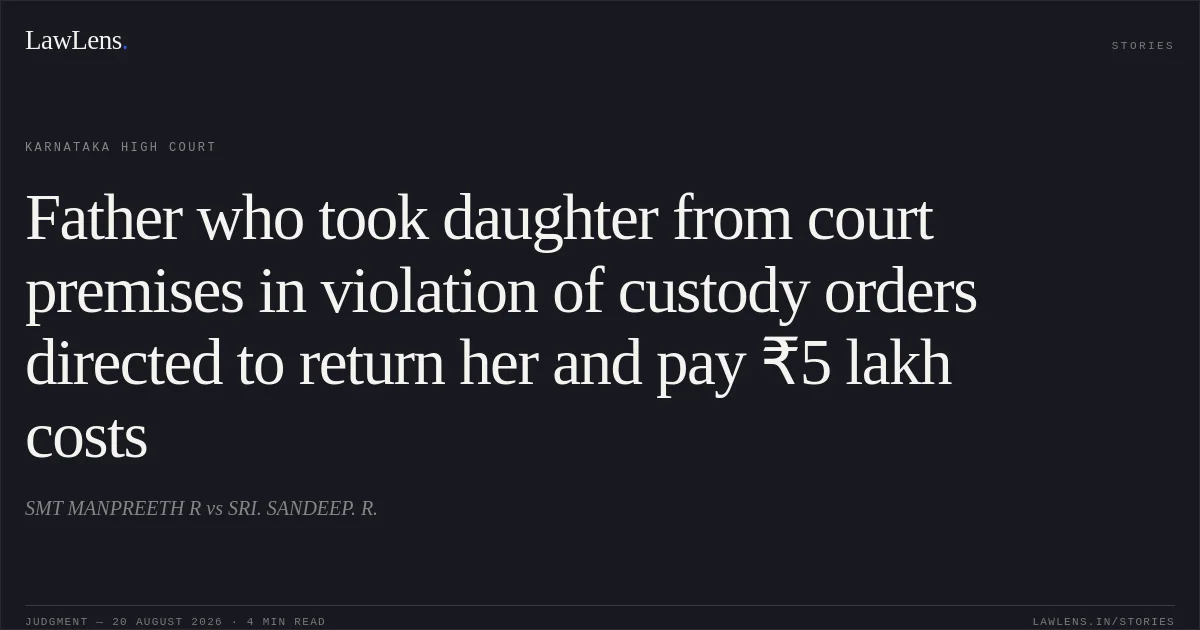
Source reference: p. 12–13For taking the law into his own hands, violating the judicial orders, and infringing the child’s basic human rights, the father was directed to pay costs of Rs. 5,00,000, of which Rs. 1,00,000 was to be paid to the Army Welfare Fund and Rs. 4,00,000 deposited in a fixed deposit in the child’s name, withdrawable upon attaining majority.
Source reference: p. 13–14The father was also prohibited from conducting G. & W.C. No. 319/2025 until proof of payment of the costs was produced.
Source reference: p. 14Acts & Sections Cited
2 provisions across 2 statutes referred to in this judgment. Each provision opens on LawLens.
Guardians and Wards Act, 18901
Code of Civil Procedure, 19081
Original Court PDF
SMT MANPREETH RvsSRI. SANDEEP. R.
Click to open original judgment
Original judgment, available to read, download and summarize on LawLens.in