Facts
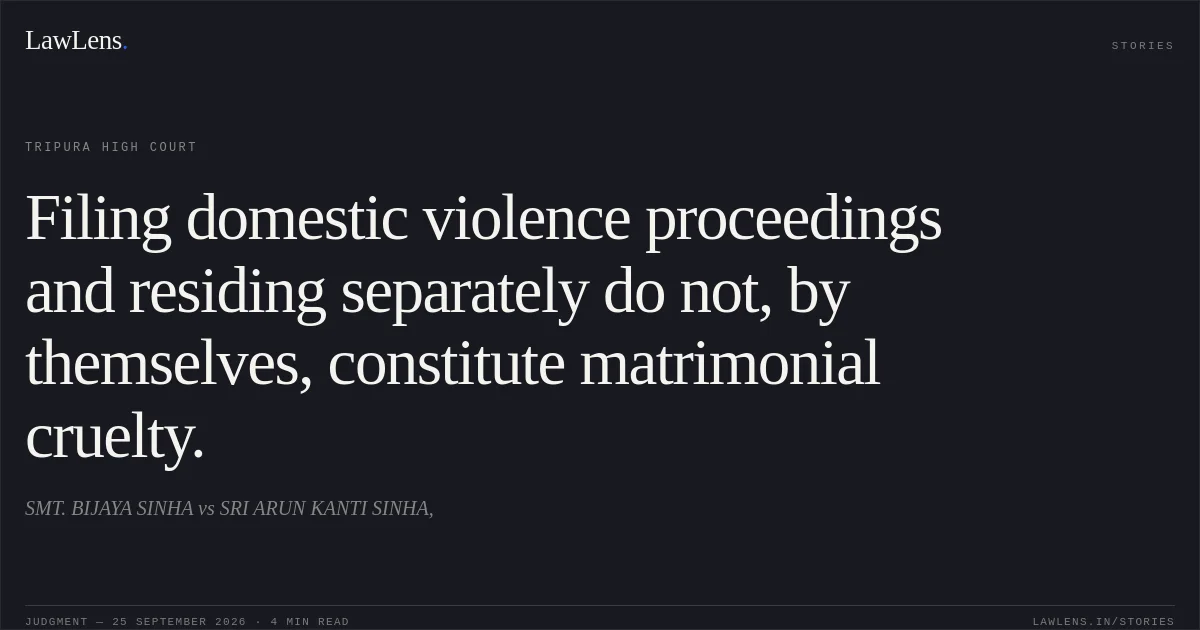
The parties married on 3 February 2017 and had a son. The respondent-husband, an Indian Army employee, filed a divorce petition under Section 13(1)(ia) of the Hindu Marriage Act, 1955, alleging that the appellant-wife had subjected him to mental cruelty through quarrels, leaving the matrimonial home, refusing to live with his parents, making complaints to his military authorities, and instituting domestic-violence proceedings against him and his family
Source reference: paras. 13.1–13.6The wife denied cruelty and alleged dowry-related physical and mental abuse by the husband and his family. She had sought maintenance and residential relief under the Protection of Women from Domestic Violence Act, 2005, and obtained maintenance orders
Source reference: paras. 13.7–13.10The Family Court, Dharmanagar, accepted the husband’s allegations and granted divorce by judgment dated 29 August 2025 and decree dated 1 September 2025.
Source reference: no citationThe wife challenged that decision under Section 28 of the Hindu Marriage Act read with Section 19 of the Family Courts Act
Source reference: para. 1The High Court reappraised the oral evidence and found that the independent witnesses did not substantiate the husband’s allegations of cruelty
Source reference: paras. 16–18Issues
1. Whether the conduct attributed to the appellant-wife— including residing at her parental home, disputes with the husband and his family, complaints to military authorities, and institution of domestic-violence proceedings— constituted “cruelty” under Section 13(1)(ia) of the Hindu Marriage Act, 1955
Source reference: paras. 18–282. Whether the Family Court was justified in granting a decree of divorce on the basis of the evidence and circumstances on record
Source reference: paras. 21–23, 28, 32–333. Whether the wife’s domestic-violence proceedings and her pursuit of maintenance and residential relief could be treated as acts of cruelty against the husband
Source reference: paras. 22, 27–30Law Applied
The Court applied Section 13(1)(ia) of the Hindu Marriage Act, 1955, under which divorce may be granted where one spouse has treated the other with cruelty, and Sections 28 of the Hindu Marriage Act and 19 of the Family Courts Act governing the appeal
Source reference: para. 1The burden rests on the spouse seeking divorce to establish the pleaded cruelty, as stated in Dr. N.G. Dastane v. Mrs. S. Dastane, (1975) 2 SCC 326
Source reference: para. 31Under V. Bhagat v. D. Bhagat, (1994) 1 SCC 337, mental cruelty must involve conduct causing such mental pain and suffering that the parties cannot reasonably be expected to live together; its determination depends on the facts, circumstances, social setting and context of the allegations
Source reference: para. 31Relying also on Shobha Rani v. Madhukar Reddi, (1988) 1 SCC 105, and Gurbux Singh v. Harminder Kaur, (2010) 14 SCC 301, the Court held that cruelty is fact-specific, has no exhaustive definition, and cannot be presumed from conduct without proof of its effect and circumstances
Source reference: paras. 31–32Under Satish Chander Ahuja v. Sneha Ahuja, (2021) 1 SCC 414, an order passed under the Domestic Violence Act is relevant evidence in civil proceedings and must receive due weight, though it is not conclusive or binding on the civil court
Source reference: paras. 29–30Reasoning
The High Court held that the husband failed to prove that the wife’s conduct caused legally cognisable mental cruelty. The independent witnesses did not support the allegations, while the evidence of the husband and his parents was insufficient and, in material respects, merely self-serving
Source reference: paras. 18, 23The wife’s periods of residence at her parental home could not automatically constitute cruelty, particularly because the husband was posted away in the Army and she had to manage domestic and childcare responsibilities in his absence
Source reference: paras. 19, 26Her applications for maintenance and residential relief were legitimate recourse to legal remedies, especially when she was unemployed and maintenance had been directed by the competent authorities; pursuing such remedies could not, without more, be treated as cruelty
Source reference: paras. 22, 24The Court further noted that the wife had sought a residential order, indicating an intention to reside in the matrimonial home, while the husband had not sought restitution of conjugal rights and expressly stated in cross-examination that he was unwilling to live with her
Source reference: paras. 20, 25, 27The Family Court therefore erred by treating the domestic-violence proceedings and other disputed circumstances as cruelty on the basis of assumptions and conjectures rather than established facts
Source reference: paras. 28–30, 32Holding
The Court answered the issues in favour of the appellant-wife and held that the respondent-husband had failed to establish cruelty under Section 13(1)(ia) of the Hindu Marriage Act.
The Family Court’s judgment dated 29 August 2025 and consequential decree dated 1 September 2025 were found perverse and were set aside and quashed
Source reference: paras. 32–34The appeal was allowed, the parties were directed to bear their own costs, and the record was ordered to be returned to the Family Court
Source reference: para. 34Acts & Sections Cited
6 provisions across 4 statutes referred to in this judgment. Each provision opens on LawLens.
Hindu Marriage Act, 19552
Family Courts Act, 19841
Army Act, 19501
Protection of Women from Domestic Violence Act, 20052
Original Court PDF
SMT. BIJAYA SINHAvsSRI ARUN KANTI SINHA,
Click to open original judgment
Original judgment, available to read, download and summarize on LawLens.in