Facts
The appellants were personal guarantors of Archon Engicon Ltd. and had executed a Deed of Guarantee dated 12 June 2014 in favour of the consortium of banks. They relied principally on Clause 24, which stated that the guarantee was restricted to the market value of the properties mortgaged by them. Other clauses—particularly Clauses 1, 6 and 9—provided for payment of the principal amount, interest, costs and charges and stated that the guarantee would remain enforceable notwithstanding the existence or realisation of securities
Source reference: pp. 5–8, 12–14; paras. 2–8, 14–16In proceedings before the DRT in O.A. No. 83 of 2017, the appellants were held jointly and severally liable with the borrower for the outstanding debt of approximately Rs. 1,492.61 crore by order dated 3 August 2021. The order was not challenged and attained finality
Source reference: p. 14; paras. 17–19The appellants also did not challenge the claims lodged by the banks before the Resolution Professional
Source reference: p. 11; para. 13During the personal insolvency proceedings, repayment plans were considered in several meetings of the Committee of Creditors. The final modified plans, involving payments of Rs. 1.60 crore each in two matters and Rs. 2.75 crore in another, failed to obtain the statutory 66% voting approval. The plans were consequently rejected
Source reference: pp. 15–16; paras. 20–23The Resolution Professional thereafter filed applications under Section 114 of the Insolvency and Bankruptcy Code, 2016 (“IBC”), read with Rule 11 of the NCLT Rules, seeking discharge and consequential directions. The NCLT held that Clause 24 did not limit the appellants’ primary contractual liability and upheld the rejection of the repayment plans. The appellants challenged that order before the NCLAT
Source reference: pp. 9–11; paras. 11–13Issues
Whether Clause 24 of the Deed of Guarantee restricted the appellants’ liability to the market value of the mortgaged properties, notwithstanding Clauses 1, 6 and 9 imposing liability for the entire guaranteed debt?
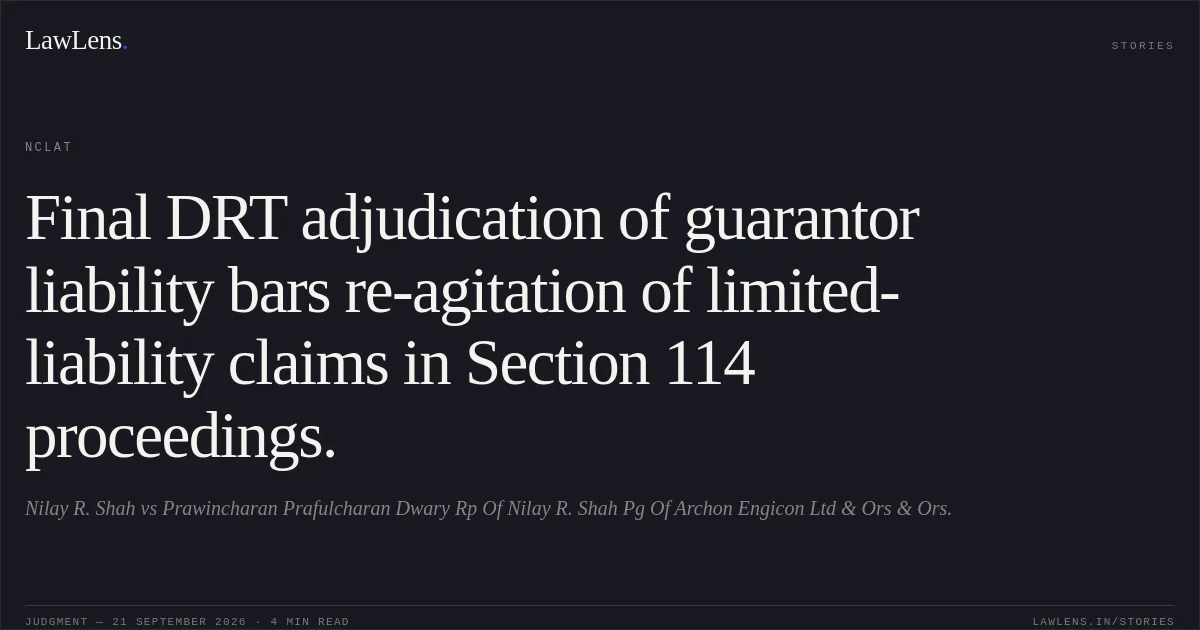
Source reference: pp. 9–14; paras. 11–17Whether the appellants could re-agitate the extent of their liability in proceedings under Section 114 of the IBC after the DRT had adjudicated their joint and several liability and its order had attained finality?
Source reference: pp. 10–15; paras. 15.6–15.9, 17–19Whether the rejection of the repayment plans was legally sustainable when the plans failed to secure the requisite 66% voting share of the Committee of Creditors?
Source reference: pp. 15–16; paras. 20–24Law Applied
The Tribunal applied Sections 111 and 114 of the IBC concerning consideration and approval of a repayment plan and the consequences where the statutory approval is not obtained; Section 114 does not authorise the Adjudicating Authority to substitute its commercial judgment for that of the creditors
Source reference: pp. 15–16; paras. 21–23Section 128 of the Indian Contract Act, 1872, concerning the co-extensive nature of a surety’s liability, and Section 101 of the IBC regarding the effect of the moratorium were also relied upon
Source reference: p. 11; para. 15.8The Tribunal applied the principle that contractual clauses must be harmoniously construed and relied on Bharat Sher Singh Kalsia v. State of Bihar, (2024) 4 SCC 318, for the proposition that where earlier and later clauses conflict and cannot be reconciled, the earlier clause prevails
Source reference: p. 10; para. 15.4It further held that the doctrines of contra proferentem and non est factum apply only in appropriate cases of unresolved ambiguity or proven misrepresentation and cannot be used to rewrite an otherwise binding commercial contract
Source reference: p. 10; para. 15.2–15.5A final adjudication by the DRT, if not challenged, cannot ordinarily be reopened in collateral insolvency proceedings
Source reference: pp. 14–15; paras. 17–19Reasoning
The Tribunal read Clause 24 together with Clauses 1, 6 and 9. Although Clause 24 referred to the market value of the mortgaged properties, Clauses 1, 6 and 9 expressly required the guarantors to pay the guaranteed principal, interest, costs and charges and made the guarantee enforceable independently of the securities. The Tribunal therefore accepted the NCLT’s view that Clause 24 concerned the security arrangement and did not extinguish or restrict the appellants’ primary contractual liability under the guarantee
Source reference: pp. 12–14; paras. 14–16In any event, the DRT had already upheld the guarantee and determined the appellants’ joint and several liability, and that determination had become final because it was never challenged. The appellants’ participation in the DRT proceedings and filing of written statements also defeated their contention that they had been denied an opportunity of hearing
Source reference: p. 14; paras. 17–19Finally, since the repayment plans failed to obtain the statutory 66% approval, the Adjudicating Authority could not approve or revive them by substituting its own assessment for the commercial decision of the creditors
Source reference: pp. 15–16; paras. 20–24Holding
The NCLAT dismissed all three appeals and upheld the NCLT’s order. It held that the appellants’ liability was not limited to the market value of the mortgaged properties; they remained liable under the Deed of Guarantee for the adjudicated debt in accordance with the DRT’s final determination
The rejection of the repayment plans was also upheld because the plans did not receive the requisite 66% voting approval under the IBC. Pending applications, if any, were disposed of
Source reference: p. 16; paras. 24–26Acts & Sections Cited
5 provisions across 2 statutes referred to in this judgment. Each provision opens on LawLens.
Insolvency and Bankruptcy Code, 2016.4
Indian Contract Act, 18721
Original Court PDF
Nilay R. ShahvsPrawincharan Prafulcharan Dwary Rp Of Nilay R. Shah Pg Of Archon Engicon Ltd & Ors & Ors.
Click to open original judgment
Original judgment, available to read, download and summarize on LawLens.in