Facts
The petitioners are the legal representatives of Smt. Raj, the widow of late Shri Jai Ram Dhiman, a former Production Manager in the respondent Corporation.
Source reference: para. 1-2Shri Dhiman took voluntary retirement on September 24, 2001, during the currency of the HP Corporate Sector Employees (pension, family pension, commutation of pension and gratuity) Scheme, 1999.
Source reference: para. 1, 6Following his death and the subsequent death of Smt. Raj during the pendency of this petition, their children sought the release of pensionary and family pension benefits.
Source reference: para. 2-3The respondent Corporation admitted the petitioners' entitlement but resisted payment solely on the grounds of a "monetary crunch".
Source reference: para. 7Issues
1. Whether a "monetary crunch" serves as a valid legal justification for a State-owned Corporation to withhold established pensionary benefits from its retired employees or their legal heirs.
Source reference: para. 82. Whether the petitioners are entitled to arrears of pension and family pension under the 1999 Scheme for an employee who retired voluntarily between 1999 and 2004.
Source reference: para. 5-6, 13Law Applied
The court applied the HP Corporate Sector Employees (pension, family pension, commutation of pension and gratuity) Scheme, 1999, noting that by virtue of prior litigation, incumbents who superannuated between April 1, 1999, and December 2, 2004, are entitled to pension.
Source reference: para. 5It further relied on the judicial principle established in R.K. Soni v. State of Himachal Pradesh and others (CWP-T No. 2530 of 2008), which held that financial constraints do not absolve the State or its Corporations from their obligation to pay pensionary benefits.
Source reference: para. 10Reasoning
The court reasoned that since the respondent Corporation admitted the petitioners' legal right to the pension, the denial was arbitrary and focused solely on financial incapacity.
Source reference: para. 7-8The court observed that the right to pension for those retiring within the 1999-2004 window is settled law.
Source reference: para. 5Critically, the court remarked that a financial crunch cannot legally obstruct the payment of dues earned through service.
Source reference: para. 8It expressed "saddening" concern that the Corporation’s excuse of financial lack had remained unchanged for nearly two decades, suggesting a lack of intent rather than a lack of means, characterizing such institutions as "white elephants" if they fail to meet basic statutory and service obligations.
Source reference: para. 11-12Holding
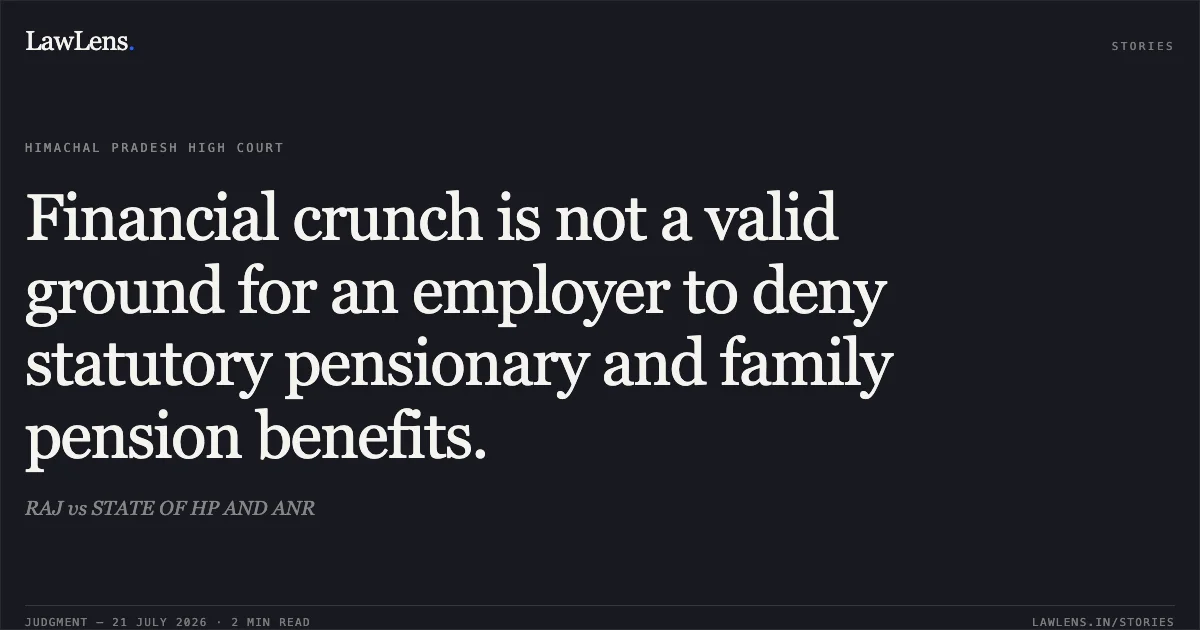
The court allowed the writ petition, holding that the withholding of pension and family pension was bad in law.
The respondents were directed to pay all arrears of pension (from the date of retirement to the date of death) and family pension (from the date of death) within three months.
Source reference: para. 8, 13The court ordered that if the payment is not made within three months, the arrears shall carry interest at the rate of 6% per annum from the date of filing the petition.
Source reference: para. 13Original Court PDF
RAJvsSTATE OF HP AND ANR
Click to open original judgment
Original judgment, available to read, download and summarize on LawLens.in