Facts
The applicants (son and father) sought to quash an FIR and subsequent chargesheet alleging offences under Sections 306 (Abetment of Suicide) and 114 of the IPC.
Source reference: p. 1-2The complainant’s son (deceased) worked at Applicant No. 1’s firm for 15 years. The prosecution alleged that due to business losses, the applicants and Accused No. 3 (Pankajbhai) pressurized the deceased to repay money based on falsified accounts.
Source reference: p. 2The complainant alleged that on 12.04.2021, the deceased expressed feeling under pressure from the applicants, and subsequently committed suicide that evening.
Source reference: p. 2The defense contended the firm had closed in 2016, there was no evidence of incessant pressure, and the specific threat to dispossess the deceased of his "Happy Parlour" shop occurred four months prior to the incident.
Source reference: p. 3, 12Issues
1. Whether the allegations in the FIR and chargesheet, taken at face value, satisfy the essential ingredients of "instigation" or "abetment" under Section 306 read with Section 107 of the IPC.
Source reference: p. 4 / para. 112. Whether the acts of the applicants had the requisite mens rea and temporal proximity to the suicide to sustain a criminal prosecution.
Source reference: p. 9-10 / para. 10-12Law Applied
The court applied Section 306 (punishment for abetment of suicide) and Section 107 (definition of abetment) of the IPC.
Source reference: p. 5-6It relied on Mariano Anto Bruno v. State (2023) to establish that conviction requires proof of direct/indirect acts of incitement proximate to the occurrence.
Source reference: p. 6Per Ramesh Kumar v. State of Chhattisgarh (2001), "instigation" means to goad, urge forward, or provoke, and the court must distinguish between mere harassment and creating a situation with no other option.
Source reference: p. 7-9Under Jayedeepsinh Pravinsinh Chavda v. State of Gujarat (2024), clear mens rea must be explicitly discernible and cannot be presumed.
Source reference: p. 9-10The court also invoked the quashing criteria from State of Haryana v. Ch. Bhajan Lal.
Source reference: p. 4Reasoning
The Court observed that while there was a business relationship/partnership, demanding repayment of losses is not an unlawful act.
Source reference: p. 12Critically, the Court found a "snap of proximity link," noting the alleged threat to dispossess the deceased occurred four months before the suicide, failing the requirement for an immediate, compelling cause.
Source reference: p. 12-13The Court determined that the deceased likely committed suicide due to an inability to clear financial dues, which does not inherently constitute abetment.
Source reference: p. 13The prosecution failed to provide specific details regarding the nature, time, or place of the alleged continuous threats.
Source reference: p. 13Without evidence that the applicants intended to provoke suicide rather than merely recover money, the legal threshold for mens rea under Section 306 was not met.
Source reference: p. 14Holding
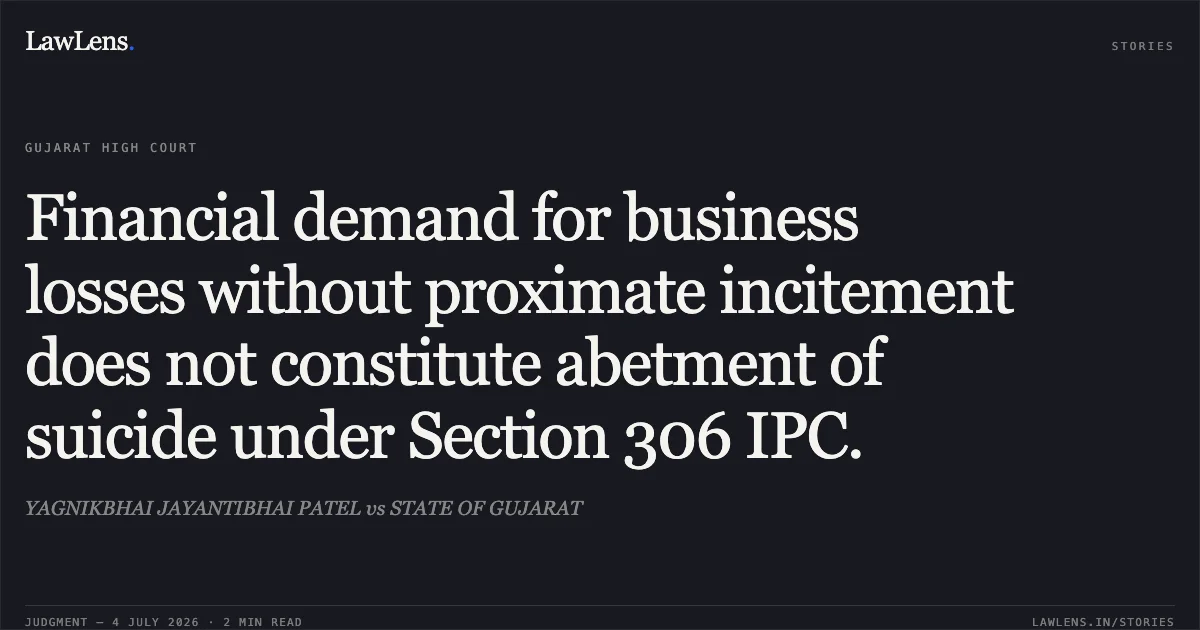
The Court held that the ingredients of Section 306 were not attracted as the allegations were vague, lacked temporal proximity, and did not demonstrate an intent to incite suicide.
The Court concluded that continuing the trial would constitute an abuse of the process of law. Accordingly, the Court allowed the application, quashing FIR No. 11209020210642 and the consequential Criminal Case No. 2331 of 2024 pending before the Principal Senior Civil Judge, Idar.
Source reference: p. 14Acts & Sections Cited
4 provisions across 2 statutes referred to in this judgment. Each provision opens on LawLens.
Code of Criminal Procedure, 19731
Indian Penal Code, 18603
Original Court PDF
YAGNIKBHAI JAYANTIBHAI PATELvsSTATE OF GUJARAT
Click to open original judgment
Original judgment, available to read, download and summarize on LawLens.in