Facts
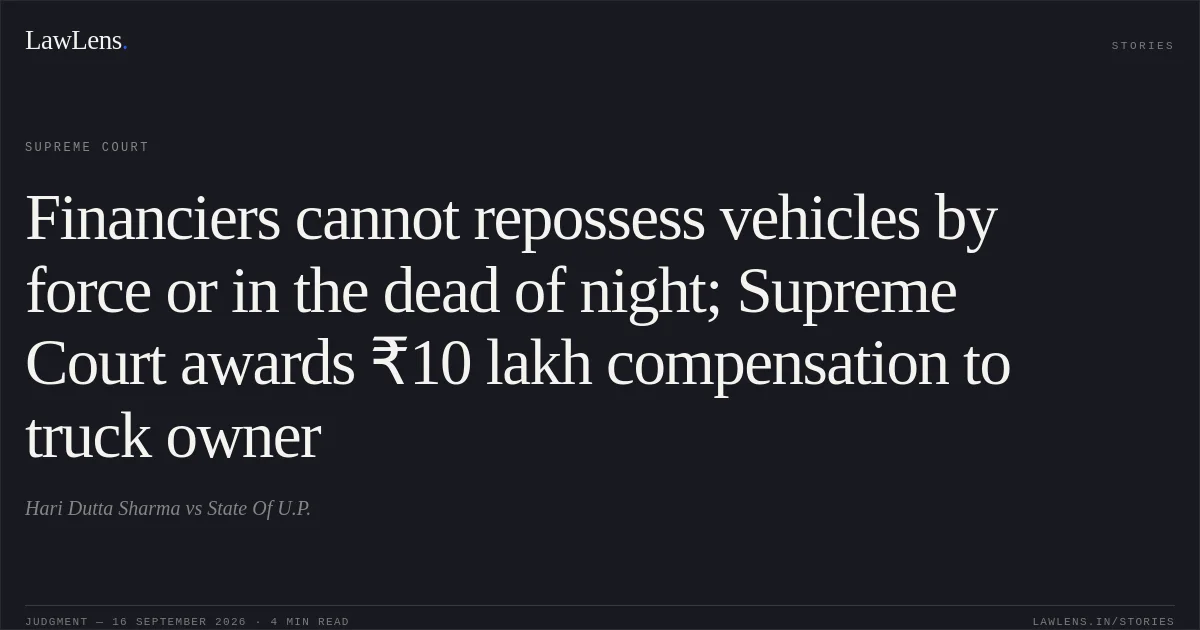
The appellant obtained a commercial vehicle loan from Cholamandalam Investment and Finance Company Ltd. for a Tata SFC 407 truck, secured by hypothecation of the vehicle. After repeated defaults, the financier issued demand and pre-seizure notices and had earlier repossessed and released the vehicle upon part-payment.
Source reference: paras. 5–10On 9 April 2023, the vehicle was allegedly taken at about 1:00 a.m. by unidentified persons who broke its steering lock. The appellant lodged a lost-article report and e-FIR the same day. The financier subsequently informed him that it had repossessed and sold the vehicle on 31 August 2023 for ₹4,50,000 against alleged dues of ₹5,71,914.
Source reference: paras. 5–10The appellant challenged the repossession and sale, but the High Court dismissed his writ petition on the grounds of default and delay.
Source reference: para. 11The Supreme Court granted leave and examined the legality of the repossession, the contractual repossession clause, and the relief available after the vehicle had been sold.
Source reference: paras. 1–4, 14Issues
Whether a financier may repossess a hypothecated vehicle through self-help measures when the repossession is alleged to have been effected without the contractually stipulated notice and by force or stealth.
Source reference: paras. 15, 21–28Whether Article 11 of the loan agreement, permitting repossession, waiver of notice, and sale of the vehicle at the financier’s discretion, was consistent with the RBI Guidelines and the Indian Contract Act, 1872.
Source reference: paras. 22–25Whether the High Court was justified in dismissing the writ petition on the ground of delay without examining the alleged unlawful repossession and subsequent sale.
Source reference: para. 27Whether the appellant was entitled to restoration of the vehicle or monetary compensation after the vehicle had already been sold.
Source reference: paras. 29–32Law Applied
The Court held that a financier’s contractual right to repossess a secured vehicle is permissible where the agreement confers such a right, unless the clause is unconscionable or opposed to public policy, but the right must be exercised lawfully and within the contractual and regulatory safeguards.
Source reference: para. 15Section 35-A of the Banking Regulation Act, 1949 empowers the RBI to issue binding directions to banking companies in the public interest and related matters.
Source reference: para. 16The RBI’s Fair Practices Guidelines, Master Circulars and clarifications require lenders to avoid harassment and muscle power, effect seizure only through lawful means, adopt valid repossession clauses, provide notice and an opportunity to cure the default, prescribe a fair procedure for possession and sale, and regulate recovery agents.
Source reference: paras. 17–21Relying on Orix Auto Finance (India) Ltd. v. Jagmander Singh, (2006) 2 SCC 598, and Sundaram Finance Ltd. v. T. Thankam, (2015) 14 SCC 444, the Court recognised contractual repossession rights; relying on ICICI Bank Ltd. v. Prakash Kaur, (2007) 2 SCC 711, it held that recovery of loans and seizure of vehicles must be undertaken through lawful means and that banks cannot employ force or “goondas” for recovery.
Source reference: paras. 15, 19–21The exercise of repossession powers must also conform to Articles 14 and 21 of the Constitution, including the borrower’s right to fair treatment and livelihood.
Source reference: paras. 28–30Reasoning
Article 11 required a seven-day notice before repossession and a further seven-day opportunity to cure the default after possession, but also purported to allow the financier to waive notice unilaterally and to enter any place to seize the vehicle.
Source reference: paras. 22–25The Court found these provisions inconsistent with the RBI framework because they left the borrower’s procedural protection entirely to the financier’s discretion and did not prescribe a fair method of possession or sale.
Source reference: paras. 22–25On the facts, no valid seven-day notice before repossession was shown; the appellant’s unrebutted case was that the vehicle was taken at night by breaking its steering lock, and the possession memorandum did not bear his signature.
Source reference: para. 26The Court held that such conduct was neither peaceful nor lawful and amounted to the very coercive recovery practice condemned in Prakash Kaur.
Source reference: para. 26The High Court’s delay finding was also unsustainable because the appellant had complained promptly, pursued criminal remedies, and continued receiving traffic challans even after the financier claimed to have sold the vehicle.
Source reference: para. 27Since the vehicle had already been sold, restoration was not ordered; however, the unlawful repossession and deprivation of the appellant’s livelihood justified compensation and restitutionary relief.
Source reference: paras. 28–30Holding
The appeal was allowed and the High Court’s order dated 4 April 2025 was quashed.
The Court held that the financier’s repossession and sale were unauthorised and arbitrary, having been undertaken in breach of the contractual notice requirement, RBI safeguards, and the appellant’s constitutional protections under Articles 14 and 21.
Source reference: paras. 29–33Because the vehicle had already been sold, the sale was not set aside.
Source reference: paras. 29–33The financier was directed to close both loan accounts, refund ₹4,50,000—the vehicle’s sale proceeds—with interest at 6% per annum from 31 August 2023 until payment, and pay ₹10,00,000 as compensation for mental agony and loss of livelihood.
Source reference: paras. 29–33The appeal was allowed with costs quantified at ₹50,000, and the RBI was directed to take effective steps to ensure compliance with its recovery and repossession guidelines.
Source reference: paras. 29–33Acts & Sections Cited
1 provisions across 1 statute referred to in this judgment. Each provision opens on LawLens.
Code of Criminal Procedure, 19731
Original Court PDF
Hari Dutta SharmavsState Of U.P.
Click to open original judgment
Original judgment, available to read, download and summarize on LawLens.in