Facts
The complainant purchased a car through financing from Petitioner No. 1. Due to defaults in loan installments, Petitioner No. 1, through its employees (Petitioners 2 and 3), repossessed the vehicle on 28.12.2015
Source reference: p. 3The complainant alleged that the vehicle was seized without notice, kept at a secret location, and that he was threatened by armed men sent by the petitioners to sign "No Objection" papers for the sale of the car
Source reference: p. 3-4A complaint was filed, and the Judicial Magistrate-1st Class, Jamshedpur, took cognizance of offences under Sections 406, 420, 387, 506, and 120B of the IPC on 26.03.2018
Source reference: p. 2-3The petitioners approached the High Court seeking to quash the proceedings, contending the matter was a bona fide civil dispute arising from a loan default
Source reference: p. 4-5Issues
1. Whether the repossession of a vehicle by a financier following a default in loan installments constitutes criminal offences under Sections 406, 420, 387, 506, or 120B of the IPC.
Source reference: p. 7 / para. 92. Whether the continuation of the criminal proceeding against the petitioners amounts to an abuse of the process of law.
Source reference: p. 8 / para. 12Law Applied
The court relied on the Supreme Court ruling in Sardar Trilok Singh v. Satya Deo Tripathi (1979), which established that seizing a vehicle upon a borrower's failure to pay installments is a bona fide civil dispute
Source reference: p. 4-5It further applied Charanjit Singh Chadha v. Sudhir Mehra (2001), holding that recovery of possession per hire-purchase terms is not a criminal offence
Source reference: p. 5K.A. Mathai v. Kora Bibbikutty (1996) was cited to affirm that a financier has the inherent right to resume possession in case of default
Source reference: p. 5Regarding the IPC, the court emphasized that Section 406 requires "entrustment" and "dishonest misappropriation," while Section 387 requires "extortion," neither of which are satisfied by a finance company recovering outstanding dues
Source reference: p. 7Reasoning
The court reasoned that since the complainant admittedly defaulted on loan installments, the petitioners were legally entitled to repossess the vehicle under the finance agreement and settled legal principles
Source reference: p. 5, 7The court found that Section 406 IPC was inapplicable because there was no entrustment of property by the complainant to the petitioners, nor any dishonest misappropriation
Source reference: p. 7Regarding Section 387 IPC, the court held that demanding or recovering outstanding dues through employees does not constitute extortion
Source reference: p. 7The allegations under Section 506 IPC were found to be directed at third parties (unnamed persons) rather than the petitioners themselves
Source reference: p. 8Consequently, the court determined that even if all allegations in the complaint were accepted as true, they failed to meet the essential ingredients of the alleged criminal offences, rendering the dispute purely civil in nature
Source reference: p. 7-8Holding
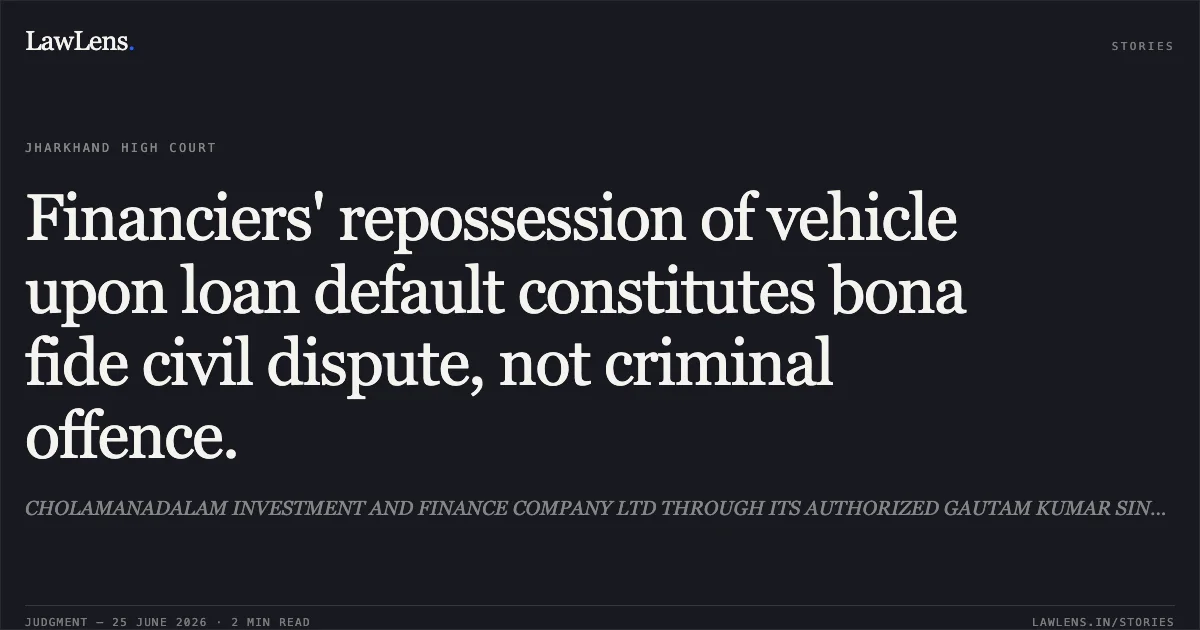
The court answered the issues in the affirmative, holding that the repossession of the vehicle by the financier due to installment defaults does not constitute a criminal offence.
The court held that continuing the criminal proceedings would amount to an abuse of the process of law. Accordingly, the High Court quashed the order taking cognizance dated 26.03.2018 and all subsequent proceedings in connection with C/1 Case No. 1111 of 2016. The petition was allowed.
Source reference: p. 8-9Acts & Sections Cited
5 provisions across 2 statutes referred to in this judgment. Each provision opens on LawLens.
Indian Penal Code, 18604
Code of Criminal Procedure, 19731
Original Court PDF
CHOLAMANADALAM INVESTMENT AND FINANCE COMPANY LTD THROUGH ITS AUTHORIZED GAUTAM KUMAR SINGHvsTHE STATE OF JHARKHAND
Click to open original judgment
Original judgment, available to read, download and summarize on LawLens.in


