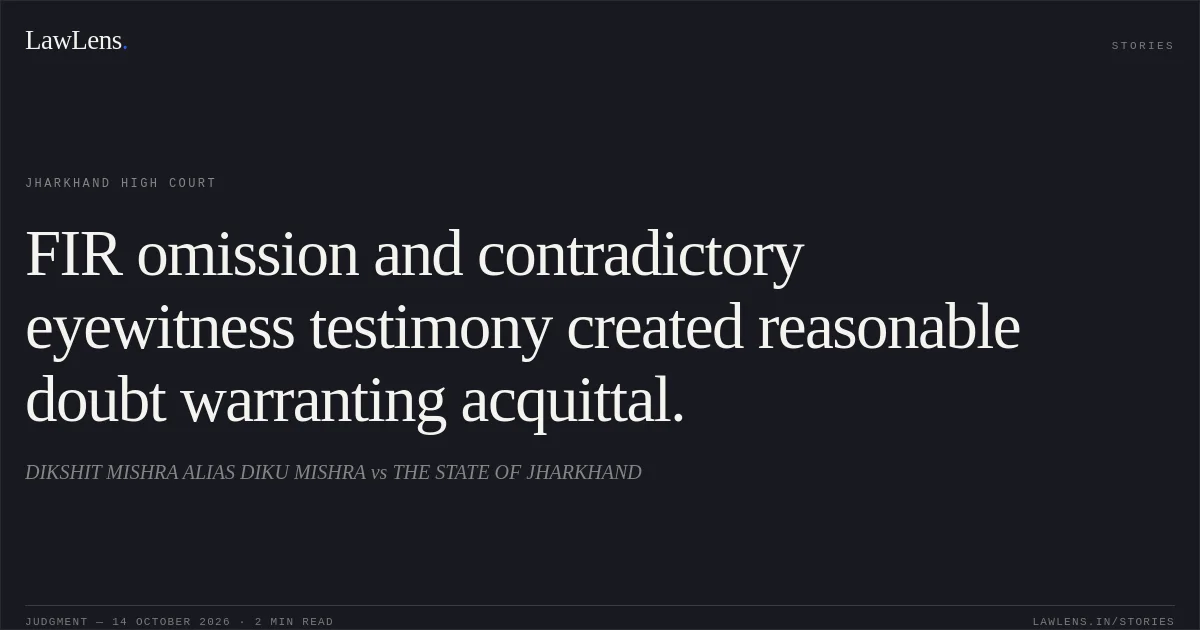
Facts
The deceased, a contractor, was shot on 8 September 2010; the prosecution alleged that the accused had demanded ₹2 lakh as rangdari.
Source reference: p.1The deceased’s wife, Nandani Devi (PW-4), lodged the case and claimed to have witnessed the occurrence.
Source reference: p.1The appellant was convicted under Sections 302/120B/34 IPC and Section 27 of the Arms Act and sentenced to imprisonment, including life imprisonment for the offence under Section 302/34 IPC.
Source reference: p.1On appeal, the appellant challenged the reliability of the evidence, noting that he was not named in the FIR, the Investigating Officer was not examined, no weapon was recovered, and the place of occurrence was not proved.
Source reference: p.1The prosecution had examined six witnesses, including two doctors who conducted the post-mortem and attributed death to firearm injuries.
Source reference: p.2Issues
Whether the prosecution proved beyond reasonable doubt that the appellant was present at and participated in the shooting, supporting his convictions under Sections 302/34 and 120B IPC and Section 27 of the Arms Act.
Source reference: pp.3–4Whether the evidence of the alleged eyewitnesses was reliable despite the omission of the appellant’s name from the FIR and the non-examination of the Investigating Officer.
Source reference: pp.3–4Law Applied
The Court considered the offences charged under Sections 302, 120B and 34 of the Indian Penal Code and Section 27 of the Arms Act.
Source reference: pp.1–2It applied the criminal-law requirement that the prosecution establish the accused’s guilt beyond reasonable doubt; where the evidence leaves a reasonable doubt about the accused’s presence or participation, the accused is entitled to its benefit.
Source reference: p.3–4The Court also considered whether the non-examination of the Investigating Officer caused prejudice in light of material contradictions in the evidence.
Source reference: p.3Reasoning
Although PW-3 and PW-4 claimed in examination-in-chief to have seen the appellant at the scene, the Court noted that the informant had not named him in the FIR and that the witnesses stated in cross-examination that they had not seen him before the incident; they also said they learned of the incident from the informant.
Source reference: p.3The Court found the eyewitness evidence insufficiently reliable to establish the appellant’s presence.
Source reference: p.3The Investigating Officer’s non-examination further caused prejudice because material evidence was in contradiction.
Source reference: p.3The brothers of the deceased were not eyewitnesses, and the medical evidence established firearm injuries but did not resolve the doubt about the appellant’s identity or participation.
Source reference: pp.2–3The Court therefore held that guilt had not been proved beyond reasonable doubt.
Source reference: p.3Holding
The High Court allowed the appeal, set aside the appellant’s convictions under Sections 302/120B/34 IPC and Section 27 of the Arms Act, and directed his release forthwith unless he was required in another case.
Acts & Sections Cited
3 provisions across 2 statutes referred to in this judgment. Each provision opens on LawLens.
Indian Penal Code, 18602
Arms Act, 19591
Original Court PDF
DIKSHIT MISHRA ALIAS DIKU MISHRAvsTHE STATE OF JHARKHAND
Click to open original judgment
Original judgment, available to read, download and summarize on LawLens.in
![A police constable cannot be removed for unauthorized absence without a Rule 359-compliant inquiry.. Mohammad Sidiq Khan vs D/o Home Ut Of Jammu & Kashmir. CAT - ['Srinagar']. LawLens](/stories/thumbnails/a-police-constable-cannot-be-removed-for-unauthorized-absence-without-a-rule-359-compliant-7b43fc316bd94f22a62676153bbc9d54.webp)
![A Review DPC lacks authority to determine or alter inter se seniority.. SAURABH KUMAR vs REVENUE. CAT - ['Patna']. LawLens](/stories/thumbnails/a-review-dpc-lacks-authority-to-determine-or-alter-inter-se-seniority-4b21640f20af46fcabdfc8273d2ce959.webp)