Facts
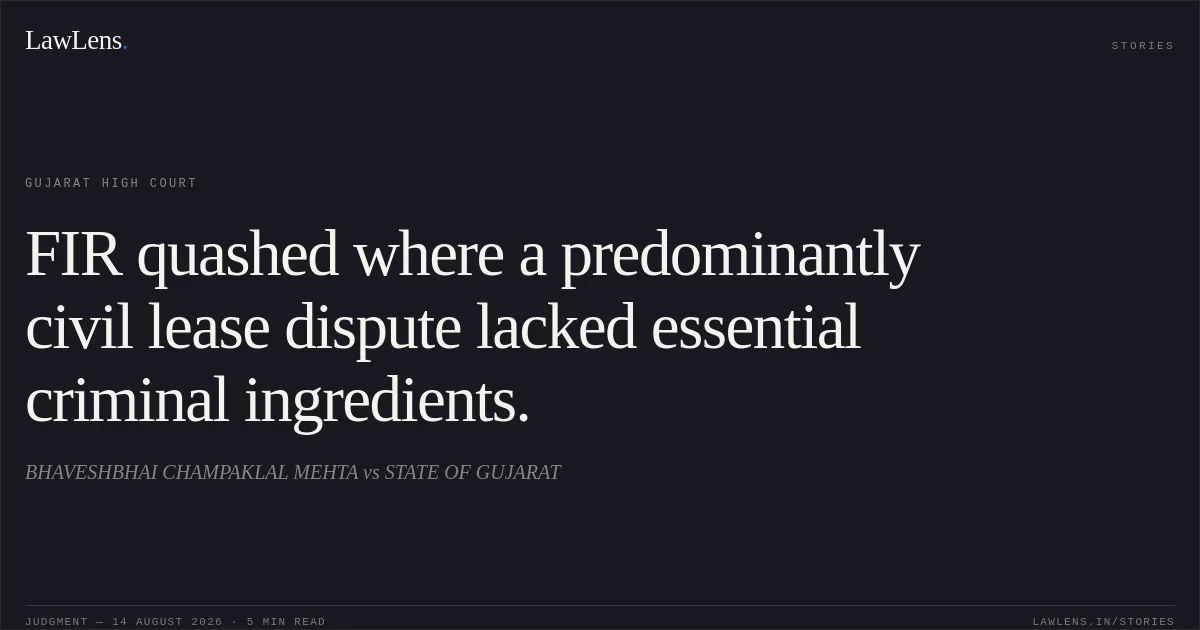
The applicants invoked Section 482 of the Code of Criminal Procedure, 1973 (“CrPC”) seeking quashing of FIR C.R. No. I-247 of 2017, registered at Kamrej Police Station, Surat (Rural), for offences under Sections 406, 420, 465, 468, 471, 120B and 114 of the Indian Penal Code, 1860 (“IPC”).
Source reference: p.1The de facto complainant alleged that he had leased land measuring approximately 3,700 sq. metres to the applicants for operating a petrol pump, but that the applicants had obtained and relied upon rent documents containing terms different from those agreed, forged his signature on an application for non-agricultural (“NA”) permission, and caused a mutation entry to be made in their favour.
Source reference: pp.2–3The applicants contended that the dispute concerned tenancy and lease rights, that the complainant had executed the rent agreement and accepted rent for several years, and that the criminal case had been instituted to dispossess them from the land.
Source reference: pp.4–6They also relied upon prior police complaints and Regular Civil Suit No. 40 of 2015 filed before the FIR.
Source reference: p.6The State and the complainant opposed quashing, principally relying upon the handwriting-expert/FSL opinion indicating that the signature on the NA application was forged and submitting that the matter required investigation and trial.
Source reference: pp.7–8Issues
1. Whether the allegations in the FIR, taken at face value, disclosed the essential ingredients of offences under Sections 406, 420, 465, 468, 471, 120B and 114 IPC against the applicants.
Source reference: pp.8–112. Whether the alleged dispute was predominantly civil in nature and whether continuation of the criminal proceedings would constitute an abuse of the process of law.
Source reference: pp.21–263. Whether the High Court should exercise its inherent jurisdiction under Section 482 CrPC to quash the FIR and consequential proceedings at the threshold.
Source reference: pp.8–10, 24–26Law Applied
The Court applied Section 482 CrPC, which preserves the High Court’s inherent power to prevent abuse of process and secure the ends of justice.
Source reference: pp.8–10Relying on State of Haryana v. Bhajan Lal, AIR 1992 SC 604, it reiterated that quashing may be justified where the FIR, even accepted in its entirety, does not constitute an offence, where the allegations are inherently improbable, or where the proceedings are manifestly mala fide and instituted for an ulterior purpose.
Source reference: pp.8–10The Court applied the statutory ingredients of criminal breach of trust under Sections 405–406 IPC, cheating under Sections 415–420 IPC, forgery under Sections 463–465 IPC, forgery for the purpose of cheating under Section 468 IPC, and use of a forged document as genuine under Section 471 IPC.
Source reference: pp.13–16It relied on Vesa Holdings Pvt. Ltd. v. State of Kerala, (2015) 8 SCC 293, for the principle that a mere breach of contract does not constitute cheating absent fraudulent or dishonest intention at the inception.
Source reference: pp.16–17Sheila Sebastian v. R. Jawaharaj, (2018) 7 SCC 581, and Mohd. Ibrahim v. State of Bihar, (2009) 8 SCC 751, for the requirement that the accused must have made or executed a false document and that asserting an incorrect ownership or contractual claim does not, by itself, amount to forgery.
Source reference: pp.18–20Kishan Singh v. Gurpal Singh, (2010) 8 SCC 775, and Madhavrao Jiwaji Rao Scindia v. Sambhajirao Chandrojirao Angre, AIR 1988 SC 709, for considering unexplained delay, predominantly civil disputes, and the likelihood of conviction while determining whether criminal proceedings should be quashed.
Source reference: pp.21–26The Court also referred to the four-step framework in Pradeep Kumar Kesarwani v. State of Uttar Pradesh, AIROnline 2025 SC 956, concerning the use of sterling and unimpeachable material in a quashing petition.
Source reference: pp.24–25Reasoning
The Court held that Section 406 IPC was not attracted because the complainant’s case was one of leasing property, not entrusting property to the applicants for a specific fiduciary purpose followed by dishonest misappropriation.
Source reference: p.16Section 420 IPC was also not made out because the complainant had executed the rent agreement, accepted rent for several years, and the record did not demonstrate dishonest intention at the inception of the transaction.
Source reference: pp.16–17Although the handwriting opinion indicated that the signature on the NA application was forged, the FIR and material on record did not establish that either applicant had made or used the alleged forged signature; further, the NA application did not itself create title or an independent right in the applicants.
Source reference: pp.17–20, 23Applying Sheila Sebastian and Mohd. Ibrahim, the Court distinguished an allegedly false assertion of contractual or property rights from the making of a “false document” in the legal sense.
Source reference: pp.18–20The prior civil suit and police complaints, the complainant’s participation in and acceptance of the lease arrangement, the applicants’ payment of rent, and the unexplained delay in lodging the FIR from the alleged events beginning in 2010 supported the conclusion that the dispute was predominantly civil and that the criminal prosecution was being used to exert pressure in the tenancy dispute.
Source reference: pp.11–12, 20–23Applying Bhajan Lal, Kishan Singh, Madhavrao Scindia and the Pradeep Kumar Kesarwani framework, the Court found the applicants’ material sufficiently reliable to demonstrate that continuation of the prosecution would amount to abuse of process.
Source reference: pp.21–26Holding
The Court answered the issues in favour of the applicants.
It held that the allegations and material did not disclose the essential ingredients of Sections 406, 420, 465, 468, 471, 120B or 114 IPC and that the dispute was predominantly civil in nature.
Source reference: pp.25–26Accordingly, the application under Section 482 CrPC was allowed; FIR C.R. No. I-247 of 2017 and all consequential criminal proceedings were quashed and set aside qua the present applicants only.
Source reference: p.26The rule was made absolute, with the clarification that the observations were confined to the quashing application and would not affect other litigation between the parties.
Source reference: p.27Acts & Sections Cited
17 provisions across 5 statutes referred to in this judgment. Each provision opens on LawLens.
Code of Criminal Procedure, 19733
Indian Penal Code, 1860
Bombay Tenancy and Agricultural Lands Act-19481
Transfer of Property Act, 18821
Registration Act, 19081
Original Court PDF
BHAVESHBHAI CHAMPAKLAL MEHTAvsSTATE OF GUJARAT
Click to open original judgment
Original judgment, available to read, download and summarize on LawLens.in