Facts
The complainant alleged that the applicants, arising out of a dispute concerning a common boundary and access-way to agricultural land, abused him and his family members, used caste-based slurs, prevented their use of the causeway, threatened to dispossess them and kill them, and thereby committed offences under Sections 504, 506(2) and 114 of the IPC and Section 3(1)(x) of the Scheduled Castes and Scheduled Tribes (Prevention of Atrocities) Act, 1989 (“Atrocities Act”).
Source reference: paras. 1–2; pp. 1–3The applicants contended that the FIR was a retaliatory and delayed complaint arising from a land-access dispute. They relied on their prior complaints to the Dakor Police Station dated 10 November 2014 and 21 November 2014, preventive proceedings under Sections 107 and 151 CrPC, and a caveat filed before the civil court.
Source reference: paras. 3–7; pp. 3–5The FIR was registered on 24 November 2014, although the complainant asserted that the police had initially declined to register it and that the incident had occurred approximately one week earlier.
Source reference: paras. 8–12; pp. 6–8The State submitted that independent witnesses supported the allegations and that investigation had been completed, although the charge-sheet papers had not been filed owing to the interim stay.
Source reference: para. 13; p. 8The applicants invoked the High Court’s inherent jurisdiction under Section 482 CrPC to quash the FIR and consequential proceedings.
Source reference: para. 1; p. 1Issues
Whether the FIR disclosed the essential ingredients of the offence under Section 3(1)(x) of the Atrocities Act, as then applicable, including intentional insult or intimidation with intent to humiliate a member of an SC/ST community in a place within public view.
Source reference: paras. 16–17; pp. 10–11Whether the allegations of abusive language, without sufficient particulars of intentional insult and provocation, constituted an offence under Section 504 IPC.
Source reference: para. 18; p. 12Whether the allegation that the applicants threatened to kill the complainant and his family disclosed criminal intimidation punishable under Section 506(2) IPC.
Source reference: paras. 19–20; pp. 13–14Whether, in view of the prior complaints by the applicants, the land-access dispute, and the delay in lodging the FIR, continuation of the criminal proceedings would amount to an abuse of process warranting exercise of inherent powers under Section 482 CrPC.
Source reference: paras. 15, 21–22; pp. 9, 13–14Law Applied
The Court applied Section 482 CrPC, which preserves the High Court’s inherent power to prevent abuse of the process of court and secure the ends of justice.
Source reference: para. 1; p. 1For Section 3(1)(x) of the Atrocities Act—now corresponding to Section 3(1)(r) after amendment—the Court relied on Gorige Pentaiah v. State of Andhra Pradesh, (2008) 12 SCC 531, holding that the complaint must disclose that the accused was not a member of an SC/ST community and that the complainant was intentionally insulted or intimidated with intent to humiliate in a place within public view.
Source reference: para. 16; pp. 10–11Section 504 IPC requires intentional insult accompanied by provocation intended or known to be likely to cause a breach of public peace or commission of another offence; mere abuse is insufficient, as explained in Fiona Shrikhande v. State of Maharashtra, AIR 2014 SC 957.
Source reference: para. 18; p. 12Section 506(2) IPC requires a threat of injury to person, reputation or property, made with intent to cause alarm or to compel the threatened person to do or omit an act.
Source reference: paras. 19–20; p. 13The Court also considered the settled principle that criminal proceedings may be quashed where the allegations, even if accepted at face value, fail to constitute the alleged offences or where continuation would constitute an abuse of process.
Source reference: paras. 17, 22; pp. 11, 14Reasoning
The Court found that the FIR did not state that the applicants were outside the SC/ST category, nor did it sufficiently allege that the complainant or his family members were intentionally insulted or intimidated with the specific intent to humiliate them in a place within public view. The essential ingredients of Section 3(1)(x) of the Atrocities Act were therefore absent.
Source reference: para. 16.1; pp. 10–11The allegations of abusive language were likewise held insufficient for Section 504 IPC because the FIR did not establish the requisite intentional insult, provocation, or likelihood of breach of public peace.
Source reference: para. 18.1; p. 12As to Section 506(2), the Court held that the general assertion that the applicants would kill the complainant and his family did not, without more, demonstrate an intention to cause alarm or compel them to act or refrain from acting.
Source reference: para. 20; p. 13The Court further treated the prior complaints dated 10 and 21 November 2014, the pending land and causeway dispute, the caveat and civil proceedings, and the approximately one-week delay in lodging the FIR as circumstances supporting the applicants’ contention that the criminal case was retaliatory and intended to exert pressure.
Source reference: paras. 15, 21; pp. 9, 13–14Accordingly, continuation of the FIR despite the absence of the basic statutory ingredients was held to be an abuse of process.
Source reference: paras. 17, 21–22; pp. 11, 13–14Holding
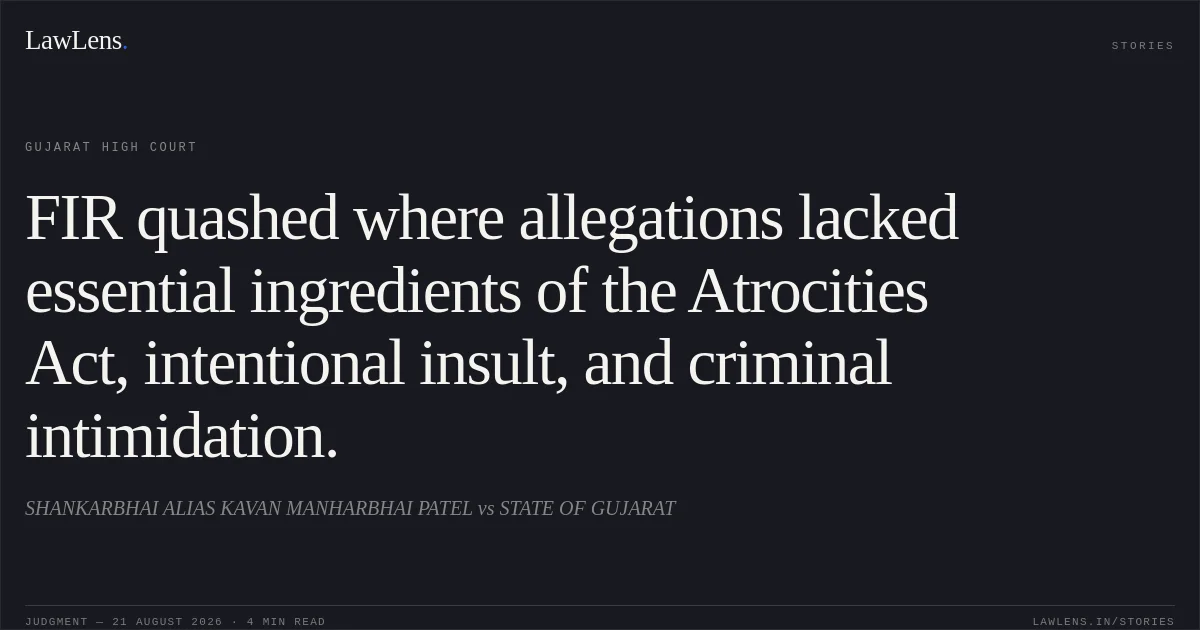
The Court answered the issues in favour of the applicants and held that the FIR did not prima facie establish offences under Section 3(1)(x) of the Atrocities Act, Sections 504 or 506(2) IPC, or the consequential liability under Section 114 IPC.
Exercising its inherent jurisdiction under Section 482 CrPC, the Court allowed the application and quashed and set aside FIR No. CR-II-161/2014 registered at Dakor Police Station, together with all consequential proceedings, insofar as they concerned the applicants. Rule was made absolute to that extent.
Source reference: paras. 22–23.1; p. 14Acts & Sections Cited
7 provisions across 3 statutes referred to in this judgment. Each provision opens on LawLens.
Code of Criminal Procedure, 19733
Indian Penal Code, 18603
Scheduled Castes and the Scheduled Tribes (Prevention of Atrocities) Act, 19891
Original Court PDF
SHANKARBHAI ALIAS KAVAN MANHARBHAI PATELvsSTATE OF GUJARAT
Click to open original judgment
Original judgment, available to read, download and summarize on LawLens.in