Facts
Respondent No. 2 lodged a complaint alleging offences under Sections 85, 115(2), 352 and 351(3), read with Section 3(5), of the Bharatiya Nyaya Sanhita, 2023, and Sections 3 and 4 of the Dowry Prohibition Act, 1961.
Source reference: p. 3The petitioners—her father-in-law, brother-in-law, mother-in-law and another relative—sought to quash the FIR registered as Crime No. 9/2026.
Source reference: p. 3They contended that respondent No. 2 had lived with her husband in a rented house for only about a month, that the petitioners lived separately, and that they had been falsely implicated in a marital dispute
Source reference: p. 3–4The respondents submitted that the petitioners had participated in alleged incidents at the complainant’s parents’ home, including assault and interference with efforts to contact the police, and that video evidence showed their presence
Source reference: p. 4–5Issues
Whether the FIR and investigation against the petitioners should be quashed at this stage, given their claim that they lived separately and had been falsely implicated
Source reference: p. 3–4, 6Whether the competing claims concerning the petitioners’ presence and alleged conduct required investigation rather than determination in a petition to quash the FIR
Source reference: p. 5–6Law Applied
The petition was brought under Section 482 of the Code of Criminal Procedure, as described in the cause documents, and Section 528 of the Bharatiya Nagarik Suraksha Sanhita, 2023.
Source reference: p. 2The Court applied the principle that, at this stage, it was to assess whether the allegations warranted investigation, not to determine their merits or the truth of disputed factual claims.
Source reference: p. 6The alleged offences were under Sections 85, 115(2), 352 and 351(3), read with Section 3(5), of the BNS, and Sections 3 and 4 of the Dowry Prohibition Act, 1961.
Source reference: p. 3The order cites no precedent or further substantive test.
Source reference: p. 6Reasoning
The petitioners’ claim that they lived separately and did not visit the complainant’s parents’ home was disputed by the complainant’s allegations and asserted video evidence.
Source reference: p. 5–6The Court considered that the petitioners themselves accepted that the complainant had stayed with her husband for a month after the marriage, and held that the disputed circumstances—including the petitioners’ alleged presence and conduct—were matters for police investigation.
Source reference: p. 5–6It therefore declined to assess the truth of the allegations or treat the petitioners’ documents as determinative at the quashing stage.
Source reference: p. 6–7Holding
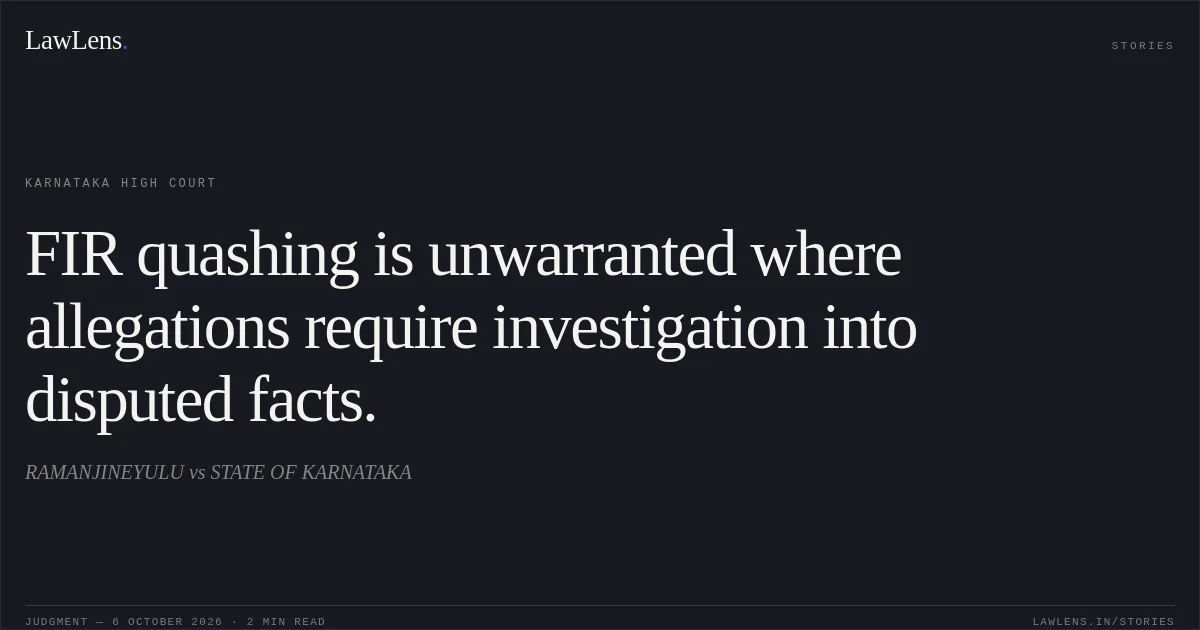
The Court did not quash the FIR; it disposed of the criminal petition, leaving the parties at liberty to provide supporting materials to the police.
The police were directed to consider the materials in accordance with law and file an appropriate report.
Source reference: p. 7The Court expressly stated that it had made no determination on the merits and left the parties’ contentions to be investigated.
Source reference: p. 7Acts & Sections Cited
9 provisions across 4 statutes referred to in this judgment. Each provision opens on LawLens.
Code of Criminal Procedure, 19731
Bharatiya Nagarik Suraksha Sanhita, 20231
Bharatiya Nyaya Sanhita, 20235
Original Court PDF
RAMANJINEYULUvsSTATE OF KARNATAKA
Click to open original judgment
Original judgment, available to read, download and summarize on LawLens.in