Facts
The Appellant purchased agricultural land in 1996.
Source reference: p. 1-2In 1997-98, she executed two registered General Powers of Attorney (GPAs) in favor of Respondent Nos. 1 and 2.
Source reference: p. 2The Appellant alleged these were executed solely as collateral for loans of Rs. 2 lakhs and Rs. 5 lakhs.
Source reference: p. 2The Respondents subsequently used these GPAs to execute sale deeds in favor of their relatives, supported by receipts (Ex. B7 and B9).
Source reference: p. 2-3The Appellant filed a suit in 2008 seeking to declare the sale deeds null and void, claiming she had repaid the loans and remained in possession.
Source reference: p. 4The Trial Court decreed the suit in favor of the Appellant.
Source reference: p. 5However, the First Appellate Court reversed this decree, finding the Appellant failed to prove loan repayment or continued possession.
Source reference: p. 5The High Court of Madras dismissed the Second Appeal, affirming the First Appellate Court’s findings.
Source reference: p. 6Issues
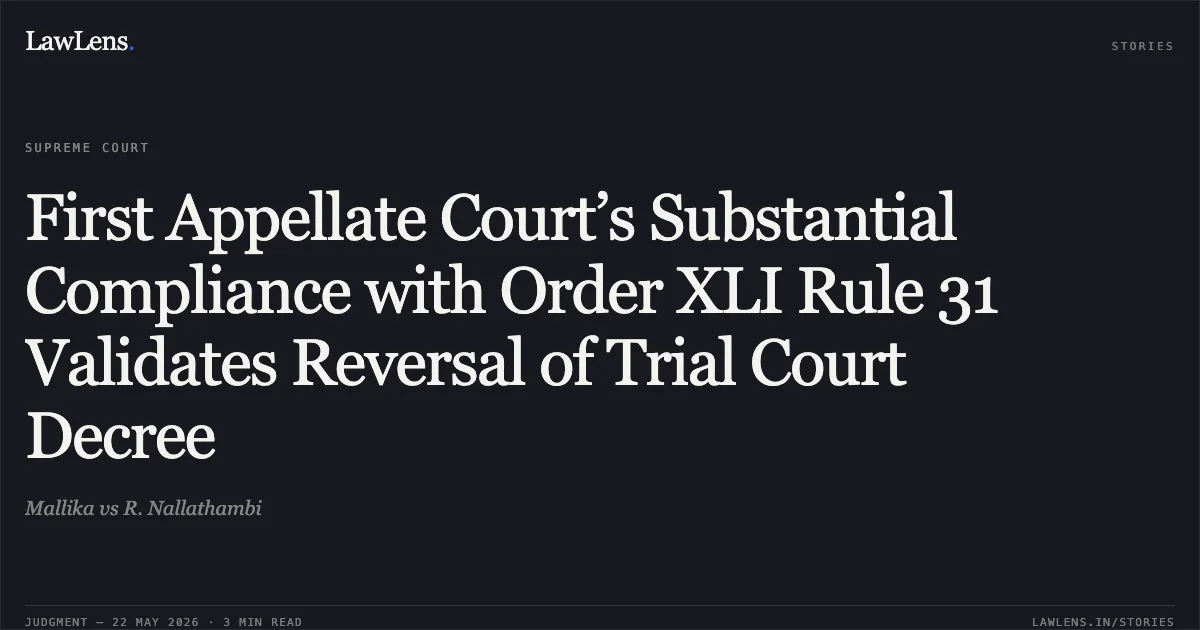
1. Whether the First Appellate Court judgment was vitiated for non-compliance with the mandatory requirements of Order XLI Rule 31 of the CPC regarding the framing of points for determination.
Source reference: p. 16 / para. 382. Whether the GPAs were executed merely as security for a loan transaction or intended as a basis for genuine sale transactions.
Source reference: p. 18 / para. 433. Whether an adverse inference could be drawn against the Appellant for failing to enter the witness box to substantiate allegations of fraud.
Source reference: p. 20 / para. 48Law Applied
The Court applied Order XLI Rule 31 of the CPC, which mandates that appellate judgments state points for determination and reasons for the decision, though substantial compliance suffices over technical formality.
Source reference: p. 16-17It relied on H. Siddiqui (dead) by LRs v. A. Ramalingam, establishing that the First Appellate Court must independently assess evidence when reversing a decree.
Source reference: p. 17Regarding the burden of proof in fraud and fiduciary misuse, the Court referenced Subhra Mukerjee v. Bharat Coking Coal Ltd.
Source reference: p. 19Finally, the Court applied the principle from Vidhyadhar v. Manikrao, which permits a court to draw an adverse inference against a party who possesses special knowledge of facts but refuses to testify in the witness box.
Source reference: p. 20-21Reasoning
The Court reasoned that while the First Appellate Court's framing of points was brief, it substantially complied with Order XLI Rule 31 by undertaking a detailed reappreciation of the facts, mutation entries, and limitation issues.
Source reference: p. 17-18The Court found that the Appellant failed to provide any documentary evidence of the loan or repayment; thus, the foundational facts for a "security arrangement" were never established.
Source reference: p. 19-20Crucially, the Appellant's refusal to testify was fatal; the Court held that since she alleged fraud and misuse of signed papers—facts within her personal knowledge—her absence from the witness box justified an adverse inference under the Vidhyadhar principle.
Source reference: p. 21Furthermore, the Court noted that the Appellant’s ten-year delay in challenging the transactions, coupled with her failure to cancel the GPAs despite being a businessperson, shifted the weight of probability in favor of the Respondents.
Source reference: p. 23-24Holding
The Court held that: (1) there was substantial compliance with Order XLI Rule 31 CPC [para. 42]; (2) the Appellant failed to discharge the initial burden of proving the loan transaction [para. 46]; and (3) a valid adverse inference was drawn due to the Appellant's failure to testify [para. 49].
The Supreme Court dismissed the appeal and affirmed the High Court’s judgment.
Source reference: p. 25Acts & Sections Cited
1 provisions across 1 statute referred to in this judgment. Each provision opens on LawLens.
Code of Civil Procedure, 19081
Original Court PDF
MallikavsR. Nallathambi
Click to open original judgment
Original judgment, available to read, download and summarize on LawLens.in